
22 May Sun 2011
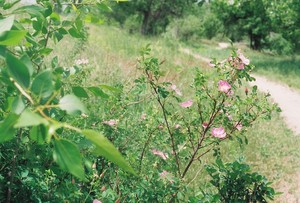
Wild brassicas blooming on the palmer divide
The wild brassicas are flowering on the Palmer divide, which indicates with extreme certainty one of the two following possibilities: either the last frost has happened, or the plants are senseless.Certainly this has been something of a crazy year throughout the United States, but, hard won as it may be, the wild throws of temperature are now at least hovering something above freezing.
Brassicas are generally edible, and more often than not, delicious.When harvesting wild brassicas, however, be careful to achieve positive identification.They know they are delicious and will pretend to be other plants.They are such good mimics that even expert hunters may mistake a poisonous or nasty tasting plant for a brassica.
Brassicas are also known as “mustards,” “radishes,” “cabbages,” or other familiar names.They are identified by having no coloration of the sap, may or may not have hairs on the stem, may or may not have a waxy coat.Their leaves are serrated and pinnatifid, with lobe tips pointing towards the leaf tip.The sprout seeds are usually cordate.Flowers are what give the plant away best: they cluster at the tops of stems, have four petals cruciform, usually four long and two short stamen, often are yellow, but can be of other colors.Their fruits are delicacies: they are capsules, with round seeds and usually spicy!
Romans were probably the first to experiment with the preparation of mustard as a condiment.They also discovered how to use the thistle to make cheese. They mixed unfermented grape juice, known as “must,” with ground mustard seeds to make “burning must,” mustum ardens — hence “must ard.”The only surviving recipe from the later Roman period (late 4th Century) includes a mixture of ground mustard, pepper, caraway, lovage, grilled coriander seeds, dill, celery, thyme, oregano, onion, honey, vinegar, fish stock, and oil.
Though the French had been making mustard since the 10th century, the first appearance of mustard makers on the royal registers in Paris dates back to 1292. Dijon, France, became a recognized center for mustard making by the 13th Century. The popularity of mustard in Dijon is evidenced by written accounts of guests consuming 70 gallons of mustard creme in a single sitting at a gala held by the Duke of Burgundy in 1336.Due to its long tradition of mustard making, Dijon is regarded as the mustard capital of the world.
An early use of mustard as a condiment in England was in the form of mustard balls – coarse ground mustard seed combined with flour and cinnamon, moistened, rolled into balls, and dried – which were easily stored and combined with vinegar or wine to make mustard paste as needed. The town of Tewkesbury was well known for its high-quality mustard balls, which were exported to London and other parts of the country, and are even mentioned in William Shakespeare's play King Henry the Fourth, Part II.
There are many varieties of mustard which come in a wide range of strengths and flavors. The basic taste and "heat" of the mustard is largely determined by seed type, preparation and ingredients. Black seeded mustard is generally regarded as the hottest type. Preparation also plays a key role in the final outcome of the mustard. Mustard, in its powdered form, lacks any potency and needs to be fixed by soaking. One of the factors that determines the strength of a prepared mustard is the temperature of the water, vinegar, or other liquid mixed with the ground seeds: hotter liquids are more hostile to the strength-producing compounds. Thus, hot mustard is made with cold water, while using hot water results in milder mustard.The pungency of mustard is always reduced by heating, not just at the time of preparation; if added to a dish during cooking much of the effect of the mustard is lost.
When hunting mustards, it is difficult to decide whether to enjoy them as a vegetable, flower or fruit!
Difference between climate change and global warming
Ana Villar and Jon A. Krosnick in their recent publication, Global warming vs. climate change, taxes vs. prices: Does word choice matter? (Climatic Change (2011) 105:1–12) found that how we describe things does matter.Their excellently worded abstract puts the situation succinctly, or should I say precisely?
Does “climate change” seem like a less serious problem than “global warming” to Americans and Europeans? Does describing the costs of climate change mitigation in terms of “higher taxes” instead of “higher prices” reduce public support for such efforts? In an experiment embedded in an American national survey, respondents were randomly assigned to rate the seriousness of “global warming,” “climate change,” or “global climate change.” Contrary to predictions made by a leading political strategist, the full sample and political Independents perceived “climate change” and “global warming” to be equally serious. Among Republicans, “climate change” was perceived to be more serious than “global warming,” whereas the reverse was true among Democrats. A similar experiment embedded in a survey of residents of 31 European countries showed that “global warming” and “climate change” were perceived to be equally serious problems. And an experiment embedded in an American survey showed that describing the increased costs of climate change mitigation legislation via “higher taxes” instead of via “higher prices” did not reduce popular support for such legislation, also contradicting a political strategy memo. Thus, word choice may sometimes affect public perceptions of the climate change seriousness or support for mitigation policies, but a single choice of terminology may not influence all people the same way, making strategic language choices difficult to implement.
Yet words mean more to those who are more educated, especially in the phrasing of questions.The doctors found that people with less education look to questioners and other people to form an ideology about a word: “among respondents with some college or less education, the primacy effect was sizable. The proportion of people who rated the problem as extremely serious or very serious when those options were presented first was 62.49%, compared to 55.89% when those options were last, a difference of 6.60% (?2 (1) = 9.04, p = 0.003, N = 2,005). Among respondents with a college degree or more education, the primacy effect was non-significant. The proportion of people who rated the problem as extremely serious or very serious when those options were presented first was 59.40%, compared to 58.14% when those options were last, a difference of 1.26% (?2 (1) = 0.14, p = 0.71, N = 861). Consistent with past research (e.g., Krosnick and Schuman 1988), education was a marginally significant moderator of the relation between response choice order and seriousness ratings (Wald (1) = 13.36, p = 0.09,one-tailed)… The primacy effect that appeared here was the same effect documented in many other past studies of rating scales and appeared here, as in past research, to be most common among people most likely to satisfice when answering survey questions: respondents low in education. It is therefore important to counter-balance rating scale point order in surveys in order to avoid bias.”
Educated people have already formed opinions and ideology, which impacts the way that we interpret words: “Among Europeans in the “center,” people were equally likely to mention global warming as the most serious problem as they were to mention climate change (63.30% vs. 64.88%; ?2 (1) = 2.47, p = 0.12.)”
Word choice matters, but no less so to those who are undeducated about a subject.When using words, it is important to choose the most objective word, and to fully understand the word’s ideological associations with the audience at hand.
Have you camped in your backyard?
A fun adventure for children is camping in the woods, but the next best thing is camping out in the backyard.While a safe place for the family to explore the basics of camping and do a “dry run” of a real camping adventure with children, it provides enough excitement and interest for the children to keen their interest in the adventure of wilderness camping while sharpening their minds to the skills they will require later.
Stay up late and watch the stars and the moon, listen to the night animals.Did they know they had so many nighttime neighbors?Give a thought to the poor who are forced to camp in the city with or without a tent.There are so many big thoughts for a small night out.Such thoughts give confidence in school.
Later, when the kids grow up they will think back on the occasional nights out and remember the lessons you taught them, and begin to think of the entire world as their backyard.
Providing for the needs of wildlife begins at home
When planning landscaping or your garden, remember the wild creatures – especially those that migrate.By planting native species, you are likely providing necessary food and or shelter to these animals.You can also then better enjoy the show this year as butterflies, bumblebees, birds and other interesting creatures come to your garden for food and shelter.
A sure bet for good wildlife watching is thistle, but you also can’t go wrong with milkweed.Both of these produce good things for you as well: the thistles are good in your cooking pot, in your cheeses, and even in vases with your ornamental flowers, and the milkweeds are edible, very sweet smelling and soothing to the eye.Don’t forget to save some of the blossoms and seeds for the critters out back!
15 May Sun 2011
Le Menu (what's cookin'?)
NEWS FROM THE FARM AND RECIPES
Ok, where'd summer go? We had 6 inches of snow out of nowhere! Luckily, most of our crops are doing ok, but our sprouts bit the dust. Dang. This week, we have some real special goodies: spring linden leaves are not to be missed. They are an excellent substitute for sugar if you dehydrate them and grind them up.
We have new friends at the farm: this week we adopted three geese from craigslist. They are honkey-dory in their new home. Two are Chinese, one is a Chinese/Tolouse cross. They are friendly and came pre-trained to whistles. Thank goodness.
During the bad weather this week we couldn't do much farming, so we expanded and improved our coops and other animal shelters. The animals seem to like it better!
Rat update: for those coming into the middle of the story, we adopted 3 baby field mice who were abandoned by their mother. This week, the rats learned how to shred things and climb. Sounds like they are ready for release! We're waiting for good weather to do so, because we'd hate for our labor to be lost when the rats don't know how to shelter themselves well. Rats are important to any ecology, and especially to agroecologies. We treat all our animals - wild and domestic - with a high degree of compassion.
LOOK FOR:
>>>> New items
> Old items
Give us a call or an email if you want samples! Let us do the cooking...Prepared meals available.
-- GOODIES --
> Eggs (Duck) - LIMITED AVAILABILITY ORDER EARLY
> Olive Oil (imported from California - olives don't grow in Colorado, silly! We make sure there is no chemicals used, just like on our farm. It is very buttery oil, very sweet)
>>>> Sprouts - due to frost, unusual limited availability
>>>> Meat shares - please inquire, not included in standard box price. Calf, lamb, kid (goat, not human, of course), turkey, chicken. These are from our farm neighbors, who raise them with no hormones or antibiotic, grazed, hayed and grained with no herbicide, pesticide or fertilizer, and are treated humanely. Perfect for you if you eat meat, and for your four-legged carnivore friends (dogs and cats) too!
-- VEGETABLES --
> Dandelion (also a blood cleanser herb)
> Fava greens (eat like chard, beet greens or pea greens)
> Lambsquarter
>>>> Linden (leaves) (very sweet, sugar substitute)
> Sprouts (pea, bean, sunflower)
> Thistle (also a liver support herb)
-- BEANS --
> Black
> Fava
> Jacob’s Cattle
> Pinto
> Trout
-- GRAIN --
> Barley
> Oats
> Sanfoin
> Safflower
> Sunflower (SEED)
> Rye
> Wheat
-- HERBS --
> Catmint
> Garlic (BABY)
> Garlic (GREENS)
> Wild Onion (limited availability)
-- MEDICINE AND TEA --
> Aspen (LEAVES, BARK) (antiinflamatory, pain relief, fever treatment)
> Cherry Blossoms
>>>> Lilac Blossoms
> Plum Blossoms
> Poplar (BUDS, ROOTS) (antiinflamatory, pain relief, fever treatment)
> Willow (BUDS, ROOTS) (antiinflamatory, pain relief, fever treatment)
> Yucca (ROOT)
-- ANIMAL FEEDS --
> Two legs
> Four legs
> Six legs
> Eight legs (?!) :::: )
10 May Tue 2011
The best gardening and farming book EVER
If you ask us, and we do get asked a lot, the best book to learn about farming and gardening (or to learn a few new tricks if you're a life long farmer or gardener) is to go to the source: Jethro Tull's Horse Hoeing Husbandry, the first, and still the best, book on modern scientific agriculture. It's available on Kindle for just under $2 at
http://www.amazon.com/Hoeing-Husbandry-Jethro-Brachfeld-ebook/dp/B0041OSBPW
The book teaches you how to farm and garden better - and the science behind why. Covering everything from soil science to harvesting and marketing, from training draft animals to training better roosters, the most basic algae to the most complex agroecology, the history of agriculture gains new relevance when updated with modern science.
Designer pumpkins
Our tests of a new variety of pumpkin from Bob’s Designer Pumpkins is underway.The sample pumpkins have been planted in three fields, each with different soil and environmental pressures.
Field 1: Located in the Denver area, the field borders a creek.The soil is clayey loam, and has been under cultivation since 2005.It is expected that wildlife will be the biggest threat to pumpkin production here.Advantages are climatic, with little wind and more moderate temperatures.No fertilizer will be used at this field.
Field 2: Located in the Agate area, the field has sandy loam and is sheltered from the north by a windblock.The seeds have been entrusted to an amateur gardener, who is expected to be the largest threat to pumpkin production here.The field has been under cultivation since 2007, with at least 2 seasons of fallow preceding planting.Fertilizer will include goat manure.
Field 3: Located in the Agate area, the field is exposed to the high winds of the Palmer Divide.Also sandy loam, also recently fallowed, the biggest threat is expected to be the climate.Fertilizer will include poultry manure.
In all three fields, the pumpkins have been interplanted with pulse, grain, and small vegetables.
For those new to the story, Bob’s Designer Pumpkins are the result of 10 years of selective breeding, crossing pumpkins with various winter squashes.The result of this open pollinated seed is a highly variable crop designed for ornamental and agrotourism markets.
Though size, color and shape are as variable as there are differences between delicate, acorn, carnival, and other winter squashes, the designer pumpkins may be characterized as being bicolored, long stemmed, thick walled and naturally long-lasting.Germination rates of the seed are more than 90%.
Bob Koenders, of the Backyard Bouquet Farm in Armada, Michigan, is new to the vegetable industry, having trained in agronomy and practiced floriculture.For 30 years, he has practiced an independent agricultural consulting business, having tested more than 250,000 acres of soil for his area farmers.He donates more than 500 pumpkins to area public schools, where he lectures on genetics and breeding.
His farm has a naturally calcium-rich ancient lakebed of level topography, loam and sandy-loam soils.He improved his soils with potassium and phosphate, and subsurface tile drainage.He is an advocate of no-till and minimum tillage, relying on rye grass cover crops.
10 years ago, he found volunteer pumpkins growing in a ditch nearby, aggressively competing among the maple trees and quackgrass, even out competing the rose bushes.Impressed by their vigor, he allowed them to fruit and the pumpkins hung on vines so strong that they were supported entirely off the ground from the branches of the trees!
By autumn, he was able to identify the squashes as being crosses between pumpkins and winter squashes.He harvested them and used them as attention grabbers at his farm stand, where they did the job well.Demand for the pumpkins was obvious, and he began to deliberately cross his pumpkins and squashes.
All farmers might tell a similar story: it is an important lesson to keep an eye out for mutations and random selections.From the pink grapefruit to the zinfandel grape, farmers have in the past learned to grab hold of opportunity when it comes, and we look forward to testing these amazing pumpkins.
America does not, has not spoken English
There are many reasons to learn another language, but the best one of all is to speak with your fellow citizens intelligently about the things that matter most to our nation.27 of our 50 States have legalized English as their primary language, but of those, 2 states have found such legalization to be unconstitutional (Alaska and Arizona).Hawaii has two official languages.Less than half of our nation, officially, speaks English.That said, 82% of America speaks English, 12% speaks Spanish, and 6% speak another language entirely, likely French, Dutch, German, or Italian.We are a nation of immigrants, and it has been our national tradition to welcome strangers as our friends, accommodating them with their language and culture.This has made America strong in the past, and is a key to our future success.American English has begun to diverge from other languages as it incorporates influences from German, Spanish, French, Italian, Russian, and other languages.To require the King’s English at home would be a sharp change to many self-proclaimed “English” speakers.When the barriers of language are put aside, we learn that we have more in common than we thought.
08 May Sun 2011
Contemplation - instinct?
It must be summertime again!The crickets are singing and the temperatures are warming up.Did you know that crickets can be used to tell the temperature?The Library of Congress reports that “the frequency of chirping varies according to temperature. To get a rough estimate of the temperature in degrees Fahrenheit, count the number of chirps in 15 seconds and then add 37. The number you get will be an approximation of the outside temperature” (http://www.loc.gov/rr/scitech/mysteries/cricket.html)
The crickets are not the only ones singing about summer.Whirlwinds have been seen, too: these long-lived whirlwinds are believed by many cultures to be the ghosts of people, some good, some bad.Though rarely as strong as tornadoes, they have been known to reach tornado intensity on occasion.They occur in summertime, mostly, though sometimes they occur in winter too.Here on the Palmer Divide, they are summertime occurrences, and I have seen them strong enough to lift metal sheets weighing many pounds.
Animals react to the changing seasons in many ways.In physiological and scientific terms, animals are sentient, conscious creatures, with emotions and memories just like people.What summertime means to them may be a mystery to us, but, just like people, they also experience chemical reactions to the changes in temperature that are as predictable as a calibrated thermometer.Sometimes, though, animals (and people) surprise us.I have seen a horse kick at a threatening whirlwind, and wild antelopes stop and watch a whirlwind’s passage.How we react to warmer temperatures is as individual as our ability to overcome our instincts: I have no doubt that a cricket need not sing faster with warmer temperatures if they wanted to.But why would they want to?
There are so many of our own instincts as human beings that we don’t even question.With the change of season, it is easier to see how other people and animals react instinctually, and take a moment to think about our own instincts.That is a truly human reaction to the change in temperature, but whether it is instinct to be contemplative I don’t even risk a guess.
Le Menu (what's cookin'?)
NEWS FROM THE FARM AND RECIPES
Wow! Summer's here. That means some tasty greens! Colorado has the best vegetables because of high altitude means better sugar production. This week, we are really happy to present our spring sprouts and fava greens. Give them a try on your sandwiches and salads, but also in your cooked pastas and sauces, in your eggs (have you tried our duck eggs?), or just steamed up on their own.
We raise our sprouts in soil and in the sunlight (not hydroponically and in the dark like other farms), so expect lots of flavor!
Rat update: for those coming into the middle of the story, we adopted 3 baby field mice who were abandoned by their mother. This week, they have all opened their eyes, learned to eat some grain, and are nearly ready to be wild rats out on the farm. Rats are important to any ecology, and especially to agroecologies. We treat all our animals - wild and domestic - with a high degree of compassion.
LOOK FOR:
>>>> New items
> Old items
Give us a call or an email if you want samples! Let us do the cooking...Prepared meals available.
-- GOODIES --
>>>> Eggs (Duck) - LIMITED AVAILABILITY ORDER EARLY
> Olive Oil (imported from California - olives don't grow in Colorado, silly! We make sure there is no chemicals used, just like on our farm. It is very buttery oil, very sweet)
-- VEGETABLES --
> Curly Dock (LEAVES)
> Dandelion
>>>> Fava greens (eat like chard, beet greens or pea greens)
> Lambsquarter
>>>> Sprouts (pea, bean, sunflower)
> Thistle
-- BEANS --
> Black
> Fava
> Jacob’s Cattle
> Pinto
> Trout
-- GRAIN --
> Barley
> Oats
> Sanfoin
> Safflower
> Sunflower (SEED)
> Rye
> Wheat
-- HERBS --
> Catmint
> Garlic (BABY)
> Garlic (GREENS)
> Wild Onion (limited availability)
-- MEDICINE AND TEA --
> Aspen (LEAVES, BARK)
> Apple Blossoms
>>>> Cherry Blossoms
> Plum Blossoms
> Poplar (BUDS, ROOTS) (antiinflamatory, pain relief)
> Willow (BUDS, ROOTS) (antiinflamatory, pain relief)
> Yucca (ROOT)
-- ANIMAL FEEDS --
> Two legs
> Four legs
> Six legs
> Eight legs (?!) :::: )
04 May Wed 2011
Drivers licenses for 14 year old farmers
Farmers who employ their children (or children self-employed in agriculture) may now obtain drivers licenses from the State of Colorado for transportation between the farm and their residence on the most direct route.The same rules that apply to all underage drivers applies to these young farmers, including passenger limits.
HB 11-1024, sponsored by Representative Vigil and Senator Brophy, does not make allowance for urban farmers, granting this right to only children residing on land zoned Agricultural. Even still, this will ease the burden on labor-strapped farms, which rely on family (sometimes 14 year olds) to operate, freeing older and more experienced labor (such as parents or older siblings) to do more complex work.
Senator Brophy, a farmer and mountain biker, has sponsored other bills include limiting liability for bikers and eliminating taxes on most agricultural products and clearly this fits right in with his other work towards empowering people to be personally responsible.Representative Vigil also has a strong focus on agricultural matters, and an emphasis on personal responsibilities.
Whether 14 year old drivers will live, and live up to the high expectations for personal responsibility of these two men will be seen.
Horses are deer proof vehicles
The deer are beginning to enjoy the first flushes of green out on the Palmer Divide.Even in Elizabeth.It is now against the law to feed the deer in Elizabeth, but luckily there’s plenty for them to eat anyway.It’s also against the law to have a horse on less than 2 acres in this “horse friendly” community without special permission from the government.
It used to be that horses were essential forms of transportation, and with gas prices climbing, who knows?Maybe they will be again.In any case, it is hard to understand why a horse couldn’t be kept on much less than 2 acres, as they have in the past through good stabling methods.Not every car is kept in a garage equipped with a mechanic’s shop, nor is every dog allowed miles of range because its natural range would extend miles (I know of dogs that are kept inside all day every day, in fact).
The deer and the horses in Elizabeth are different: the horses require people to feed them (even on 2 acres), and the deer don’t.Elizabeth says that deer are traffic hazards and that feeding and watering them is a danger to the public.But they are not so quick to explain the mysterious limitation on livestock.
In days when even the City of Denver is allowing chickens, goats and other critters, why would Elizabeth restrict these necessary animals?
I could imagine the solution to the traffic hazards of the deer might be encouraging horses as a form of transportation again.Why not make some streets non-automobile?Horses have a built-in speed limit.And they have a knack for not running into deer.Even if you’re riding while drunk.
But planners are too busy making automobiles necessary to consider practical solutions like mine.They first make all activities fall into particular zones, then separate residential zones from commercial and industrial zones so people can’t live and work in the same place and need a car to get from home to work and back again.Sometimes they offer a bus, but not all the time.Planners are paid enough to not need to ride the bus.Thank goodness.
Microshares in CSAs: farms on the ropes
Many people like to read farm blogs, and want to support farmers but - for too many reasons - the expense and commitment of actually subscribing to a farm is too much to undertake.As farmers, we at Two In Tents would encourage you to consider microshares.
We offer microshares to folks who want to enjoy some produce and support farms but may only have $20 or sometimes less to invest in a farm.Sometimes, they are paired with workshare so that a full share of produce can be enjoyed, but we are also quite happy to simply provide some delicious treats to those who can’t afford the entire season’s worth.
Wherever you are, if you have been holding off subscribing because of the significant financial commitment required, consider asking your local farmer for a microshare.Tell them what you can afford, and ask what you could get for it.You might be surprised at the warm welcome you receive: thanks to Walmart and government intervention into the free market, many farmers are now hungry and scared too.
It is a fact that small farms are going out of business, and while getting involved politically is a good step to securing our nation’s long term interests in small farms and local food supplies, the first step actually begins with helping those farmers who are still in business.With a microshare, you can do a lot with a little: just like one signature on a petition can change the law, one customer, however small, might make or break a farmer.
01 May Sun 2011
Le Menu (what's cookin'?)
NEWS FROM THE FARM AND RECIPES
We have three new friends this week: we rescued abandoned baby field mice and are giving them a warm, safe place to finish growing up. In gardening news, we have planted our sprouts this week, and can't wait until next week when they are ready! The cold weather continued and our hardy spring crops withstood the light dusting of snow. We have tilled our aisles for spring, and the crops are looking GREAT. Our baby ducks are just learning how to quack! Not much new this week, but life isn't always full of excitement and it gives us a chance to savor this moment before the rush of summer flavor.
LOOK FOR:
>>>> New items
> Old items
Give us a call or an email if you want samples! Let us do the cooking...Prepared meals available.
-- VEGETABLES --
> Curly Dock (LEAVES)
> Dandelion
> Lambsquarter
> Thistle
-- BEANS --
> Black
> Fava
> Jacob’s Cattle
> Pinto
> Trout
-- GRAIN --
> Barley
> Oats
> Sanfoin
> Safflower
> Sunflower (SEED)
> Rye
> Wheat
-- HERBS --
> Catmint
> Garlic (BABY)
> Garlic (GREENS)
> Wild Onion (limited availability)
-- MEDICINE AND TEA --
> Aspen (LEAVES, BARK)
> Apple Blossoms
> Plum Blossoms
> Poplar (BUDS, ROOTS) (antiinflamatory, pain relief)
> Willow (BUDS, ROOTS) (antiinflamatory, pain relief)
> Yucca (ROOT)
-- ANIMAL FEEDS --
> Two legs
> Four legs
> Six legs
> Eight legs (?!) :::: )
Embarassed by San Francisco
If the reader will pardon first an explanation of bias, I will pass into truly alarming news.It seems that the disturbing assault against religious freedom undertaken in Europe has come home to America, again targeting Moslems, Jews, Sikhs and other minority religious groups.The facts of our multicultural heritage and the enormous contributions of Jews and Moslems to American society notwithstanding, legal gimmicks aimed at preventing the free exercise of religion, especially when undertaken in the guise of public safety or health, is obnoxious and pernicious.
In Europe, especially France, laws forbidding the covering of the head have passed under the explanation that these measures are necessary for security.To some extent, this has also been adopted here at home: in Elbert County Courthouse, not even tight fitting head coverings are allowed because they disrupt the identification process undertaken by security cameras and guards, and in many other public places, head coverings are not permissible.
Despite several noticeable commendable and remarkable acts of resistance against this growing intolerance of religious and cultural minorities, including resistance by military lawyers that permitted Sikhs to retain their religious right to long hair and head coverings, today is a shameful day to be an American.
It seems our indomitable American spirit cannot withstand being outdone by the French.In San Francisco, citizens have organized a petition to outlaw circumcision for males under the age of 18, an essential rite for both Jews and Moslems, and several other minority religions too.
Though there is significant medical evidence demonstrating the healthful benefits of circumcision, the petitioners use the argument that it is damaging to the health of a boy to be circumcised.They use the argument, falsely, that the parents do not know what is best for their child.They use many arguments citing the Christian bible, and expect all other San Franciscans to live like Christians.
This is against the interests of a polycultural society like America, against the interests of any society.A society is richer for cultural and religious diversity, it is a strength that should not be underestimated.
Joshua Sabatini, a San Francisco reporter for the Examiner, reports that, “needing at least 7,168 valid signatures by today’s 5 p.m. deadline, San Francisco resident Lloyd Schofield, who is the lead proponent of the measure, said Monday he has 12,250 valid signatures. ‘It’s in excess of what we need to qualify for the ballot,’ Schofield said. He plans to submit the signatures to the Department of Elections today. The department has 30-days to review and determine whether it officially qualifies for the Nov. 8 election.The measure would amend The City’s police code “to make it a misdemeanor to circumcise, excise, cut or mutilate the foreskin, testicles or penis of another person who has not attained the age of 18.” (http://www.sfexaminer.com/local/2011/04/san-francisco-circumcision-ban-makes-november-ballot#ixzz1KxH5Eewv).
San Francisco has prospered by welcoming people of diverse religions and cultures, and this would be a step in the wrong direction.It sets dangerous precedents of law over the interests of public health and free religion.It also goes to show that you can get 12,250 people to sign anything in front of them.If each one of those people had stood their ground and denied this the opportunity to appear on the ballot, I would sleep better tonight.