
The Call Again Farm Journal
08 Apr Wed 2009
The Miracle of Life
I candled the older bunch of turkey eggs today, and what a contrast it was from the candling I did five days ago. It was so easy. All but four of the twenty-three eggs were clearly developing well. I saw the embryos in most of the developing eggs moving. The first time I saw an embryo moving while I was candling two years ago I utterly overwhelmed by the miracle of life. All these cycles of incubation and candling since I've seen many more moving embryos, but it still never ceases to bring a smile to my face. I'm not sure exactly what part of the embryo moves, but it's something knobby sticking out from the main lump of the embryo. I imagine it's a leg and foot kicking, just like a human embryo.
I also put the chicken eggs in the incubator today. These eggs are the ones laid soon before and after the rooster's death, so they should be fertilized. Unfortunately, though, I'd promised to sell all the chicks in this batch to a woman I'd met last fall, so I won't get to hatch any chicken eggs for Call Again Farm uses. I'm not sure how well this clutch of eggs is going to do anyways, though, because we borrowed this incubator from a friend. It isn't an incubator I would have bought because it's a still-air incubator, the cheapest, most basic kind of incubator out there. The heating within a still-air incubator is uneven, so some eggs do better than others. All of the incubators I own are moving-air models, but I needed these for my chicken eggs. Well, as Bob said, the price for the still-air incubator is right.
07 Apr Tue 2009
Winter in April
It looks like December outside. It's the kind of weather that's nice at that time of year, big snowflakes dancing merrily in a slight wind over the neighbor's field. If it were December, instead of April, I'd be curled up with a book, with a nice fire in the fireplace, enjoying the Christmas card-like view.
It's April, though, so instead I'm cursing the weather, feeling cold and sorry for myself. He-loooo-oooooooooo, Mother Nature, didn't anyone inform you that the season is now officially spring? Okay, so maybe it wasn't a rule that you made, but one from these measly, self-important creatures called Homo Sapiens, but still, IT'S OFFICIALLY SPRING!
Well, at least the dog's enjoying the weather. Although there's only a couple of inches of snow on the ground, he was trying to roll in it! Many people ask if he's a puppy. He was a stray, so we don't know his exact age, but he's at least nine or ten years old.
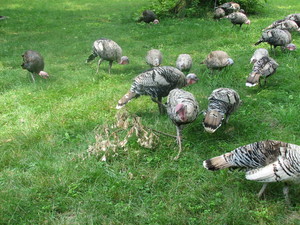
The turkeys went outside today as usual, despite weather. I suppose I'll just have to keep moving through this backslide into winter towards spring, just like a turkey tramping through the snow. I've saw a little bit of hope today, in the form of blooming pussy willows.
05 Apr Sun 2009
Change I Believe In
Tonight, when I brought the turkeys into the barn, I saw my first two violets of the year. For some people, crocuses or daffodils are their favorite indicators of spring among flora, but for me, it's violets. Crocuses often come up in early March, only to be buried in a week of snow storms, but violets usually don't start showing up until the arrival of spring weather is imminent. (Incidentally, since we were speaking of daffodils, the daffodils at church were blooming today.)
Now, I admit that tomorrow night, snow is in the forecast. However, it should only be a light dusting. The little purple wild violets in my yard are just the latest in a long series of signs in nature, including many sightings of our local crestless male cardinal and his crested lady, hearing peepers, seeing kettles of migrating hawks, a bush in the back yard with the green buds of leaves, and the lengthening of the days, that the change of seasons is happening. There may be setbacks, like the little snow that may come soon, but this is only one step back. For every one step back, there are many bounds forward. In several weeks, spring will be in full throttle. I've seen this change many times, yet every year it fills me with awe. This is a change that I truly believe in - and love.
In incubation news, I put a second batch of twenty-nine turkey eggs in the incubator last night. I also noticed that another one of my turkey hens, Two-Tone, is flirting with broodiness. This is what I call the early stages of broodiness (a mother bird deciding to incubate eggs) where the hen sits on the eggs for a while, then will get off for a day or two, then get back on, etc. After a few days, she'll either settle down to be a good, reliable broody or, in a few unusual cases, abandon the nest.
Barbara Kingsolver's "Miracle"
What is the result of one southwestern family’s decision to kick their oil and water addictions by moving to Virginia and becoming locavores?Animal, Vegetable, Miracle, a book written primarily by the acclaimed novelist and essayist Barbara Kingsolver, with contributions from her elder daughter, Camille Kingsolver, and her husband, Steven Hopp.
Animal, Vegetable, Miracle is both an account of Barbara Kingsolver and her family’s year of eating almost exclusively locally and an effort to convince others to follow their lead.In support of the latter, the authors provide a damning look at our current agricultural and food distribution systems in this country.They cite all sorts of reasons to support local farmers instead of huge agribusiness, from the distance food normally travels to reach your plate* to GMOs, and refutes the claims that eating locally is expensive and elitist.In fact, they don’t simply advocate eating locally, they’re truly advocating eating ethically.Barbara Kingsolver and her family only eat grass fed meats, and prefer produce produced with sustainable methods.
My favorite parts of the book were the ones on poultry.Barbara Kingsolver’s younger daughter, Lily, decides to start a business selling eggs and raising chickens for meat.I smiled at the parts talking about Lily pouring over hatchery magazines, because one of my favorite things to do when bored is to read all about poultry breeds on hatchery websites.Barbara Kingsolver herself decides to raise Bourbon Red turkeys, a heritage breed, and I laughed out loud at her descriptions of turkey reproduction.I know all about it, and have seen every step a million times, but she made it very, very hilarious.
My only complaint is the lack of day-to-day details of how they were coping with the lack of out-of-season food, especially in the first third or half of the book.I do admit they included some nice recipes throughout, though.In later parts of the book, she talks a lot about poultry, of course, as well as canning and generally what they were eating.My favorite chapter title was probably “Zucchini Larceny”.However, in the beginning, it’s more of reasons to eat local then what the family was eating locally.Perhaps it’s because there isn’t much local food in spring, so it’s hard to write a lot about not much.
The other book I’ve been reading about eating organically/locally is The Omnivore’s Dilemma, which is well written for nonfiction, but Animal, Vegetable, Miracle is nonfiction that reads like a novel.I highly recommend reading it.However, I do feel obligated to warn you that you may finish the book and never be able to food from out of your region again.
04 Apr Sat 2009
A Tough Week
I was planning to make today's blog entry a review of Animal, Vegetable, Miracle by Barbara Kingsolver, which I just finished reading last night. However, in light of last night's events, I am putting off posting the review until tomorrow and instead telling you the big news.
Last night was a miserable night. It was cold, rain (later, a mix of rain and snow) was falling, and it was very, very windy. Apparently, it was so windy that the top of the chicken coop blew open. We used to latch it shut, but then the top got out of alinement with the frame, and the latch no longer lined up. We never did anything about that, because in the design for the chicken coop, the latch was called a "predator proof latch" and the top of the chicken coop seemed too heavy for a predator to lift. Perhaps if we'd done something about the latch, the wind wouldn't have been able to blow open the coop.
It was late at night when the coop blew open, so we didn't realize what happened. We went to bed, and at 2:30 a.m. Bob heard the chicken making a racket. He ran outside, the dog following him, but he was too late. Two hens were missing. Our dog led Dianna to the fox den in the neighbor's yard, so we suspect it was a fox (or Mr. and Mrs. Fox) who took the hens.
I cried and cried and cried about those hens. After having a 100% survival rate for the chickens all year, we lost 25% of our flock (between King Louis and these hens) in less than one week. I won't let anything like this happen again, though. I've learned the hard way.
03 Apr Fri 2009
Customers and Candling
What an exciting afternoon for my business yesterday! I sold two dozen eggs to the woman we split our winter CSA share from Thorpe's farm. Also, a woman who'd wanted to come to my little farm and get some honey around noon yesterday couldn't, because the doctor's office asked her to bring her father in for an appointment early. However, it turned out we both had to go to Thorpe's in the evening, so we met there! She was very friendly, bought lots of honey, and had read my blog! She's the first person I ever met who'd read my blog, so I was rather excited. I was even more excited to find out that she'd still like to come to my farm and see my animals, because I love to show them off. However, I realized I never got her phone number or email address (she'd called me), so I'll just have to hope that she'll remember to call sometime again.
This morning, Dianna and I candled the turkey eggs in the incubator. For those of you not familiar with incubation, candling is a process of deciding whether or not eggs in the incubator are fertilized and developing. To candle, you hold an egg, big end up, next to a bright light in a dark room. An unfertilized egg will be see-through, but a fertilized egg will have a dark splotch in the middle after several days of incubation (although I've found this very hard to discern.) As incubation continues, candling gets easier and easier. When candling eggs at sixteen days or so, the egg's contents look completely black, with the exception of the air cell. (The air cell is exactly what it sounds like, an area at the top of the cell that contains oxygen.)
We were supposed to candle yesterday, seven days after we put the eggs in the incubator, but were very busy and never found time to do it. We own a wonderful book, called The New Incubation Book, that has very comprehensive information on incubation and many pictures of what eggs should look like in various phases of incubation when candled, including seventh day. Following the picture in the book, we were looking for the dark blob in the middle to be bigger, there to be the beginnings of an air cell visible, and perhaps the appearance of a few veins. Seventh day (or, in this case, eighth day) candling is a lot easier than third day candling, which I've given up on altogether, but still it's really hard to be sure.
We ended up not getting rid of a single egg, but we marked the most questionable ones with a question mark in pencil on their shell so if they still look bad at twelfth day candling we know it's probably best to get rid of them. The reason you candle and dispose of the eggs that aren't developing (or the ones that started to develop and then, for whatever reason, ceased to) is because bacteria can grow in such eggs and then hurt the perfectly good embryos in other eggs.
With regards to our broody turkey hen, we've decided to just let her incubate the eggs she's collected. Some of them are undoubtedly very old, and have sat outdoors through some very cold weather. Therefor, we're not going to count on her hatching a single poult (baby turkey), but if she does, we'll just count it as a bonus. I hope she does, though, because there's nothing happier than a little family of a mama hen and her babies. I love that heritage breeds have this trait (broodiness), and would never consider keeping a breed that has broodiness bred out of them.
02 Apr Thu 2009
Chasing Chickens
The weather is lovely today, very sunny with a predicted high of 63 degrees Fahrenheit. A customer was supposed to come today at noon for honey and possibly eggs, so I used this as motivation to do a badly needed cleaning of the chicken coop early this morning. I couldn't seem to get anything done because I kept having to catch escaped chickens. (They've been stuck in that coop ever since the rooster's death.) I swear, for every one minute I cleaned, I spent four minutes chasing chickens that flew out. In hindsight, it seems that I should have just let the chickens go where they wanted while I cleaned and did morning chores, then rounded them all up at the end.
With regards to incubation and baby poultry, a friend has offered to lend us an incubator so we have more incubator room to try and make us of the eggs that the chickens lay over the next few days which may still be fertilized. I'm still afraid we won't have enough space, though, because we already have over a dozen chicken eggs and eighteen turkey eggs waiting to go in the incubator. We are planning on ordering chicks, because we know whatever chicks we may be able to hatch won't be enough. We're definitely going to order Javas, New Hampshires, and Iowa Blues, three heritage breeds, and may also try out the slower-growing Colored Range Broilers from J.M. Hatchery.
01 Apr Wed 2009
Incubation: My Love/Hate Relationship
Oh, incubators! Without them, there would be far fewer chickens in the world, and hardly any turkeys big enough for Thanksgiving. They provide kids a view of the joyful miracle of hatching. They can't don't get freaked out by human presence and abandon the eggs, like some broodies will. They are also a pain in the neck.
I put the turkey eggs in the incubator last Thursday. It is a two-year-old table-top circulated air machine, made of styrophome and sporting two little plastic windows to down at the eggs through. Last year it was the good one, the reliable one. This year, I can't seem to get the temperature right. It was too hot in the incubator, so I kept turning the knob further and further clockwise, to get the temperature down. It stayed as high as ever. Finally, I got I lower, but it was way too low, an average temperature of ninety-eight degrees, when turkey eggs need a temperature a tiny bit over ninety-nine. (Even a degree to cold or a degree to hot can seriously mess up incubation.) So I turned the knob counterclockwise a tiny bit to increase the heat a bit, and the temperature's back at averaging one-hundred point five degrees.
Meanwhile, the newer incubator, the fancy one with the completely see-through plastic top and the automatically-setting temperature, the one that I called "the root of all evil" last year, is working great. Last year, it was too hot, and my hatch rate for many batches of turkeys was below fifty percent. In May, we figured out how to get the setting lower, but then the power cord kept coming unplugged from the incubator. This year, we've found the correct angle to set the power cord at so it'll stay in, the temperature setting is right. We'd plugged it in to get all these kinks worked out before we put any eggs in, and, with no eggs in it yet, it's averaging a perfect ninety-nine point five degrees.
Oh, when I speak of broody hens afraid of humans, I'm not just making them up. Two years in a row, my tamest turkey hens have gone broody and hatched eggs. Good experiences. Now, though, my wildest turkey hen has gone broody, and there's no way I expect that I'll be able to transfer into the safe, controlled environment of a nest box. If she were to hatch babies, they'd probably out of control, running all over the barn. I'm afraid a lot of them would die, either by getting trapped somewhere and freezing away from their mother or getting caught by some predator. It's a shame that I'm probably not going to be able to let her hatch eggs, because I need incubator space!
Well, my love/hate relationship with incubation, both natural and artificial, continues. It may not always work out perfectly or at least easily, but I'll continue incubating eggs. You'll be hearing about my trials and tribulations on this subject many, many more times if you continue reading my blog.
31 Mar Tue 2009
Louis XIV, June 2008 to March 30, 2009, R.I.P.
Yesterday evening, Dianna and I had somewhere to go, so Bob had to put the turkeys and chickens away. He didn't say anything about the birds when we got home, so we presumed all was well. Just before he went upstairs to bed, he stopped and asked me, "How many chickens do you have?"
"Twelve," I replied.
"I think King Louis might be missing, then," he said.
I went out to the chicken coop, and there were eleven hens, but no rooster. Dianna and I took flashlights and looked all over the yard, but we could find no rooster. At that point, I knew he was dead, because King Louis loved his hens, and would never leave them. If somehow he got left out of the chicken coop after it was closed, he would have been perched on it or next to it, trying to be as close to his hens as possible.
This morning we looked for King Louis again once it got light. He was nowhere to be found, and there was neither blood nor a suspicious trail of feathers to be found. (These would be signs of a fox or raccoon attack.) This leads us to believe that the pair of Red-Tail Hawks that was hanging around and watching the chickens finally took action. Red-Tails are, after all, also called Chicken Hawks.
Although King Louis was a real terrorist, he really cared for his flock. Every time he attacked me, it was only because he thought his hens were in danger. Recently, Louis and I were starting to come to understand each other. I was learning what to do to avoid provoking him. I suppose I can use such lessons on a future rooster, but I wish I could still practice with Louis. I'm surprised how much I'm missing him.
29 Mar Sun 2009
I'm Back!
Well, with all the business of Christmas, I got out of the habit of blogging. It's spring now, and I've made a "New Season Resolution" to start blogging again.
No major changes have occurred on the farm since I last blogged, but there's a little news. Blue's poults are now all grown up, and one of them made a very tasty meal for the piano tuner. We haven't gotten around to butchering the other three yet, and two of them have acquired names, courtesy of Dianna. She calls the young tom "Sonny" and the flighty young hen "Flake". She's lobbying to name the other young hen "Sister" (her aunt and uncle were called "Sonny" and "Sister"), but I'm resisting. Who wants to eat their aunt and uncle? Our rooster, King Louis XIV, is just about as mean as ever, but I've been handing him more and giving him food in an effort to tame him. The birds have gotten the idea that's it's now spring. The turkeys have started laying eggs (which they like to hide in clever places like the raspberry bushes) and the chickens' lay rate has started to pick up. On Thursday, I put twenty-three turkey eggs in the incubator, so we should have some baby turkeys hatching on April 23rd. I'm planning on starting incubation of more turkey eggs and some chicken eggs soon.
We've had a flock of wild turkeys hanging around lately. Every few days we see about nine wild turkeys flying or running across our pasture, from across the street into the woods. Every now and then, a wild turkey will get to the fence in the back of the pasture and not know how to go through. I'll then go outside and over to where the wild turkeys is. That will freak it out so much it will fly into the air, then realize oh! flying is the way to get over the fence! Turkeys aren't stupid, but they can act like they are when they panic. The funniest part about having the wild turkeys around is seeing how they react to the chickens. A wild turkey was running through are yard recently but almost ran into a chicken. It then stop, and starting walking very slowly and jerkily. It was scared of a bird that was half its weight and a third its height!
I promise that I'll blog again tomorrow!
13 Dec Sat 2008
Icy Hay
It's been snowing a for the past two or three weeks. A few inches will accumulate, then it will melt a couple of days later, then snow the next day, and the cycle repeats again and again and again. Currently, their is a thin layer of ice covering everything, with an inch of snow on top and a little more drifting down as I write.
It's the perfect conditions for slipping, as I have a tendency to do every time I go outside. I just was out at the chicken coop. The chicken coop is only three or four feet tall, and I access by climbing in. It is surrounded by stacked-up hay bales, which I have to climb over every time I want get into the chicken coop. Well, today I decided to weigh one of my laying hens, because they're smaller than they should be and I was hoping that they'd started to put on some weight. I caught a chicken, and was holding her by the feet. The hale bales, like everything else, are covered in ice and snow. I was climbing out and put my foot down on a hay bale, slipped, fell over the side of the chicken coop and hale bales, and landed on my back side, still holding the (unharmed) chicken high in the air! I was a little sore at first, but feel fine now.
It may be too cold for the chickens to go outside (as I've written about previously), too slippery for me, but the turkeys are happy. Every morning, they run outside as soon as I open the doors. They don't roam around as much of the yard as they used to in warmer weather, instead staying close the barn (and the feeders). They spilled a lot of their food yesterday, but as soon as they went outside today they immediately started pecking at it. What good birds I have!