
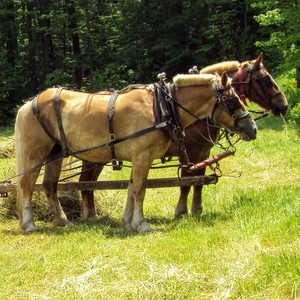
04 Feb Thu 2010
It's Alive!
We're really proud of doing lots of things here the old-fashioned way, usually with horses. But there are some tasks that are easier to do when you're using motorized equipment. We have both a baler and a feed grinder here, but we're not able to run either of these without a motor. Stored away for the past 15 years or so has been a large Wisconsin 4 cylinder engine. It hasn't run for all that time, and wasn't the most reliable piece of equipment on the farm when it did. Stories like "the time the motor caught fire" "the other time the motor caught fire" and "the time it almost cut Dad's finger off and we had to rush him to the ER" make me very nervous about trying to use it again. It's surprising it never was hauled away to the scrapyard, but Dan thought that someday it could be rebuilt and be a real asset to the farm. He's been working on it for a good part of the winter; tearing it down completely, cleaning the gunk that forms when hay, dust and motor oil combine, and looking for parts, mostly online, and waiting on UPS/FedEx/USPS to deliver them. I was amazed it's not that hard to locate parts for a motor that was manufactured from the 1940's through the mid-60's. Because it was a popular, commercial engine, we were able to find pretty much everything.
Yesterday, it fired and ran for the first time in well over a decade. Sure, there are still adjustments to be made, but it's possible that we will be grinding our own feed here at the farm before Valentine's Day. We have the luxury of a feed grinder & mixer system in the top of the barn, and it will be a huge time and money saver compared to hauling our corn to the closest feed mill that will grind, which is well over an hour's drive each way. This motor will spin a large belt to run the grinder, baler or other equipment. It's a heavy motor, nearly 500 lbs, but with only about 25 horsepower. It's exactly what we need, and still a rather old-time piece of equipment itself. To start it, you need to crank a handle around until it fires. It also needs a special additive to the gasoline, as it was built to run on leaded fuel.
I know Dan is beyond pleased to hear it roar to life. I'm really proud of him, it was a pretty big project, but he had patience and figured it out. And I've been told some plug wires or an electric start are right at the top of his list of nice Valentine's Day surprises...
30 Jan Sat 2010
How Much Corn Do We Need?
When I was younger, my family didn't garden, so I really never paid any attention to vegetable varieties. Corn, for instance, came on the cob, canned, creamed, frozen, or popped. Now that I'm actively involved in planning the varieties we'll depend on for the year, the names of different varieties are like old friends to me. I'm always on the lookout for a new friend who will perform well, too. This means we'll plant multiple varieties of many vegetables, and there really is a lot to learn before you can be successful.This year, we are planning to plant seven different varieties of corn. Not all seven will ripen at the same time, or even be used for the same purpose.
Probably the most important corn is one we won't eat, and that is our field corn. It will be the variety we plant the most of, for it is what we feed to the animals all winter as a supplement to their hay. Many a city kid has been bitterly disappointed when raiding a farmer's field after dark for those luscious looking yellow ears, only to take them home, cook them, and find them to be starchy and tasteless. We'll leave it on the stalks to dry until late fall, when we'll pick it. Some will be left whole and on the cob, while some of it will be ground into feed. We also use some of this (in a different grinder!) to make the cornmeal we sell here.
I have planted Earth Tones Dent corn for the past 2 years now, it's an ornamental, or "Indian" corn. It's very pretty, and we sell some of it for decoration in the fall. It also dries like the field corn and can be fed to the animals or used to make colored cornmeal. I'm still using up my yellow cornmeal, but the next time we grind, I'll be interested to see what it looks like. It is also not a hybrid, unlike most corn varieties, so I save the seed from the biggest and prettiest ears every year. We plant a little more each year, and are going to try planting more this spring to use as animal feed as well. It would be so nice to have a dependable corn crop from a seed that we don't have to buy each year, as it can be quite an expense! Plus I have a fondness for the old time varieties.
Two varieties we're planting this year are new to the farm. Dan wanted to plant Bloody Butcher, a macabre name for a red corn that again can be used for animal feed, decoration (it's a deep, deep red) or for an interestingly colored cornmeal. I wanted to try strawberry popcorn, a cute little miniature ear, only 2" long, that can be popped right in the microwave. It just sounds fun, and if it does well, we'll have it for sale at the farm stand later on in the season. We purchased both these varieties from Seed Savers Exchange, so if they do well, we'll be able to grow them for years to come, saving the seed from year to year.
So four of our planned varieties are for the fall, as the kernels have to dry out before they are ready to harvest. Don't worry, it just wouldn't be a farm stand without sweet corn, and we have three varieties of that in mind! I really thought sweet corn only came in three varieties- all white, all yellow, and butter and sugar, the yellow and white kind. Turns out that's not the case at all. One catalog we receive has over 70 varieties of sweet corn alone! Most are bi-colored- turns out "butter and sugar" could be one of at least 50 different, named, varieties. That explains why some taste so much better than others! We'll be planting 2 bi-color and one all yellow variety of sweet corn. While they all mature much earlier that the fall corns, each variety has its own pace. The catalog gives you a rough guess of how long it can take between the day you plant and the day you pick. A short one will be something around 65 days, extending all the way to 90 or so. This is a rough guess, and will vary depending on weather conditions and the like, but if you pick varieties that ripen a week or two apart, it's possible to have fresh, ripe corn for a much longer stretch in the summer. So there really is a lot more to planning than deciding something named Silver Queen or Seneca Dancer sound tastier than the new ACX MS4012BC F1 (all real varieties!) Of course, all the planning in the world can't protect you completely from bad weather, bugs, or blights, but doing my gardening homework and looking at the pictures of those delicious plants of summer sure help to pass the winter nights!
28 Jan Thu 2010
All About Eggs
The days are starting to lengthen noticeably. I'm so glad to have the luxury of daylight after my 25 mile commute home when I change into my farm boots and begin my share of the evening chores. I know the chickens can sense spring is coming too, since I'm getting more eggs every day now.
A hen will only lay one egg per day, but her body tells her to knock that off as fall approaches and winter sets in, because that's no time to be raising babies! Even though the mothering instinct and the will to sit on eggs for 3 weeks has been bred out of the majority of laying hens, their bodies still respect the natural rhythms of the seasons. It's possible to trick the hens into thinking the dark days of winter have passed by putting a light on a timer in the hen house. During the shortest days in December, we set it so that it the hens have light for 12 hours- 7 am to 7 pm. (it helps me get the eggs collected when I'm running late as well!). It does make a big difference, but even though the light is still on, I'm noticing an average increase in my eggs as the weeks creep toward spring.
We actually eat more eggs during the winter, for although the chickens are not laying as many as they do in the summer months, I'm not selling near as many since the stand is closed. So it's egg salad to pack my lunch or a treat of deviled eggs with dinner. Having fresh eggs all the time, it's easy to forget what a treat they are compared to those white things in the supermarket.
When I went to North Carolina over the holidays to visit with my family, my brother Cory was so excited to have "real eggs." He wanted to know why brown eggs taste better, and what the difference was between brown & white. I told him that the shell color is determined by the breed of hen it came from. While the breed that holds up best in factory-farm type conditions lays a white egg, most barnyard breeds lay brown eggs. Since barnyard birds usually get more exercise, sunlight, and good natural food like worms and grass, the eggs do taste stronger, but it's a flavor most folks appreciate. Farm eggs are generally fresher as well, so that's why a common misconception is that brown eggs taste better. All my fresh eggs taste wonderful, and I have eggs that are dark brown, light brown, white, and even blue-green! The last ones come from yet another breed of hen, but yes, they really are chicken eggs!
I love having "rainbow" eggs.
22 Jan Fri 2010
Seeds for the Garden, Flowers for the Outhouse
Despite the snow and freezing rain, spring feels a little closer. I've started to order seeds for this year's growing season, so visions of tomatoes and zucchini have been dancing through my head. Planning a home garden takes some thought, and planning a garden you intend to sell from is an even bigger project!
We start out with the list of what we planted last year and decide if we want to plant the same varieties this year. There are so many varieties of each type of vegetable, there's no use sticking to one that doesn't do well for you. I had no idea there were over 70 varieties of sweet corn available until the cover of one of our wholesale garden catalogs came last year! Our next consideration is how long the plant takes to finish growing. We have a short growing season this far north, and need to make sure the plant will do what it is supposed to do before the frosts come again in the fall. Also, if you plant varieties which ripen at different times, you can have that vegetable available for a longer season, both in the stand and in the kitchen.
The order I just sent out was to Seed Savers Exchange, a nonprofit group committed to saving rare and heirloom vegetables. They have lots of things not seen in any of the other catalogs we receive (and we get plenty!) so I always spend a little extra time picking out a few goodies to experiment with. As an added bonus, I can save the seed to plant next year if they do well! Last year I fell in love with Grandpa Admire's lettuce, so I ordered lots more of that. Since it was such a rough growing year, I ordered a few things that didn't do very well last year, but either showed promise or I just can't resist. Normally, we wouldn't be so lenient, but almost no tomatoes survived the summer anywhere, and the weather didn't favor melons either. However, if I don't get any Delice de la Table melons this year, they won't be on my list next year. I ordered most of my fun experiments through this catalog. Hopefully, I'll find a tasty use for a bounty of ground cherries and you'll be able to purchase mini popcorn on the cob from the stand this fall!
SSE also carries flower seed. I love to plant flowers, but I favor hardy perennials that take care of themselves year after year. I simply don't have time to spend hours on flowers in the spring, but I love having good habitat for pollinators like bees and hummingbirds, and every place needs a bit of pretty, farms included! My mom had her own floral shop once upon a time, so I know a bit about flowers, which is more than I could say for vegetables until recently. This time I decided to give hollyhocks a try- they are big, bold flowers that come back on their own, although planting from seed I won't see flowers until next summer. This variety is called Outhouse Hollyhocks, which sound like a terrible name for a flower, but they have a charming story. According to the Seed Savers catalog, "years ago, refined ladies just looked for the hollyhocks and didn't have to ask where the outhouse was." Being 6-9 feet tall, they hid the building as well. We still have an outhouse here, although we do prefer the pleasure of indoor plumbing, it is a part of the character of the farm and we have no plans to tear it down. So it seems fitting to me to decorate it with hollyhocks!
I've been working on the website again, and have plans to start a monthly e-newsletter. If you'd like to be a part of that, just go to www.pleasantvalleyfarm.weebly.com and fill out your name and email on the form on the home page. There is a place to leave a comment or let me know what you'd like to hear more about as well. And when I say monthly, I mean it...I'm too busy to send you spam! I also set up a fun little poll you can vote as well. Once I get some names, I'll work on a newsletter, but it will probably be late February before it goes out.
17 Jan Sun 2010
Mustard Madness
For Christmas, I received a cookbook with recipes for over 400 sauces in it. I've been flipping through it ever since, and the rainy, chilly and generally dreary weather today made it seem like a good idea to stay in the kitchen. I'm always looking for new flavors and things I can try out that I may be able to make for the stand as well, so I decided to make a few different mustards today. I made a wonderful, simple, whole grain honey mustard. The only change I may make is to thin it out a bit...it's a bit thick for dipping, but would spread well with a knife. With a bit of tweaking, I'm sure you'll see it at the stand this year!
Next I tried a horseradish mustard. It was everything you would expect it to be: yellow, creamy, with a spicy kick. Not a mild mustard, but it wasn't supposed to be. Another success. I've been very fortunate, in all my canning adventures, there have been small glitches, but never big disasters where I ruined a whole batch of jelly or something.
However, I've found one mustard recipe I just can't seem to succeed with. I bought a small jar of champagne dill mustard a little while ago, and it was fabulous. We could have eaten the whole small jar in one sitting, it was that good. Mild, with hints of vinegar and dill. The ingredients were pretty straightforward, so I tried to duplicate it, just substituting white vinegar for the champagne vinegar, since that is something I just don't have on hand here. It was horrible!!!! So hot, it made me cough and my eyes watered! Now I know that if you leave mustard sit at room temperature, it will mellow out. Since I made this about 3 weeks ago, I tried it again today, and the initial taste was much closer to what I was aiming for, but still finished overpoweringly hot. So I put the lid back on the jar and returned it to the pantry. This new cookbook, which just gave me 2 delicious new recipes, had one for tarragon-champagne mustard. I figured that if I substituted dill for the tarragon, it should be close, as the description was for a mild, herbal mustard, which sounded like what I was aiming for the first time. Again, no champagne vinegar either, but I had some rice wine vinegar, which I find mild and pleasant and close enough to give it a try. (Just ask my husband, unless I'm canning, I'm basically incapable of following a recipe. I'll get about halfway through and then start making substitutions which I think will be better. These almost always do turn out more to my liking than that boring old printed recipe, which of course only encourages me to try such things again!) Well, the first problem with this mustard was that there was so little liquid, I was basically making a paste which threatened to blow up my blender, and that was after I cut the amount of dry mustard in half! So I added a cup of water, which saved the blender and made a nice consistency. It was looking better, until I tasted it. Again, it was hot and bitter enough to take your breath away! So I checked online to make sure that ground mustard and dry mustard powder were the same thing, and all sources seemed to say it is, so that isn't the problem. So again, I put it in a jar, dated the lid, and placed it in the pantry to age. Maybe it is like making champagne or fine wine, it may need to age 6 months or more before it's palatable. Or maybe I really do need to follow a recipe the whole way through and find a place to buy champagne vinegar. Who knew making dill mustard could be this hard?
15 Jan Fri 2010
Goodbye, Warlord
Wednesday was a very sad day for me, and one that has been on my mind since. During evening chores, Dan discovered our buck goat, LLP Warlords Dream, (or Buddy) had died unexpectedly. There was no sign of illness that morning, so it came as a complete and total shock. Not only was this a registered, pedigreed breeding animal which we had invested money into for a solid foundation to our breeding program, he was my friend. It was a huge loss emotionally for me...he was a massive animal with the largest horns I'd ever seen on a goat, but was incredibly gentle, asking only for a cookie or a scratch behind the ear. He was gentle with his babies. He made funny faces with his lips, begging for a cookie, when he popped his face over the door into the main part of the barn.
I'll miss him very much.
We got into goats before we opened the farm back up as a business. At first, they were a natural way to keep the pasture from being overgrown with shrubs and thorns. Any goat was ok, our first purchase was a pair of pygmy crosses, we didn't care about the breed. Then we learned more about the Boer goat, a meat breed that is becoming increasingly popular and profitable, so we bought the best Boer stock we could afford, and have watched quite a few delightful kids arrive here at the farm. We had the expectation that goats would be low maintenance, as the crossbred goats that Tom & Betty purchased years ago ran about the farm and thrived on nothing more than a bit of hay thrown out in the winter. As the herd grew, more maintenance became necessary, vaccines, wormer, and sometimes other medication, like an antibiotic, for a sick goat. As I do some real soul searching, I can see a pattern...it was always the Boers who needed the most attention...the mongrels from the auction, the pygmies we first bought, are thriving, and have been thriving with less care. Boers are not native to our area, the breed originated in South Africa. Although they are raised quite successfully in our area, perhaps there is something about the microclimate of our farm that is especially hard on them. I don't know. I do know that we need to look at the farm animals as a business, not just Emily's petting zoo of snack friends. The financial cost to keeping these goats healthy is not profitable. The emotional loss is hard too. Besides heartache over a death, there is a toll whan an animal isn't well or a young one fails to thrive. You worry. You look through the veterinary manuals and fear that your entire herd is soon to be affected with some horrid, incurable disease. So through my tears, I mentioned to Dan that maybe we should get out of the goat business. He quietly agreed, and suggested that perhaps we'll get more sheep, who are the low maintenanece, profitable animal I hoped for with the goats. (They aren't, for the most part, so full of personality though.) We also agreed that this was not a decision to make lightly or emotionally, so it is something to work through in the coming weeks and months. I would feel so guilty if, by keeping them here, illness befell some of my healthy, wonderful, personable Boer does. It will be a very sad day for me if they leave as well. We also can't afford the upkeep on 20+ goats either, if we're not breeding them. We'll definately hold on to some of our goats regardless, and we are still hoping for a healthy crop of kids in March or April sired by our buck.
Before we did chores Wednesday evening and discovered our loss, I was pleased to find a poster I had ordered for the stand had come in the mail. It was for the American Livestock Breeds Conservancy, a group I'm passionate about who advocates for the preservation of endangered farm animals, especially those native to the U.S. Boers are the hot thing in goats right now, so they are not on the ALBC's list of endangered breeds. However, the Tennessee Myotonic goat is, and is more commonly known as the "fainting goat". They are also regarded as a meat goat, but have the unusual quality of tensing up and falling over (fainting, sort of) when startled. When I came back inside, in tears, I may have snuffled out some comment about getting out of the goat business, but I also completed that thought with "...or we could try fainting goats..."
11 Jan Mon 2010
No Recess for Finni
It's still snowing here, and for the most part the animals are well adjusted to the routines of winter. Mostly. Every evening, we let the horses and cows outside to romp and drink from the creek while we take care of evening chores. They all know that when the barn door opens, food and warmth await, so they march in and file into their stalls. Every so often, one of them wanders around inside a bit before going to their spot, but it's usually not a big deal. However, the cold can make the animals pretty rambunctious, and lately Fiannait, our Dexter cow, has been giving us quite a bit of trouble when it comes time to head back inside. The worst part is she becomes the ringleader for misbehaving cows! Here's a picture of her (black cow on right) and Louie refusing to come inside:
Just after the picture was taken, they ran away from the barn door, scattering the sheep and geese calmly waiting to be fed outside. Dan spent 45 minutes chasing cows around the barnyard last night, and so he decided to take away "recess" for Finni, hoping the other cows would return to the normal routine. So tonight, while everyone else got to run about, Finni was led down to the creek by Dan for her nightly drink.
In this picture, she's waiting for her turn at the open water hole, since most of the creek is frozen over. She wasn't happy, but got her drink and was led back inside without incident. The other three cows, or the Three Stooges as they were known tonight, still acted like knuckleheads that were afraid to come inside anyway. However, as we finished up chores, they decided to come inside without being chased. So we'll see...either Finni will stay on lead rope probation for a bit longer, or we'll let all four cows out a couple hours early, so they can run around in the snow and be a bit chilly, a little hungry, and ready to come inside when they are supposed to next time!
10 Jan Sun 2010
Brrr!
Winter is really here, and with a low temperature of -13 last night the main job around the farm these days is keeping warm! We'll bed the pigs down with a bit more hay, and increase the hay fed to the other animals (horses, cows, sheep & goats) since they'll use the extra calories to keep warm. The bunnies have lots of hay too, but I've never seen creatures less concerned about the weather. My does love to be outside, and I can frequently see the outline of the individual snowflakes on the backs of my black girls. The chickens have plastic over the windows to keep the wind out, and have plenty of feed as well, but they can actually suffer frostbite on their combs, especially the roosters who have large, single-type combs. Rocky, our not-so-creatively named Barred Rock rooster, lost a good bit of his comb last winter when it got down to -25 one night last winter. I've heard that if you cover the combs with Vaseline they won't get frostbite, but that doesn't seem like a very practical solution when you have more than just a few pet or show chickens. It looks like our Delaware might have a bit of frostbite the tips of his comb this time, but nothing major. The frostbit part will eventually turn black and fall off, which sounds horrible, but doesn't seem to bother the birds. Some people actually dub, or cut off, the combs as a standard practice anyway, so the overall effect is more cosmetic than life-threatening. But as much as I'd like to keep this from happening, there isn't much else I can do besides move south or put heaters in the pens when it's really cold. And since both my chickens and I prefer that the hen house doesn't burn down in the middle of the night with them inside, space heaters are out too!
Not surprisingly, there hasn't been much outside activity around the farm these days besides plowing out the parking area and knocking ice out of the animals' water buckets. Dan has been busy trying to repair and old farm engine so we can use it to grind our whole corn into animal and chicken feed later this month. It can also be used to run our hay baler in the summer so we don't have to put everything up as loose hay again. The old Wisconsin engine has been sitting for many years, so it's not going to be a quick project, but he's making progress. We recently got a new computer, so I've been busy transferring records and setting up new tracking sheets for the new year. While bookwork isn't my idea of fun, it does give me something constructive to do and, more importantly, it's inside!
The other main project we're working on is planning our seed orders for the coming growing season. Looking through the list of what we planted last year reminds me of all the successes we had despite the difficult weather we had here last summer. The color pictures of all the beautiful plants, vegetables, and herbs get me excited about planting a new garden. Our final order will be a good mix of heirlooms and commercial varieties, some which have grown here successfully in past years, and some new ones which seem too good to pass up. While keeping in mind what we need to plant for the stand and for us, I'm adding some "wish list" seeds to my initial lists. I'm sure I'll have to trim back the final list, but I figure that because I was able to save seed from a few varieties of plants, I don't need to purchase those seeds again so I have some room in the budget for some new varieties or anything that just sounds fun to plant!
08 Jan Fri 2010
Tastes of Winter
It's been a cold and snowy new year...so far we haven't had a day without being under a winter advisory or warning of some sort. Currently, we have about 18 inches of snow here. A lot more has fallen, but it's been fluffy snow that compacts, so while the white stuff keeps falling, and the cars need to be cleaned off every morning, it's not too deep, which is a good thing!
Since it's not nice outside, I spend a lot of time in my kitchen on these cold winter nights. The hardest part of learning to eat seasonally is picturing what winter dinners will look like...no one wants to eat boiled potatoes and turnips all winter, so how to you stay seasonal and love what you're eating? My first suggestion would be to buy a freezer! I have lots of dinner choices since we have frozen beef, pork, lamb and chicken in the freezer. Corn and green peppers freeze well and aren't hard to process at all, so we can still enjoy those as well. Of course, we have squash, onions and potatoes which keep well in a cool, dark place like our basement. The chickens are also laying reasonably well, providing us with fresh eggs. Combine that with the things I canned over the summer and we can eat well all winter long.
Earlier this week, I came home from work and defrosted some pork chops. After browning them in a pan with some olive oil and butter, I put them in an oven proof dish. Then I caramelized an onion in the same pan and topped the chops with the onion, a dab of butter on each, and some herbs I'd dried from my garden (I used thyme and sage this time, but this recipe adapts well to whatever herbs you prefer/have on hand). I put it in the oven at 350, covered with foil. Since I had some room in the oven, I added a kabocha squash, seeded and halved, cut side down on a baking sheet as well. In about an hour, I pulled it all from the oven and had a simple, but seasonal and delicious meal!
The next night I made a half leg of lamb. I slow cooked it in a crock pot all day with water & cooking sherry, garlic, onion and rosemary. I did cheat a bit on this one and also added some fresh ginger root which was store bought, but I love the taste it adds! A side of pasta completed a very filling meal.
Last night I made enchiladas with our ground beef, my homemade salsa, and the raw milk cheese we sold at the stand this year. I only have a few blocks of cheese left, and I'm sure going to miss it when it's gone! Although we grind our own cornmeal, I haven't yet tried to make my own tortillas, so those came from the store too. Besides, I am back to work full time now and I don't always have the time or energy to make everything from scratch every night.
So, no matter where you live, it is possible to eat seasonally, and eat well! And for those of you starting out, don't feel bad if everything isn't completely homemade or local...we all start somewhere, and the first step is being aware of our food choices and learning to recognize what seasonal looks like. Just one or two local, seasonal items added to your everyday cooking does make a difference!
02 Jan Sat 2010
Cooking in the Living Room
2010 is here, and it's brought quite a winter storm with it! We're forcasted to get up to another foot of snow by Sunday night, with wind chills of zero. There have been a number of snowmobiles riding up and down the road, and other than the state plow trucks there haven't been too many travelers our way. I'm just glad to be home before it hit, as I was visiting family in North Carolina for a few days earlier in the week. In my opinion, the only thing worse that a 9 hour drive home is a 9 hour drive through a blizzard!
I was gifted with some new cast iron cookware for Christmas, and it's something I've wanted to become better at using. It's been really cold here, and we heat the house with a cast iron woodstove in the living room. The stove is very hot and has a flat top, so I've been wanting to try cooking on it...it's kind of like a primitive crock pot, and I love cooking with my crock pot! So I decided to try something fairly foolproof. I defrosted a smoked ham hock and added some beans and the other necessary ingredients to make barbecue beans (crushed tomatoes, cider vinegar, molasses, Worcestershire sauce, etc). I mixed it up and set it i the middle of the stove. After a few hours, the meat was falling off of the bone, and other than a slight amount of scorched beans, Dan and I declared it a success, and a perfectly warm and filling meal for a cold January night.
So, why bother when I have a perfectly good crock pot? Even though a crock pot uses only a little electricity, it does use some. And my home is no colder for using the woodstove as a cooking surface. Plus, I do have a wood burning cook stove in the kitchen, perhaps someday I'll be bold enough to cook meals on it, just to see if I can. I like to challenge myself to learn new things. In the past, for instance, I have taught myself to can and to make balloon animals. While at the time they didn't seem like necessary, everyday skills, you'd be surprised how often I find myself making pink parrots or blue elephants, and of course the canning became a big part of our farm stand this year. I'm never sorry when I learn something new, except that I may not have enough time for everything I'd like to be doing!
So, I guess you could say learning is always my New Year's resolution. I'm also planning on learning to make my own vinegar from wine or cider this year, and when it is warm enough that the sheep won't need their fleeces, I'd like to try doing something with the wool, perhaps making a braided rug or something easy. (I don't know how to knit...yet, at least!) So best of luck to all of you on your resolutions as well, if they haven't been broken already, and Happy 2010!
25 Dec Fri 2009
Not the Tradition I Had in Mind...
Every family has holiday traditions, whether it is the food we eat, the people we share the day with, or other special things that become part of our annual celebrations. One thing I have wanted to make a tradition here at the farm is taking a Christmas Eve sleigh ride with my husband, Dan. We got the sleigh ready, I brushed Sara, my little Morgan mare, put on her fancy harness, and I even added a few pieces of Christmas garland for a festive touch. We started out into the snow-covered hay field, and it was magical. She trotted away with a pace which felt like we could keep all day. The sun gleamed off of the holly-like tinsel, and the single bell I adorned her hames with jingled merrily. It was a picture worthy of a Christmas card. At least for the first round.
She began to pick up a bit too much speed, and as I slowed her down, the strap around her backside tightened. She hates this feeling, and before I could blink an eye, she began a kicking fit. Pieces of harness and sleigh shafts began to break apart, and soon there was nothing connecting pony to sleigh besides my grip on the reins. This caused me to fly from the sleigh, with none of the grace of Santa's reindeer, breaking the front board before I hit the snow-covered ground, face down. Still Sara kept going. I was now being drug on my belly behind her flying hooves, which suddenly seemed much closer than when I was safely aboard the sleigh. My shoulders were now functioning as snow plows, and I couldn't see much beside those hooves. There was nothing to do at this point besides let go. She continued racing across the field as I picked myself up and assured Dan that I wasn't hurt. Sara turned around at the far fence and came galloping back toward us, but was in no mood to slow down and be caught, so I didn't try anything foolish like jumping in front of her. She broke a gate and was into the barnyard. By the time I made it down there, a switch had flipped, and she calmly trotted over to me so I could take her inside. We stood there for a minute, catching our breath, and Dan arrived to help me unharness her. She was ok; missing a bit of hair on her leg, but no blood. Nothing would swell, and when we let all the horses out for an evening drink at chore time, she was prancing away from Dixie, just like any other night. I have a fair number of bruises on my legs and knees and my hands have a bit of rope burn, but the skin will grow back, so no major harm to me either besides some major stiffness that will fade in a day or two. The harness and sleigh are both broken, but both can be fixed. We live near an Amish community, so we'll take the harness over to the Amish harness shop, where they will fix it like new. I want to get a new set of lines and replace the nylon ones that burned my hands as well. Dan is confidant that with a trip to Home Depot and a new coat of paint, the front of the sleigh will be fine too. We had been meaning to replace that board anyway. Even the digital camera in my front hoodie pocket escaped intact! I remarked that at 24 years old, Sara should be too old for such episodes, but I'm very fortunate that she is still healthy enough to be bad. I'm also happy that I did not get the sleigh bells I had been wanting for Christmas this year!
There was one major casualty in the whole fiasco. My pockets had been filled with animal cookies to give to the critters as treats. Snow + cookies = soggy mess. However, my goats love cookies, soggy or not, so they cleaned them all up. Jerry was happy to take all the broken bits of legs and elephant trunks from the palm of my hand, and the whole herd was very pleased with their Christmas treats.
Now Dan and I are anxiously waiting for the Christmas ham, glazed with my mulled blackberry vinegar, to come out of the oven. We'll have a feast of sides, like homegrown squash and frozen corn from the summer. We hope your holiday is a merry one as well, completely free of sleigh wrecks and other fiascos, and full of love, good food, and happiness.
Merry Christmas!
21 Dec Mon 2009
Christmas Snow
The snow is falling gently outside, and we're not expecting weather above freezing, so it looks like we'll be having a white Christmas here at Pleasant Valley. The big storm that blew up the East Coast spared us, so we only have about 4 inches here. In my opinion, just enough to make it pretty, but not so much we're digging out or unable to travel. Most of the animals are spending their days inside where it is warm and dry. Although the horses love to kick up their heels when we let them out at chore time, Dixie will be pawing at the barn door wanting to come back in if she thinks we're taking too long! The only critters outside now are the sheep. Although they have access to dry shelter under the barn roof, you will see them outside with an inch of snow on their backs. Wearing a wool coat all the time keeps them plenty warm! The pigs are snuggled up in their nests of hay most of the time. Although they still have access to the great outdoors, the frozen ground is tough for them to walk on, so they stay inside most of the time in the new, improved and very dry hog house. The chickens also don't want to be out in the snow, but because we have a timed light in the hen house, we're still getting plenty of eggs. The only animals besides the sheep who still love to be outside are the rabbits. They spend as much time out playing in the snow as they do in their hutch. I can see them from my kitchen window and they seem to enjoy sprinting through the snow and playing.
For those of you who stopped in to see us at our farm stand, you probably noticed the black and red sleigh. It is more than just a decoration, and we have enough snow to take it out now. My little Morgan mare, Sara, is able to pull it easily. I wanted to start a Christmas Eve tradition of taking a sleigh ride last year, but it rained ant there was nothing but mud last year. This year is looking a lot more like Christmas!
13 Dec Sun 2009
History in Context
One of the great things about our farm is the sense of history you get just by being here. Not just because we choose to farm with horses and use antique equipment, but the very buildings are antiques too! One of my long-term goals is to research the history of the farm and write it down, but for now I know for sure that the barn was built in 1894. It's carved into the foundation stones, so that I'm quite sure of. The building used as the workshop is older than that, and the house was put here later than the barn, but not by too many years. It was built on an adjacent farm, pulled by horses and rolled on logs to its current location, so it is a bit harder to date. Looking at the hand-hewn beams of the barn, it's fascinating to me to picture how it was actually built. It's been in continuous use without any major structural repairs (other than a board here and there or a new roof) so it was built right the first time, as the saying goes. The pictures of horses and buggies and a blacksmith shop here are easy to picture. It's a bit more mind-boggling to picture that in the larger context of history, of the area and the nation as well.
At my day job, we are in the process of relocating the office. We will be moving to the historic Transit building in downtown Oil City. While touring the building looking for office space, we found out a lot about the history of the structure. It was built by John D. Rockefeller in the days of Standard Oil. It processed something like 90% of the world's orders for petroleum products at that time. Our little corner of the world was the birthplace of the oil industry, and at that time huge Victorian homes were being built, many of which still stand today in places like Oil City, Franklin, or Titusville. Boom towns like Pithole appeared overnight, full of the lawless and the newly rich. I knew all this, it is celebrated in annual town festivals, it is talked about frequently in the local newspaper, and there are many historic monuments within a short drive of home. But somehow, it can be hard to reconcile with our little farm. Still farming with horses and heating with wood, we seem pretty far removed form the oil boom. So what brought it all home to me the day I was in the Transit building? J. D. Rockefeller, a prominent national historical figure of his era, was building his 4-story brick superstructure to handle petroleum orders the very same year my barn was built, 1894. The two structures are separated by less than 30 miles. I had never really put those events side by side, as one seemed to be something from a history textbook and the other an extension of personal history, the history of my home. Wow. History in context.
06 Dec Sun 2009
Closed for the Season
This was the first weekend our farm stand has not been open for business. It's just too hard to grow much produce in December in northwestern Pennsylvania, and there comes a point when the butchering is also over for the year. That point would be now. All the creatures still here will be with us over the winter, either for breeding or providing meat for the stand's opening next year. We are tentatively planning on being open for Memorial Day weekend, 2010, but that sure seems far away!
Although I'm a big fan of sleeping in on the rare occasion I can, it sure seemed strange not to wake early to an alarm yesterday. I felt like I should be gathering things to take down to the stand, and straightening up what was there already. I can't say I was truly sorry to be in my nice warm house for those 4 hours though, since the temperatures ranged from mid 20's up to a high of about 32 yesterday. We've removed all the products and stored them ourselves. Things like potatoes or winter squash will keep in the basement nearly all winter, but aren't much good to eat if they freeze sitting down on the concrete in the stand. All the jars are safely put away in the pantry as well. But there is no such thing as empty space on the farm, as within the week the stand was full again...but this time with animal food! We had a large amount of feed delivered which, along with our homegrown hay and corn, should keep the critters happy and full for quite a while to come!
I'm often asked these days if the work is pretty well done for the year. It sure hasn't seemed like it lately, but that probably has more to do with being called back to a full time job than with what's really going on here. While we are busy every day, it isn't with major farm activities like plowing, planting or hay making. Now it's cleaning up around the hog house and doing some home improvement projects we've talked about for months. I've even pulled out some Christmas decorations, and if it ever warms up above 25, maybe I'll get outside and finally take down the sagging cornstalks on the porch and replace them with some festive lighting!
Thanks again to everyone who stopped by our farm stand these past few months. If it weren't for people like you, who appreciate food that is local, organic, home-grown, hormone-free, and fresh, we wouldn't be able to do what we love. We hope to see each and every one of you again next year, and in the meantime I'll be blogging so you can stay connected to what's going on here!
29 Nov Sun 2009
New Roof
Although most of the major farm projects for the year are over, we're thankful that the weather is holding so we can get one last major project accomplished this year. The hog house is finally getting a new roof! While the ground level of the building is made of blocks, the upper story was wooden. The roof has been leaking for some time now, and the big blue tarp over the roof has long been shredded by the weather. The whole building was turning into an eyesore as well as a danger, as the leaning wood promised to collapse sometime if we didn't get to it ourselves. Since the bottom is in good shape, Dan and I had decided this spring the best plan would be to tear down the upper story and replace it with a steel roof, sloping only one way so the water would no longer end up in front of the pigs' door to the outside run. We're hoping this new layout will help to eliminate the giant mud puddle currently in front of their door. Eliminating the second story is really no loss of space, since pigs don't use staircases and we weren't using the space for storage or anything else. It should cut down on the mice as well, as they had taken over the top story and were abundant below as well.
The project began yesterday, with Dan and his brother knocking down all of the boards not responsible for holding the roof up. Then ropes were tied to the support beams. The other end was fastened to the van. The second story came down with a big crash, but safely for all involved. They've recycled lots of the usable lumber to build supports and give the roof a proper angle so that snow and rain will slide off. As I type, the green sheets of metal roofing are being nailed into place. Daylight will be running short, but we'll try to get it all on tonight. The the most time consuming part will start- the cleanup! We'll save any still-usable boards for future projects, but there will still be lots of rotten wood and shingles and random junk that will need to be picked up and disposed of. We'll give the inside a thorough cleaning and spread the manure on the fields and then line the pens with fresh bedding. This was really important to get done before winter, this way the sows won't have to go to a new building before the next litter of piglets are born in early March.