
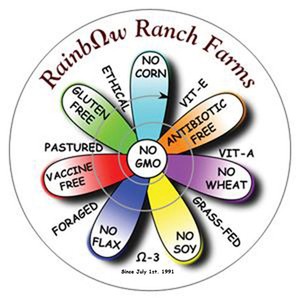
Rainbow Ranch Farms
12 Jan Wed 2011
10 Good Reasons to Grow Your Own Food
10 Good Reasons to Grow Your Own Food:
1. Great tasting, fresh, and nutritious food right outside your door.
There is no doubt about it, home grown food tastes better and is more nutritious than imported foods. In fact, the nutritional content of fruits and vegetables begins to decline the moment they are harvested. Considering the typical weeks or months it takes for much produce to get form the field to our plate, it is no wonder that both taste and nutritional content have highly declined.
2. Practice good economy.
Both economy and ecology come from the same Greek word oikos meaning “household.” When we grow some of our own food, we are beginning to bring together both the ecology and the economics of our household. Many urban dwellers find that they are able to save a substantial amount of money every year by growing some of their own food. The value of one apple tree producing bushels of fresh, organic apples year after year cannot be underestimated. Such a practice also reduces many of the “hidden” environmental costs (use of fossil fuels, water, pesticides, soil erosion) of the food that we eat. Furthermore, much of the food we import is grown by underpaid workers in difficult conditions on land that is much more needed to sustain their local populations.
3. Nurture your physical, emotional and spiritual health.
The therapeutic benefits of gardening are many. The physical activity involved in regular gardening activities contributes to general health and well-being. The pride and satisfaction that comes from harvesting one’s own produce is hard to match. Growing and consuming our own food, however, goes one step further – it connects us to the earth in a fundamental way that has been lost for most of us. Thomas Berry says that “Gardening connects us to the deepest mysteries of the universe” and many gardeners find that this is so.
4. Create beautiful, aesthetically pleasing spaces.
Gardening is a very creative activity and growing your own food is no exception. Developing a landscape with diverse food producing trees, shrubs, perennials and annuals adds tremendous colour, texture, smells and tastes to the local environment and in turn attracts many insects, birds, butterflies and other creatures. Such a beautiful landscape nourishes both the body and the soul.
5. Conserve wilderness, natural areas, and bio-diversity.
As world population and consumption increases, the pressures on our little remaining wilderness and natural areas builds. When we grow some of our own food, we help to reduce the pressure on yet uncultivated lands. This is particularly critical as the available agricultural land on the planet is finite and is degrading at a very alarming rate. Our own gardens can contribute to supporting bio-diversity both by decreasing pressure on wilderness areas and by providing additional habitat for local flora and fauna.
6. Connect with your own bio-region.
One cannot help but learn about their own ecosystem when actively gardening. Gardeners, and particularly food gardeners, are invariably more attentive to the seasons, the weather, the water cycle, and the local flora and fauna. Our gardens and we ourselves, become active participants in the bio-region in which we live.
7. Learn and preserve endangered wisdom and essential knowledge for living.
While most of us are the descendants of small farmers, there are relatively few people who now know and practice the essential human activity of growing food. With close to half of the world’s population now living in cities, it will become increasingly important for urbanites to play a role in learning and passing on this critical wisdom. From Africa to Asia to Latin America, city dwellers in the Southern hemisphere are leading the way in developing intensive urban agriculture. Many cities in North America are beginning to rise to this challenge.
8. Contribute to world food security.
Most of us depend on others, usually “far away others” for all of our food. When food production is far removed from where we live, we are vulnerable to events or circumstances that could interrupt this flow of food. The inevitable decline in the availability of fossil fuels will spell great changes for world food production and distribution in the coming years. It will be in all of our interests to invest in local food production – from our own yards, to our communities, to the farms that surround our cities.
9. Help to preserve diverse seed stocks.
The diversity of world seed stocks have been rapidly declining over the past 100 years. As more and more agriculture is controlled by transnational corporations whose primary agenda is to exert control over food production for profit, fewer and fewer strains of many fruits, vegetables, grains and legumes are now available. The development of genetically modified crops further threatens the integrity of our food supply. By planting and collecting diverse seeds, you are helping to protect our common heritage created by countless generations of small farmers over the past five thousand years. (For information on seed conservation in Canada go to Seeds of Diversity).
10. Reduce climate change.
Growing our own food is a tremendous way to reduce our impact on climate change (see The Earth Policy Institute). Most large scale, conventional farming uses tremendous inputs of fossil fuel in the form of fertilizers, pesticides and herbicides, fuel for machinery, and other indirect means. Fruits or vegetables grown thousands of kilometers away must be refrigerated and shipped from the field to our community. Much of the food (some estimates are as high as 50%) never gets eaten as it is lost due to spoilage at various stages of the production and distribution chain.
When we choose to develop a yard lush with fruit trees, shrubs, vines, and diverse annuals and perennials, we are reducing our own use of fossil fuels and are also contributing to the absorption of CO2. This very simple act can be a major step in redirecting our path towards a more sustainable future.
http://www.theurbanfarmer.ca/edible_landscaping.html
For the original article, please click the link http://www.sodahead.com/living/10-good-reasons-to-grow-your-own-food/blog-273363/
11 Jan Tue 2011
New USDA Labeling Requirements for Meat and Poultry
As in the earlier post, the new labeling laws will go into effect by Jan 1st 2012. I have posted an informative article here with the link to the Federal Register and the phone numbers for you to call for more information.
Published: Wednesday, 29 December 2010
Alerts & Outbreaks
New USDA Labeling Requirements for Meat and Poultry
WASHINGTON, Dec. 29, 2010 – The U.S. Department of Agriculture's Food Safety and Inspection Service (FSIS) today announced that it will be making important nutritional information readily available to consumers on 40 of the most popular cuts of meat and poultry products. Under a new rule, packages of ground or chopped meat and poultry will feature nutrition facts panels on their labels. Additionally, whole, raw cuts of meat and poultry will also have nutrition facts panels either on their package labels or available for consumers at the point-of-purchase.
"More and more, busy American families want nutrition information that they can quickly and easily understand," said Agriculture Secretary Tom Vilsack. "We need to do all we can to provide nutrition labels that will help consumers make informed decisions. The USDA and the Department of Health and Human Services work hard to provide the Dietary Guidelines for Americans every five years, and now consumers will have another tool to help them follow these guidelines."
The nutrition facts panels will include the number of calories and the grams of total fat and saturated fat a product contains. Additionally, any product that lists a lean percentage statement, such as "76% lean," on its label also will list its fat percentage, making it easier for consumers to understand the amounts of lean protein and fat in their purchase. The panels should provide consumers with sufficient information at the store to assess the nutrient content of the major cuts, enabling them to select meat and poultry products that fit into a healthy diet that meets their family's or their individual needs.
Examples of the major cuts of raw, single-ingredient meat and poultry products include, but are not limited to, whole or boneless chicken breasts and other pieces, or beef whole cuts such as brisket or tenderloin steak. Examples of ground or chopped meat and poultry products include, but are not limited to, hamburger and ground turkey. This rule is effective on Jan. 1, 2012. The Federal Register notice announcing this rule can be found at http://federalregister.gov/a/2010-32485..
Consumers with questions about the new labels should call the toll-free USDA Meat and Poultry Hotline at 1-888-MPHotline (1-888-674-6854). The hotline is available in English and Spanish and can be reached from l0:00 a.m. to 4:00 p.m. ET Monday through Friday.
How To Eat Healthy part 2 of 2
- Avoid processed foods. They are unnatural so are more difficult for your body to break down which means they will lie in your gut making you feel bloated and lathargic. Eat things which are not messed with such as raw fruits and vegetables, brown rice, wholewheat pasta and so on.
- Avoid diet soft-drinks and other products containing artificial sweeteners (such as light yogurt). The artificial sweeteners are much worse for you than real sugar. If you can't give them up, make the real thing a very occasional treat. Look at the ingredients list and avoid anything with aspartame.
- Seek solace in the fact that once you are used to eating fresh, healthy food you'll really begin to like it. You will stop craving cookies, chips, fries - everything that was damaging your body to begin with.
- Eat before you shop so you can focus on your grocery list without having any unnecessary cravings.
edit Warnings
- There is a vibrant debate in health circles about whether organic food is healthier. Some believe that the chemicals in conventional foods are just as safe and healthy as the expensive organic alternatives. Organic food advocates would argue the opposite. Everyone agrees that organic options have just as many calories as non-organic options. So even if it is organic, make sure you pay attention to your calorie intake.
- You should always consult your doctor before making drastic changes to your diet and your lifestyle.
- Excess body fat is hard on your body. It's hard on your heart because it needs to work extra hard to push blood through your larger body. Your body builds extra veins that run through the extra body fat and has to work harder to push blood through those veins.
- Excess body weight is also hard on your muscles and joints. Carrying around extra weight puts more pressure on your knees, hips, and back. While this might not have a huge effect in your youth, you will feel it as you get older.
- Any drastic change in your diet can cause constipation, so make sure you eat a lot of dark green leafy vegetables, and other naturally high fiber foods. Your digestive system will typically adjust after a week or two, but you should consult your doctor if it continues. (Other good sources of fiber include: flax seed, psyllium, whole grains, fruits and vegetables, and beans!-- Remember, you can always look at the nutrition facts to see the daily percentage of fiber given in different foods. For fresh, unpackaged foods, you can look up nutrition facts online; although, it usually won't ever hurt you to eat fresh, unpackaged fruits and veggies!)
- Make sure there isn't a lot of unhealthy food in your house that can tempt you. Give or throw away the foods you shouldn't eat. You can't eat what you don't buy!
- Please do not underfeed yourself. Even if you have extra body fat, do not let yourself go hungry. That is worse than being fat. Eating the right food and exercising daily is a much better way to lose weight!
- Don't ever under-eat. Going hungry or skipping meals will actually make you put on weight. Your body will think you're experiencing famine so will hoard all the fats you ingest to see you through a time of little food. This will make you feel lathargic, depressed and listless.
- Diets don't work. Don't think you can just eat well for a few months then go back to a diet of junk food and expect to stay slim and healthy for the rest of your life. You need to completely revolutionise your lifestyle. It's hard work but it's worth it.
For the original article, please click the link http://www.wikihow.com/Eat-Healthy
How to Eat Healthy Part 1 of 2
10 Jan Mon 2011
Growing Your Own Chickens For Meat
Growing Your Own Chickens For Meat
The decision to raise your own chickens for their meat is one that many more people are making. By raising your own meat you will control what your chickens eat. If you are choosing to feed your family only free range chickens, then you can insure your chickens are free range.
COST OF RAISING CHICKENS FOR MEAT: You will be surprised to learn you probably won't save much money growing your own chickens for meat unless you plan on raising a large number of chickens and filling up your freezer.
ARE ALL CHICKEN MEATS THE SAME?: Meat you raise yourself may not taste exactly like the chicken you buy at your local grocery store. Most people think the fresh meat you raise yourself actually tastes better, while other people think the taste takes some getting used to. Some people can not tell the difference between the store bought chicken and home grown chicken meat.
HOW LONG DOES IT TAKE?: How long it'll take to raise chicks to butcher depends on what type of chicks you choose to purchase. You can purchase fast growing chicks from online hatcheries which will be ready to butcher in about 15-16 weeks or so. This is a very fast turn around time. If you choose to raise a standard breed like New Hampshire's or Rhode Island Reds then it may take a little longer until they are ready to be butchered.
If you are concerned about the treatment chickens may be in commercial farms while they are being raised for meat then you may wish to raise your own chicks for meat. This isn't a decision for everyone. Butchering can be hard, especially if you form a close bond to the chickens. If you are unsure if you will be able to handle the butchering, then you can probably hire someone to do it for you.
|
Check out Katie's newest website Easy Chicken Coop Designs dot com. Tips for designing or picking out a Small Chicken Coop Plans. Please stop by and check it out! Article Source: http://EzineArticles.com/?expert=Katie_Pepper_Morgan |
Please click on the link for the original article http://ezinearticles.com/?Growing-Your-Own-Chickens-For-Meat&id=4084810
07 Jan Fri 2011
Protect Family Farms! Save Food Freedom!
Protect Family Farms! Save Food Freedom!
By Stanley Fishman, Author of Tender Grassfed Meat
The FDA has gone to war. It has marshaled all its resources, and obtained the support and help of the FBI, sheriff’s departments, attorney generals, police departments, courts, and dozens of other state agencies. Agents with drawn guns, laboratories, warrants, lawsuits, injunctions, embargoes, press releases, internet postings, armed raids, the seizure and destruction of huge amounts of property, breaking into private buildings, are just some of the methods the FDA has used in this war.
What horrible crime justifies all this vast effort and expense?
There must be a serious threat to public health, at the very least?
Is the FDA taking action against the drug companies who have killed hundreds of thousands of Americans with dangerous prescription drugs?
No.
Is the FDA closing down the Concentrated Animal Feeding Operations (CAFOs) that pollute our land and water with actual lagoons of manure and waste, that spread dangerous bacteria into the soil, that create great suffering for animals who are crowded together so tightly that they cannot even turn around?
No.
Is the FDA raiding the large industrial food facilities that cause illness and death from their profit-over-everything practices, and have been the cause of every recent food safety outbreak?
No.
The FDA is targeting single family farms that produce raw cheese.
The FDA is trying to drive them out of business, with the enthusiastic support of various state agricultural agencies.
How many people have died from raw cheese from the targeted farms?
None.
How many people have become ill from raw cheese from the targeted farms?
None.
How many people have complained about being ill from raw cheese from the targeted farms?
None.
Why has the FDA gone to war against family farms making raw cheese?
Raw Cheese Is Legal, when Properly Made and Stored
You might think it is illegal to make and sell raw cheese. It is not. The FDA’s own regulations, in place since 1949, allow the selling of raw cheese in interstate commerce. The cheese must be aged at least sixty days, which results in beneficial bacteria destroying the harmful bacteria, if the aging is done properly.
In the 61 years that have passed, there have been no deaths and very few, if any, illnesses caused by properly aged raw cheese. This excellent record makes properly aged and stored raw cheese one of the safest foods, as well as one of the most nutrient-dense. Raw cheese is widely used all over Europe, with little or no reported illness. In fact, the great legacy cheeses of Europe are all made from raw milk, and have been enjoyed safely for hundreds of years.
Tyranny at Work
When the government uses its awful, overwhelming power to crush and destroy a person or a business that has harmed no one, and broken no law, it is tyranny, plain and simple. The kind of tyranny that freedom-loving people have resisted throughout history. The United States of America is supposed to be a free country, with our fundamental rights protected from government abuse and tyranny.
The FDA is focusing on tests that show the presence of a very common bacteria called listeria monocytogenes, which is sometimes considered dangerous. However, nobody has had a reported illness traced to this bacteria for at least 38 years. FDA’s Ace in the Hole
The system is not working here. There are many examples, but I will pick three.
The Rawsome Raid
On June 30, 2010, armed agents from the FBI, the FDA, the California Department of Agriculture, and the local police department entered a warehouse owned by the Rawsome Co-op. Rawsome is a buying club that provides raw and organic foods to its members. You can see the video of agents brandishing guns in the co-op here. You would think they were looking for armed drug dealers, or terrorists, instead of people selling food. Fortunately they did not shoot anyone.
The government agencies had a warrant that allowed them to take samples of the foods contained in the warehouse. If they had simply knocked on the door, and politely gone about their business of taking samples, nobody would have resisted them. The use of large numbers of armed agents, the brandishing of guns by agents obviously ready to shoot, belongs in the old Soviet Union, not the United States.
Instead of just taking the samples authorized by the warrant, the agents seized all the raw dairy products, placing them in unrefrigerated containers. This took place during the sweltering heat of a Los Angeles summer. Some of the cheese seized had come from Morningland Dairy.
Morningland Dairy
Morningland Dairy is a family owned farm in Missouri. They have been making high quality raw cheese for thirty years. In all those thirty years, nobody has ever claimed that they got sick from this fine cheese.
More than seven weeks after the Rawsome Raid, Morningland Dairy was visited by agents of the FDA and the Missouri Milk Board. The agents embargoed all the cheese in the dairy, preventing its sale, without a hearing, without trial, without testing the cheese that was there. Morningland Dairy was informed that the California Department of Agriculture had tested Morningland cheese seized in the Rawsome raid and found it to be contaminated with listeria monocytogenes. The testing took place SEVEN WEEKS AFTER the cheese was seized and placed in unrefrigerated containers. The circumstances of the testing were not in compliance with FDA regulations, and there was no indication of whether the cheese was even refrigerated during the seven hot weeks between seizure and testing. Nevertheless, the FDA and the Missouri Milk Board demanded that all the cheese at Morningland be destroyed. The cheese was worth $250,000.
The FDA later reported that Morningland had issued a voluntary recall of its cheese, which Morningland denies. The FDA sent Morningland a letter citing the California tests and claiming that Morningland’s cheese was an “acute, life threatening danger to health.”
The Attorney General of Missouri has gone to court to try to get all the cheese at the farm destroyed. The family is currently engaged in a desperate legal battle to save their business. Their ability to earn money had been severely reduced by the embargo, and this financial pressure may result in the death of their farm.
You can find a detailed description of what was done to the family farmers at Morningland here.
And there is even more information on Morningland Dairy here.
Estrella Family Creamery
The Estrella Family Creamery is a family farm that makes some of the most delicious raw cheese in the nation. A number of their cheeses have won awards for excellence. They have been in business for many years, and their cheese has been widely distributed. Their cheese has been a very popular item at many farmer’s markets in the Seattle area. Nobody has ever claimed to have gotten sick from their cheese.
Earlier this fall, the FDA and a Washington state agency claimed that some of Estrella’s cheese was contaminated with the bacteria listeria monocytogenes. The problems centered on one cave, and the company voluntarily destroyed the affected cheese and issued a recall for several cheeses. The farm made changes that solved the contamination problem. It must be emphasized that nobody got sick from the contaminated cheese.
The government agencies demanded that ALL the cheese at the creamery be destroyed, which would be a financial disaster for the farm. The FDA demanded that the creamery recall ALL of its cheese, including the types that had never been contaminated. The creamery refused. The creamery had testing done which proved that none of their current cheese was contaminated with listeria, or anything else.
In October, three carloads of FDA agents and Federal Marshals drove onto the farm, and closed it down. The Estrellas are now prevented from selling their cheese, though they are going to court to fight for their business, at great expense.
There is more information on the Estrella Family Creamery here.
S510 Will Give the FDA Almost Unlimited Power over Agriculture
We have seen what the FDA will do to make war on small family farms now. If the FDA gets the almost unlimited power over farms that S510 will give it, the situation could be much worse, with family farmers facing up to ten years in federal prison.
The FDA Is Not Evil, But It Is Misguided
The FDA has done much good in the past, and could do so again. I used to admire the FDA, and it used to do a great job of protecting our food supply.
I think it is important to realize that the average employee of the FDA is not an evil person. The FDA is full of people who really want to protect us, who are devoted to making our food safer. People who really care about what they do. Good people, full of talent and dedication. But they have to follow the directions of their superiors, and they have been trained to believe certain things which are not accurate. It would be terrific if the FDA would stop focusing on small farms that have hurt no one and use its power and ability to take on the real threats to safety, the threats that are actually killing people, like dangerous drugs, filthy food processing facilities, tainted imported food, and factory food filled with dangerous chemicals and pathogens. They could become heroes again.
What We Can Do
First, we can contribute money to Estrella Family Creamery and Morningland Dairy, so they will not be destroyed by the shutting down of their business and can finance their fight in court.
Keep Family Dairying Alive!
Click the Pledgie Buttons for details!
Estrella Family Needs Your Help in Washington State!
Dixon Family Needs your Help in Missouri!
Second, we can contact our Senators and ask them to stop S510, or support the Tester amendment and remove the criminal penalties.
We must ask our congresspeople to stop FDA tyranny against family farms, and turn the FDA against the real threats to food safety. If they do so, we can save Morningland Dairy, and the Estrella Family Creamery, and many other good farms and dairies that have come under attack.
This post is part of Fight Back Friday and Monday Mania blog carnivals.
See more posts about how to save farms at Save Farm Freedom Friday!
1.Thanksgiving Menu, 2010 Edition « Jan's Sushi Bar posted on November 19, 2010:
[...] dairy farms selling raw milk and raw milk artisan cheeses. I encourage you to read this and this – even if you do not drink raw milk or consume pastured meats, eggs or locally grown, organic [...]
2.Farm Raids – Small Farms Need Your Support! | Agriculture Society posted on November 19, 2010:
[...] Stanley Fishman of Tender Grassfed Meat -Protect Family Farms! Save Food Freedom! [...]
Read more
« Save Our Food Freedom and Right to Privacy! Stop S510
Thanksgiving, Freedom, and S510 »
For the original article please click this link http://www.tendergrassfedmeat.com/2010/11/19/protect-family-farms-save-food-freedom/
Grow Your Own Eggs
Grow Your Own Eggs
For your own taste of the good life, keep a few chickens in your garden. You'll be surprised at how easy it is, and once you’re enjoying your own 'homegrown' fresh eggs, you'll wonder why you didn't do it sooner.
Chickens have so many benefits. There are the obvious eggs, but chickens offer so much more. Believe it or not, chickens make great pets (when I was younger, my chickens, which I'd had since they were chicks, would hop up on my shoulder, so friendly were they). They can be really social creatures, and can bring your garden to life, as they strut around, pecking and clucking.
And while they're pecking around, chickens are fantastic for the organic gardener. Your chickens will make short work of all those pesky bugs and pests in your garden. And if you go round your garden at night with a torch and pick off all the slugs, snails and caterpillars, your chickens will love you forever when they get a tasty breakfast!
And there's more good news for the organic gardener, chicken manure is fantastic for your plants. Just remember that, like horse manure, it needs to be matured first, or it will burn your plants, especially young tender ones. The best thing to do is to spread the chicken manure out over your soil, leaving it to dry, before turning it in, or add it to your compost heap.
If you have children, they will love these pets, and enjoy collecting the eggs in the morning, and helping to feed them. The whole egg laying, chick hatching experience (if you decide to do this) can also be very educational.
So, there are plenty of good reasons to keep chickens, but where will you put them? There are a few things to bear in mind when choosing a hen house **http://www.easydiychickencoop.com**. First, how many chickens do you want? For a family of four, five or six hens should be enough to keep you well supplied: if there's just the two of you, 3 or 4 may do. There's no need to have a cockerel unless you plan to breed from your hens, and if you have close neighbors, they may not appreciate his crowing at 4am in the summer!
Each chicken should have about a square foot of space for roosting, so just multiply that by the number of chickens you want to work out what size of house to go for. The chicken house should be neither too small (which will lead to an increase in diseases) nor too large (which could lead to the birds, particularly small ones such as bantams, getting too cold).
The hen house should also be well-ventilated. Not only does it make the chicken coop more pleasant for the birds, but also a lack of ventilation and high humidity can lead to respiratory diseases.
Check out the size of the nesting boxes, too. Each bird needs to be able to stand up to lay her eggs, and have room to run around. It’s also best to have fewer, bigger boxes, rather than lots of smaller ones.
The style of house will depend on your personal taste and the size of your garden. You may want a house that can be moved around, so that the ground underneath can recover, or be planning to leave the house on spot. Depending on how secure your garden is, you can allow your chickens free range, or have a run or attached compound for them to scratch around in.
Remember that bigger birds will need something more than a triangular run, as they can really only stand up properly along its highest central part. If you have any concerns about foxes, make sure your house is very secure and you may want to place it within a secure compound. Obviously, if your chickens are kept on an allotment, security will be a particular issue.
If you're planning on keeping chickens for a good long while, it's worth investing in a good-quality shed for them. Plywood may be cheap, and is light, but it won't last for long. Featheredge wood looks nice but can warp easily and can be pulled off by badgers! Shiplap or tongue and grooves are good options to go for.
Remember that the hen house will need cleaning, so a good-sized door to allow you access to do this is vital.
And if you're opting for a second-hand house, be sure to treat well to kill any red mite before you use it.
Talking of which, one thing all chicken keepers will tell you to steer clear of is roofing felt, which is just like heaven on earth for red mites!
So, with your hen house, run, and chickens you're all set to enjoy your very first, home-grown, fresh eggs. With their deep yellow yolks and full flavour, once you've collected, cooked and eaten a really fresh egg all within the hour, you'll never resort to supermarket eggs again!
For the original article, please click on the link
http://www.easydiychickencoop.com/Your-Own-Eggs.php
06 Jan Thu 2011
Swanson Health Center
NATURAL PET FOOD NEEDS
PET FOOD NEEDS
Local Harvest features many wonderful products made by small family farms, to host the delicate needs for your pets.
Here is the link http://www.localharvest.org/store/pets.jsp
It is convenient for some of us to make our pet foods, for others it may be time consuming and require special attention.I found that the prices offered by the farms and producers are reasonable here on local harvest and from the product descriptions, they seem to be of high quality and beneficial. Happy shopping!
What’s Different about Heritage Breeds?
What’s Different about Heritage Breeds?
The American Livestock Breeds Conservancy states that heritage chicken breeds must be an American Poultry Association (APA) standard breed. The chickens also must be allowed to mate naturally, lead a long, productive outdoor life, and maintain a slow growth rate. It takes heritage chicken breeds at least 16 weeks to reach market weight.
http://www.motherearthnews.com/blogs/blog.aspx?blogid=1508&tag=chicken Original LINK
03 Jan Mon 2011
DIY – Grow your own fish for food at home
DIY – Grow your own fish for food at home
by Marshall Brain |
Looking for something to do with that extra space in your basement, garage or backyard? Aquaculture is one option. You raise fist to eat in tanks. Here’s a small tank in the basement:
For videos, articles, how to instructions and for the original post, please click the link
http://blogs.howstuffworks.com/2008/06/30/diy-grow-your-own-fish-for-food-at-home/
Catfish and tilapia: Healthy or harmful?
§Catfish and tilapia: Healthy or harmful?
By Jennifer Nelson, M.S., R.D. and Katherine Zeratsky, R.D.
There's an interesting discussion in this month's "Journal of the American Dietetic Association." What it boils down to is this: Is the fatty acid mix in catfish and tilapia healthy or harmful? The debate has even reached the popular press. Why all the fuss?
First off, since 2000, catfish and tilapia rank as two of the most popular fish consumed in the United States thanks mainly to their taste and relatively low expense. And both contain heart-healthy omega-3 fatty acids.
Consumption of these types of fatty acids is thought to be associated with reduction in blood pressure and reduced risk for certain cancers, inflammatory conditions such as rheumatoid arthritis, and even mental decline.
You may not have heard so much about a second ingredient they contain, omega-6 fatty acids. Like omega-3s, these are polyunsaturated and help lower blood cholesterol levels, however they are thought to play a role in clotting function, are inflammatory and susceptible to oxidation — thereby possibly increasing risk for blood clots, arthritis, inflammatory bowel disease and cancers.
The National Institutes of Health funded study by Weaver and colleagues looked at the favorable omega-3 fatty acid content and unfavorable omega-6 contents of commonly eaten fish and found that while catfish and tilapia contain both, they contain a high amount of unfavorable omega-6 fat.
They report that a 3-ounce portion of catfish or tilapia contains 67 and 134 milligrams respectively of the bad fat (the same amount of 80 percent lean hamburger contains 34 milligrams, and bacon 191 milligrams).
Does this mean you should give them up? No! The rebuttal by Harris is in the same journal. He says the logic of judging fatty fish by the amounts of omega-3 and omega-6 fat contents is flawed. Governmental and professional organizations haven't used such a ratio for years.
He also says that to think that eating catfish or tilapia — because of its high omega-6 content — is more risky in terms of heart disease than eating bacon or hamburger is "flawed."
My take? I'm going to continue to eat fish — at least twice weekly. I'm going to choose a variety of fatty fish — including tilapia and catfish along with others especially high in the good fats such as salmon, tuna and mackerel.
P.S. When you see this on the evening news you can say that you got the scoop here.
http://www.mayoclinic.com/health/tilapia/MY00167/rss=10 Original Article
02 Jan Sun 2011
Organic Weight Loss-Lose Those Extra Pounds
Organic Weight Loss - Eating Organic Foods Can Help You Lose Those Extra Pounds
Right now, it seems like everyone is looking for the secret to weight loss. There are tons of diet pills to choose from at the mall, and the latest quick fix diets are heavily publicized. The truth is, there’s no healthy miracle diet that will help you take off 20 pounds overnight, but there are things that can give you that extra boost to finally take the weight off once and for all. One great “extra boost” is organic food. These are foods grown without hormones, preservatives, pesticides, or other harmful chemicals. They are designed to grow naturally in the environment and work within the human body who eats them. Eating healthy with organics can help you finally take off those excess pounds naturally.
When the nutrients in an organic fruit or vegetable are compared to their traditional counterparts, they’ve been found to have significantly more beneficial substances. In some cases, there are as many as three times the amount of certain beneficial nutrients found in organic foods. In one study, organic oranges were half the size of the traditionally grown oranges and still had more vital nutrients. Eating appropriate amounts of organic fruits and vegetables can even replace your multivitamin, by giving you every essential nutrient you need. When foods are not genetically and chemically altered, they are nature’s finest.
If you doubt that organics are healthier for you, consider the fact that the artificial chemicals used in many foods are relatively new and have only been consumed for a small fraction of the time humans have been around. Our bodies are not designed to process these artificial chemicals. Hormones, preservatives, and pesticides can not be processed by the liver and therefore place excess stress upon the organ. The end result is a build up or artificial products in the fat stores of your body and this has been linked to storing even more fat. If you’re concerned about removing these chemicals from your system sooner rather than later, you can go on a juice fast just prior to starting an organic diet, but this should be supervised by a nutritionist or medical professional.
We’ve mentioned that natural nutrients and a lack of harmful chemicals helps your body function more efficiently, but you’re probably wondering how this helps you to finally lose weight. First of all, when you eat natural organic foods your body is able to digest them quickly and efficiently. When it does not have to deal with extra chemicals, your metabolism increases (which is essential to weight loss), and you are also able to gain the full energy potential of your food. This means you’ll be less fatigued and ready to get up and move. You’ll have the extra energy you need to exercise and burn off even more calories. Studies have also found that laboratory rats who consume organics sleep better. That means you’ll be even more rested and ready to conquer the day, and perhaps even a morning walk or jog.
Another advantage to your body working properly is that you’ll be less likely to get sick. Eating organic helps provide your system with the proper nutrients to stay healthy as well as providing your body more energy to fight off infection. You’ll also be motivated to keep up with your organic diet when you realize how healthy you feel.
While switching to an organic diet is a great way to lose weight, do remember to eat the right organic foods. Try to eat fresh, unprocessed foods that contain a lot of fiber, lots of fruits and vegetables are the perfect choice along with small amounts of protein and carbohydrates. This will help you lose even more weight and most importantly help you feel great.
Your Secret Weapon for a Healthy Eating Lifestyle
Would you like us to come up with most of your grocery list? Join the Healthy Menu Mailer today. We will send you 7 healthy dinner recipes a week with a grocery list to go along with it. We make healthy meal planning simple.
For the original article or for more information, please click this link http://www.healthymenumailer.com/articles/organic-weight-loss.html
The Links Between Diet and Behaviour
http://www.foodforthebrain.org/content.asp?id_Content=1767
The Links Between Diet and Behaviour
The influence of nutrition on mental health
Government advisors recommend ‘food for the brain’ campaign
A significant contributor to the increasing rate of crime, aggression, depression and poor school performance is poor nutrition. That’s the conclusion of the inquiry held by the Parliamentary Food and Health Forum, who issue a report urging for government to fund a campaign to research, increase awareness, and encourage us to eat more fish and whole foods, high in essential fats, vitamins and minerals.
The Parliamentary Food and Health Forum want more money spent on researching the link between diet, nutritional supplements and mental health; doctors to be better educated; mental health patients to be checked for nutritional deficiencies as a first line procedure on the NHS; and government funded healthy breakfast clubs at schools; government campaigns promoting the importance of optimum nutrition for mental health.
Patrick Holford, director of the educational charity, Food for the Brain says: “Less than half a percent of all money for medical research is spent on nutrition largely because there are no patented, profitable drugs at the end of it. Most doctors today have virtually no training in this area and simply don’t know that improving diet and supplementing specific nutrients often works as well, if not better than drugs for treating depression and mental illness. We welcome this report, which fairly and squarely recommends that government should put more money where our mouths are."
“We desperately need funding to follow through on extremely promising preliminary studies that suggest that optimum nutrition can improve behaviour, academic performance and reverse symptoms of depression and even schizophrenia”. The Food for the Brain website, www.foodforthebrain.org, provides free on-line advice for those with mental health concerns.
“Our results are extremely encouraging.” says Mary-Ann Munford, former NHS Primary Care Trust CEO, now director of the charity’s outpatient clinic, the Brain Bio Centre in London, which is pioneering nutrition-based treatments for ADHD, depression, schizophrenia and dementia. “I’m convinced that an optimum nutrition approach is a vital, and often ignored, piece of the equation for reversing most of the prevalent mental health disorders GPs see on a daily basis.”
Recent research has reported:
• Children with learning and behaviour problems improve focus, concentration and school grades when given essential fat supplements; and IQ scores when given multivitamins.
• Eating breakfast and a low glycaemic load (GL) diet, low in sugar, improves behaviour and concentration.
• Supplementing essential fats improves depression.
• Supplementing B vitamins improves depression and symptoms of schizophrenia, and stops or slows down memory decline in older people.
“Optimum nutrition is a forgotten factor in mental health today” says Professor David Smith, chair of the Scientific Advisory Board of the Food for the Brain Foundation and Emeritus Professor at Oxford University.
“The Associate Parliamentary Food and Health Forum” launched this report on 30 January 2008 following a year long inquiry into the links between diet, mental health and behaviour.
Food and Health Forum, click here The Links Between Diet and Behaviour.
More detailed information about the inquiry, including minutes of all the meetings and presentations given by witnesses, is available on the Forum’s website at: www.fhf.org.uk/inquiry.”
Heritage Chicken Breeds’ Various Values
Heritage Chicken Breeds’ Various Values
Monday, September 20, 2010 11:00 AM
By Abbie Stutzer
Tags: heritage breeds, chicken, raising chickens
Yum, yum … and more yum. The wonderful aroma and succulent taste of grilled, fried, baked (the list goes on) chicken. Although almost no one can resist fresh fried chicken, some diners might think twice before placing that standard pack of chicken in their shopping basket at the grocery store.
A discerning buyer may think:
“Where did this chicken come from?”
“Is this chicken free-range?”
“What’s the real nutritional value of this chicken?”
“I wonder if this chicken was raised locally …”
If only these concerned consumers knew they could purchase (or raise) a chicken that had noteworthy nutritional value. The nutritious chicken breeds I’m referring to are heritage breeds. Meat from heritage chicken breeds is nutrient rich and has myriad other natural benefits.
With a bit of research, reading and planning, conscientious chicken connoisseurs can easily purchase fresh heritage chicken meat, or raise heritage chicken breeds in their own backyards.
By Abbie Stutzer