
15 Aug Mon 2011
The End-of-Summer Rush
Hello again, blog! It's so easy to neglect you this time of year...
August is rolling by mighty quickly, it's hard to believe we're already halfway through! It has been a typically busy late summer so far, and it's set to get even more hectic. The end of summer is always exciting in Tionesta, as it brings the Indian Festival, our community's week-long celebration. That started on Saturday and will run through this coming weekend. The following weekend will also bring lots of visitors, as it's Rumble on the River, a motorcycle rally that takes place at Wolfe's Corners fairground, only 2 1/2 miles from the farm. We are sure to have busy weekends because of this, both with increased traffic at the farm stand and also because friends & neighbors will be gathering to share food and fun.
But in order to have a little free time on the weekends, that means I need to stay extra busy during the week! It seems the canner goes nonstop through the week, usually except for one day which I use to run errands like going to the feed store or picking up more canning jars to hold all the garden goodness! Last week alone, I made cases of Carrot Cake Jam, Emily's Own Dill Pickles, Pickled Beets, Sweet Garden Relish and added my medium-spicy Fiesta Salsa to the product lineup down at the stand. Today I'm packaging sun dried tomatoes to offer this coming weekend, plus this week I'm sure I'll be doing some of the previously mentioned products, plus Hot Pepper Rings and Bruschetta in a Jar, possibly Dilly Beans, and whatever else I can come up with to preserve what is in the fridge right now. I have a new batch of Mulled Blackberry Vinegar that is ready for bottling, and I need to check on my first-ever batch of Malt Vinegar as well. I'm also busy freezing things like chard and zucchini for my own personal use over the winter. And of course weeding, drying herbs,mowing the yard, working in the garden and taking care of the livestock & poultry. And did I mention I'm experimenting with some artistic projects that I hope to have on sale soon, possibly even this weekend? (More details to come on that when I actually complete them!) So it's crazily busy here right now!
We're also butchering. It's nice to have a break from doing chickens right now, but I can't believe how demand has gone up since just last year- I can't keep them in stock, which is a great problem to have! We'll be doing pork again the next couple of weeks, with sausage this week and the return of chops and roasts next, with ham & bacon returning the week after once the curing process is complete.
So even though that is more than enough to keep us busy, I'm also excited to be adding a new crop to our farm. I place my order with Seed Saver's Exchange this morning for a quantity of garlic, something I have not grown before (but Dan has). It will ship the middle of next month. We'll plant it then and look forward to offering garlic scapes early next spring and garlic next summer. I'm always excited to offer new things, and garlic has been something we've had requests for from our customers.
Well, I best get back to the canner...stop by and see us if you're visiting Tionesta over these busy, fun weekends!
29 Jul Fri 2011
Rain, Finally!
Another crazily busy week here on the farm, but that is just July for you! We were so happy that the oppressive, 100+ degrees temperatures broke, but most days we're still seeing upper 80's and into the 90's, so with the humidity it sure feels like summer anyway. But I can't complain, because finally we got some summer rains!! The ground was so dry here that the creek through the pastures dried up and the garden soil on the unirrigated parts was about bone dry as well. Between the heat and the dry creek, we've spent much more time than usual hauling water to the livestock- up to 5 times per day in the worst of the heat, up from our usual schedule of 2x per day (morning and evening). The tomatoes and peppers have been doing great with the drip irrigation under them, but we were starting to worry that we'd lose the entire sweet corn crop if we didn't get some rain. Fortunately, we got a plentiful amount, and over a few days, not all at once in a single, severe storm. Dan swears the corn stalks grew a foot one day while he was away at work as a result of the rain. The creek is even showing feeble signs of life again!
But hauling water isn't the only thing that's kept me busy. I love to find great canning recipes to use up the garden bounty, and the canner has been getting a workout lately. I've got dilly beans (green beans pickled with dill), hot pepper rings, pickled beets, and my popular dill pickles, made with my own secret recipe. Those have all been great things to make, and I've enjoyed doing that over the last few years, but I also love to see what else I can find to make- every cook gets bored with the same old things day after day! So this week, I made something I'm calling "Sweet Garden Relish". It's like a sweet pickle relish, but instead of using cucumbers (the heat has not been kind to them) it uses zucchini, onion and bell pepper. A combo that really works for what the garden is producing right now, and it tastes amazing! I admit, as I was finishing canning it and tasting the final product, I started craving a hot dog or burger from the grill, anything on which I could pile this relish!
Meats have been keeping us busy, too. I got to visit my friends from Hirsch's today as I picked up a whole carload of ground beef. After reading my post about saying goodbye to Buzz, you might imagine that it was an awful trip, but it wasn't. It was hard to say goodbye, but there is almost instant closure to it, at least for me. I'm not going to cry about it anymore, or refuse to sell, handle or eat that meat- I respect my animals by treating them with kindness and dignity while they are alive, and not wasting the food they provide later. If I had trouble moving on like that, I doubt I could farm the way we do.
We also have been busy processing chickens. Although it's still just Dan and I, hand plucking and processing, we're trying to up our output a little bit, as we have the wonderful problem of selling out of chicken every week we offer it. We've talked about making a nice processing pavilion, one that would streamline the process a bit, and we've gotten that underway. If you have wondered what the new building with the green roof is behind the greenhouse, now you know! We do have some siding up now, which was so nice in this heat to be out of the direct sun. The gravel floor is down, and now the next step will be to pour cement. We'll also be running some lines for a sink and the cooling tubs soon. It's already much nicer that before, and I can't wait to get it all done. I've been trying to take pictures of the construction process, so hopefully soon I can post a whole start-to-finish slideshow of that project.
I also took a rare day away from the farm this week to attend a field day put on by PASA, the PA Association for Sustainable Agriculture, along with WAgN, the Penn State Women's Agriculture Network. (I know, it's a mouthful!) The even was in nearby Brookville at Quiet Creek Herb Farm and focused on Chantrelles and exotic PA mushrooms. I learned a lot and was really happy to attend, the folks there were amazingly knowledgeable. The workshop was a fun mix of mushroom hunting for personal fun and use (which Dan & I started just last year), cooking with mushrooms (and an amazing lunch!) and a bit on growing & selling mushrooms to the public. It's something we may like to try in the future, we are always looking to keep up and expand the diversity of our farm stand offerings.
So, it's been more than enough to keep us busy, but we don't expect any less from the summer months!
20 Jul Wed 2011
What Do I Want?
Lately, I've been thinking a lot of big-picture thoughts about the farm. The kind of things that are important, but often get lost in the shuffle of day-to-day duties. But it's important to stand back and take a look at the overall picture some days and not just get lost in the details. What do I want to accomplish with this farm? What will it take to be a success? In 10 years, what would you like to see change? What should remain the same?
These kinds of thoughts have been swirling about in my head for a month or so, for a variety of reasons. My birthday is in June, and I do tend to get a little reflective as another year is marked. The transition from June to July marked my one-year anniversary of being home on the farm, not working 25 miles away. Our wedding anniversary is this week, and marrying Dan was a beautiful ceremony here at the farm. In retrospect, it showed a commitment to this place I didn't even realize I was making at the time. Also during this time, I had to decide whether or not to continue a business relationship which sold our meats for us to the customers of a small CSA. All of this added up to some thoughts about where I am and where I want to be.
Dan's biggest fear when I lost my job was that I would be unfulfilled here. I have a master's degree, I was teaching classes, helping people, part of civic organizations committed to changing the county I was working in for the better. Important stuff, events that made the local paper, sometimes even the front page. But, unsurprisingly for social work, I was getting burned out. I was in a rather dead-end job with no hope of further advancement, and I was ready for new challenges. I hated leaving every day because I just wanted to be here. On the farm, hands in the dirt. Or here on this blog, helping to educate others about what it's really like to grow your food. Why what you eat matters. In that way, I very much feel like I'm still teaching.
What I love most about the farm is that we make an honest living producing healthy food for our neighbors. It's not fancy or glamorous, but it's real. And important. I like being a direct link between food and consumer. I love talking to our customers and friends about how things are growing, about why our food is different from what's in the store. One of the greatest concerns with the CSA was not knowing how we were being represented, and having no direct link to the consumers. All questions and problems were filtered through a third-party middleman. The more I thought about this, the more deeply I was uncomfortable with it. There were other issues too, and in the end, I felt it best to decline their business. It felt like the right thing to do. So I know I want to stay in touch with our customers- I like answering questions, both in person and online via email. And I'm committed to staying hands-on. It's hard to answer how things are really growing if your fields are full of employees while you're inside. It can be overwhelming to be the veggie picker, the chicken plucker, sausage seasoner, website editor/blogger/email contact, in charge of advertising, labeling, ordering, record keeping, tester of new recipes, food processor. Maybe it just means I'm a control freak. But I think of it differently- many years ago, when small farms were the norm instead of the anomaly, the family did everything, or nearly so, without hiring a specialist for each task- each family member was expected to wear many hats. I'm fine with that.
One of the main things I want to do is preserve what is here. While that sounds straightforward, it's really pretty complex. Those of you who read my blog regularly know that I am passionate about preserving heirloom plants and heritage livestock. Keeping the old bloodlines, designed for family farms instead of mass production, alive for this generation and for the future. We make more steps toward that each year. But there is more than just the gardens and the livestock. Our barn was built in 1894. The house (the “new house” to the elderly gentleman who used to live here years ago) was built in 1929. The workshop is older yet then either of those. I want to preserve these too. There are plenty of barns in the area, built around the same time, that are falling down. I want to preserve these treasured old buildings, but at the same time I want them to be functional. I'm not trying to live in Colonial Williamsburg or anything. I want to respect the history, but I don't think we need to forsake metal roofing in favor of the wooden shake shingles that would have originally been used, for instance, as long as the overall character of the place remains intact. I'll keep the wood burning stove in the house for heat, but replacing the original windows with energy efficient ones does not greatly change the character of our home, but does add greatly to my comfort in the winter, plus it keeps out the ladybugs. I'm OK with modern materials with trade-offs like that. I also want to make it pretty here. I know that the farms with show-stopping landscapes generally have, well, hired landscapers, but there is already much I've done in a few short years. Perennial flowers, a little at a time. Painting the porch posts to bring out the carved beauty. Peacocks strutting in plain view. Keeping up on some of the pruning. Little things that make it our own.
But possibly the most important thing I want to preserve is the idea of the hands-on, horse powered, family farm. The kind without employees, that relies instead on the family members, and sometimes the extended family, to get things done. One that has an intimate knowledge of the land, because they have cared for it personally for generations, walking behind the plow and weeding by hand- the kind of knowledge of a place that does not have its roots in diesel engines and herbicides. Like the seed banks that preserve various strains of plants against future calamity, we need small family farms to safeguard the knowledge of how to do things without gasoline and chemicals. To produce for our neighborhoods instead of the commodity markets. I didn't realize how important these kind of things were until I started reading Wendell Berry's essays. But in doing so, I feel like we're part of a solution to some of the problems of industrial agriculture.
So in the end, if I can be a part of keeping these ideas and buildings and animals alive, I will be a success. There are other, more tangible things I want too, of course. Number one to stay here on the farm. We'd love to get to the point where Dan can be here full time, too. I had such a great experience at the Farm to Table conference, I hope to be able to do more speaking out to the public about farms and real food. I think that too, will come with time. And I want to continue to grow, leaning new skills. I don't for a second feel I'm in a dead end job anymore. Each day is what I make of it, and I can choose to expand what I do and what I know at any time, or to step back and take a break if I need one. I can choose to focus on learning to operate more of the machines, to make more and different processed goods, more about herbs, more about our farm's history, more about new crops or new animals. In that way, the future is nearly limitless.
11 Jul Mon 2011
I'll Miss Him
I'm having a rough day today. It's 90+ degrees out, which is just too hot for me...I'll find stuff to do indoors rather than be out in it, but it's hard not to feel like I should be out in the garden or mowing the lawn or doing something outside. But the main reason for my melancholy is not the blistering sun. I know that the trailer will be here tonight to take a cow for processing. And this time, it makes me very, very sad.
I've gotten used to the idea of sending animals to be processed and I don't really get bothered by it anymore. I know that the life we provide for these creatures is a good one, and light years away from the conditions found on feedlots & factory farms. I take pride in being able to offer my customers meat raised without cruelty or inhumane conditions- meat from healthy animals, leading a natural life in the sun and grass. I'm proud of what we do and how we do it, and I know the purpose of the animals when they come to the farm. I don't pretend I'm getting a pet cow, even if I do name them and feed them. I monitor the inventory and make the arrangements with our processors. The process is one I'm totally involved with from start to finish.
So why is it so hard this time? We got a little calf, just days old, two years ago. We fed him bottles and watched him grow. We called him Baby Buzz. He would gleefully run up to people, and like all bottle baby cows, you had to watch that he wouldn't headbutt you trying to get you to feed him. As he grew, he went from the small paddock into the fields with the other cows. As he grew and the heard changed, he went from being the smallest cow to the tallest. Buzz appointed himself the leader of the herd. The girls follow him around, the babies play with him. When Lil went into the barn, Buzz called for her more than Lil's calf from the previous year did- Buzz wanted to know where his herdmate went. And he's still a friendly beast, always sneaking up on you to see if any snacks are to be found. Besides Finni, he is the most sociable cow here. I've been telling Dan that he would make a great ox, because I hate to see him go so badly. But that's just not in the cards. So tonight, the trailer comes, I don't think I'll be there. While I'll help get Buzz into the barn this afternoon, I think, for the first time ever, I'm going to stay out of the barn when they load him up. This time, it's just a little too hard. Dan tries to cheer me up by reminding me that we saved Buzz from his likely fate- veal- and extended his life very considerably. And I know he's had a good one, and that I need more burger for the stand, but...
Some animals are just special for some reason or another. Some have the ability to capture your heart, and it's hard when they go. I'll sure miss this face.
27 Jun Mon 2011
All Natural
Another busy week here on the farm! Last week was full of excitement. As I began the early Saturday garden rounds, I heard a soft noise coming from the turkey nest by the old greenhouse. I knew that the Royal Palm hen had been sitting on a few eggs, but since she was nestled on top of some of the wire onion drying racks and not a hard surface, I wasn't holding out much hope that she'd actually hatch anything. However, this was the last nest standing, because we've had some trouble with raccoons and such lately, having lost a couple of hens and the eggs in the turkey nests were raided as well. But as I was getting ready to cut lettuce for sale at the stand, I saw that there was a fuzzy poult with the Palm hen. She ended up hatching 2 of the 3 eggs she was sitting on! While turkeys would normally sit on a larger clutch than that, because of the location, I took most of the eggs and put them in the incubator.
I was somewhat conflicted this spring, because I wanted to have lots of turkey poults, both to sell and to raise for our own Thanksgiving offerings, but I also wanted to see if the hens have enough mothering instinct to actually rear their own young. With poultry, eggs are taken away to incubators, and breeding stock is selected for characteristics such as egg production, weight gain, feather coloration, etc. Mothering instinct is actually selected against in many cases, because if the hen defends her nest from humans, then it's harder to collect the eggs to sell for consumption. Most chickens lay an egg, but never think to do anything further than that. This is not as true with the heritage breeds, as we have seen Phoenix and Cochin hens successfully hatch chicks, which is just the first step. We had a Pekin duck hatch out a few ducklings this spring too. While that was exciting, she just kept on at her normal pace, wandering all around the farm with the drakes, and in a few days the ducklings were gone. She just didn't call to them and keep them close and warm, and when left to sort of fend for themselves it was not a success. But our turkey is doing very well. It's been 10 days now, and both poults are growing and thriving. She stays mostly in the backyard, away from the other birds, and calls to the little ones to keep them close as they forage around. At night or during a rain shower, she hunkers down and collects them between her wing and body, keeping them warm and dry. To me, it's amazing to watch. She was just a poult herself last spring, one raised in a brooder pen with a heat lamp instead of a mother. She has never seen this modeled by other birds, yet she knows.
Just a day after Father's Day, Pixie's father returned to the farm as well. The Muirs of Muirstead farm were willing to lend us one of their bulls, Finnbar, again this year. This is another instance where we do things the all natural way. Many farms that breed cattle never have a bull set foot on the premises, instead relying on Artificial Insemination to produce calves. The advantages to using AI are that you don't have to deal with a bull, and they can be very dangerous to work around. You can also breed your cow to the best bull, basing your decision on any quality you are looking for- milk production, breed show champion, weigh gain for beef, etc. And doing it this way means one bull can produce many, many more calves than he would be able to otherwise. As long as the semen is properly stored, it can last for years so you can even breed to a bull that's dead! The downside to this is that everyone wants to breed to the best, and by doing so the breed as a whole can tend to become very inbred. The Holstein cow is the worst example of this, as 2 bulls born in the 1960's actually make up 30% of the genetics found in the breed today. When that happens, it means that if that bloodline is particularly sensitive to a new parasite or disease, it could go a long way towards wiping out the breed. Inbreeding can also have a lot of other nasty side effects, like genetic deformities, low reproductive rates and shorter lifespans.
Beef cattle to some extent rely less on AI. Heritage breeds are also more likely to use the tried and true method of turning the bull out to pasture with the cows and letting nature take its course. We were thrilled to have Finnbar come again, not only is Pixie a beautiful baby, but he was a pleasure to have around. The biggest concern last year was that a bull would be nasty, and that we would have to be watching over our shoulder as we went about our routines in the barnyard. This was not the case at all! Finnbar isn't aggressive, and while I always keep my eye on the livestock, I don't feel the need to take any more precautions around him than I do the other males, like Rambo the sheep. And it seems Finnbar had a good time here last year as well. As the trailer was backing up, he had his head up and ears forward in anticipation of getting out. When the door was opened, he calmly stepped off and began heading out to the herd. Our Finni was just coming out of heat, so he was a bit more interested in her, but it just amazed me how calm everyone was- no chasing or headbutting, just some sniffing and then back to grazing. He settled in almost instantly. So he will be with us for a couple of summer months before returning to his farm, and we will anxiously await more lovely Dexter babies in the spring!
What a good looking bull!
20 Jun Mon 2011
Spreading The Word
I've always been an avid reader. Dan is too, an so we subscribe to a number of magazines. The latest National Geographic came in the mail on Saturday. I love reading about the exotic places, cultures and animals inside, but in this issue, one of the stories was very close to home. On the cover, I spotted "How Heirloom Seeds Can Feed The World". The actual article is entitled "Food Ark". It begins by discussing Seed Saver's Exchange in Iowa, where we buy many of our garden seeds. The two-page photo spread feature of uncommon chickens featured a dozen breeds of chickens, and out of the hundreds that could have been used, two featured (Orpingtons & Phoenixes) have been hatched in our incubator here at the farm. The selection of potatoes, showcasing unusually colored and shaped tubers, included the blue that I enjoy growing. Of course I read that article first, and found that it introduced quite a few concepts that are familiar to me but not for many Americans: heirloom seeds and heritage livestock breeds, and the fact that they are in real danger of extinction; why reliance on a few high-yield varieties is dangerous; and that knowledge of traditional farming techniques is also slipping away as farming, like everything else, becomes increasingly mechanized. While mud huts in Ethiopia are much more in line with the expectations of this publication, much of what they said could have easily been written here too. Although I know I lead a far from mainstream life, I never really though of it as exotic enough for National Geographic!
Of course, I knew all about he concepts they were introducing, and to do more than touch on each of them was beyond the scope of the article. But I was really excited to see it because it reaches out to such a wide scope of people. Plenty of information is out there, but if you're not keeping up on agricultural or food-centric publications and websites, this might be totally new to you. An article in National Geographic certainly reaches beyond those niches. Hopefully, it will get even just a few more folks to really question where their food comes from, how it is grown, and maybe even inspire them to stop by a farm sometime.
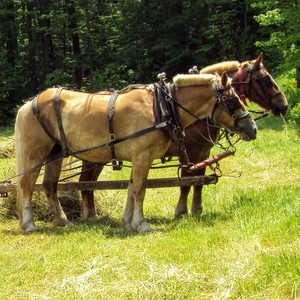
It was also neat to see something I do featured so prominently in a national publication. Not only are we dedicated to growing, selling, eating and preserving heirloom seeds and heritage breeds, we're doing our best to conserve farming knowledge, too. Using the horses in the fields isn't some sort of gimmick, it something we truly believe in doing. To many, it seems like the hard way, and it does take more time to do many tasks, as horses need to rest, unlike a diesel engine. But to be on one of the horse drawn pieces of equipment, and many of them are antiques, with the lines in your hand, and the horses moving on your command is something powerful, something amazing. I know it's sustainable. I know it's healthy for the farm, the environment, the food and the eaters of that food. And in a very real way, I feel like I'm touching history. And by touching it, I'm keeping it alive, bringing it forward through time to share with my customers, and here online with the world. That is something really large, and surprisingly easy to lose when you're so focused on the day-to-day tasks at hand.
14 Jun Tue 2011
Tour Time!
If you live on a small farm, it's pretty much guaranteed that you'll be asked to do tours from time to time. People don't have personal connections to how their food is grown anymore, and lots of people don't have connections to animals either, not even pets. So it's no wonder that a farm like ours is a source of interest. In my previous life I was in adult education, and I do think it's important to give people of all ages the opportunity to learn new things, and as farmers I believe we have a duty to engage those interested in learning more if we want to succeed both as businesses and as advocates for knowing and supporting where your food comes from. It's really impossible to tell people that they need to take personal responsibility for knowing what they are putting into their bodies, but not allow anyone to ever look around our own farms. That being said (and as I talked about in my last entry) my farm is also my home, and I'm not going to indulge everyone who just shows up and wants to walk around, I couldn't or I wouldn't get my farming done! I am however, willing to coordinate with groups, especially for educational purposes, as long as we can get it set up far enough ahead of time.
So yesterday, I was excited to host a group of youth from Clarion University's Educational Talent Search program. This is a program open to kids in grades 7-12, as a way to tour different places and give them some new perspectives on what careers are out there, perhaps introducing the kids to something they never thought of as a viable occupation before. I had talked with their advisor and had set up that they would arrive in the morning, we would tour the barn and the animals, they would go to nearby Tionesta Lake for their bagged lunch (call me selfish, but I just wasn't willing to have 20-30 kids tromping through my house to use the single bathroom, so that was a nice alternative!) and when they returned we would take a look at the garden, talk a bit about the plants, they would plant a seed to take home, and we would have time for a question and answer session about anything they had seen before the bus pulled away. The weather was perfect, not too hot, and sunny, and everything else went almost flawlessly. Almost, in that the horses refused to come into the barn in the morning before the kids arrived, except Sara. So I was able to let the kids pet her before turning her back out with the other (misbehaving) equines. The cows were almost too friendly, sneaking into the open barn while we looked at the pigs, but the kids got to see them up close as well. Even the rabbits seemed charmed by the kids, and Scotchie patiently ate blades of grass out of as many hands as cared to feed her. The boys in particular seemed to enjoy looking at the horse drawn equipment. The kids were great listeners and stayed together as a group, heeding my requests to watch where they stepped in the garden. The kids all had the option of planting something to take home with them; basil, sage, chive or Swiss Chard, and I had enough that everyone was able to plant their first choice. As we got to the Q & A, I got some thoughtful questions, like "how do you water your garden?" and "Do deer eat your plants?" to some unexpected ones- "Are there any palomino colored cows besides Guernseys?" or "Do you trim the turkeys' beards?" We talked a bit about the different careers a small farm like this encompasses- from horticulture to animal husbandry, to being an entrepreneur or a butcher or advertising & web design.
We probably would have come up with many more, but some of the kids noticed that the big horses had come out of the far reaches of the pasture and were under the trees by the barn. I was able to put all the horses in their stalls, so we ended the day by seeing all the horses up close, and all were gracious about letting many hands pet them, even Ponyboy, who can be quite skittish (even with Dan and I) at times. The most popular question by far was whether it was possible to ride our impressively large Belgians, which I assured the kids we were able to do. At that point, it was time to board the bus for the return trip, each youth armed with a planted seed and instructions for its care and use, as well as a paper listing resources for finding our more about farms and food. I sincerely hope that the little seeds in the paper cups grow for each and every one who was here, and I also hope, even in a small way, I was able to plant some seeds in their mind, whether it is just to look for small farm to connect with instead of only shopping at Wal-Mart, up to introducing the idea that farmer is still an occupational choice, even in this modern age. We need all the good ones we can get!
06 Jun Mon 2011
Time Management
Now that we've gotten a few open weekends under our belt, it's easy to be right back in the summer/market routine. The weather has been great for both the garden and the hay fields, and we're still working on getting our first cutting hay raked and put away in the barn. Dan is actually raking right now, and I'll be helping him get a few loads in the barn before dinner tonight. After dinner,when the shadows begin to fall across the garden rows, we'll work on keeping the weeds at bay in the garden. Also, tonight Hirsch's will come to pick up a pig, and we'll be grinding sausage this week. We'll cut and season the meat Thursday, let it marinate in the fridge overnight, then grind and package Friday night so we'll have fresh offerings on Saturday. Earlier today I cleaned out the incubator, then put new eggs in the hatcher. I moved rabbits around and added another tractor to the number of pens in use (and that will need feed and water daily now), both to utilize grass instead of pelleted feed and because I have a new litter of bunnies on the way. Other tasks I also have to fit in this week include mowing the lawn, getting chicken feed, canning rhubarb, bottling vinegar, mucking stalls, potting some herb starters, and taking poultry and possibly some rabbits to the livestock auction. Although it always seems as though there is no season where I don't feel busy, this is perhaps the most jam-packed part of the whole farming year. I'm also trying to finish my monthly email newsletter, get it sent out and also posted online and keep the website price list up to date, as well as blog.
As you can imagine, that doesn't leave much free time, although Dan and I have been taking some time to do things (away from the farm) that we enjoy as well. While we have to be responsible to the farm, we also don't want it to rule our lives so completely that we can't take a break or take time for ourselves. That's important, too, no matter what your occupation or how much you love it. We also see a lot of folks here in Tionesta who are on vacation, as Forest County has the highest percentage of seasonal residences anywhere in the country. Lots of people have camps or cottages that they come to in order to get away from the hustle and bustle of everyday life. We love our seasonal visitors, and find that once they visit our farm stand, many make it a point to stop by again the next time they are in our area. It becomes a destination, a sort of attraction, that they add to their vacation schedules.
However, lately I've been getting a pretty high volume of emails asking me to go out of my way to coordinate pickups for folks at times other than our business hours. They're on vacation, they tell me, and they would just rather come by Thursday. Or Friday. Or Saturday evening or sometime Sunday. Maybe Monday morning. When it's convenient for them. Some even give me a window of 5 or 6 hours, they'd like to be there sometime during that window, say between 2:00 and 7:00 PM , depending on traffic and all. (I wonder if these same people are annoyed when a plumber or cable guy gives them the same sort of time estimate!) In the past, I've bent over backwards to coordinate such pickups. This year, I'm learning to say no. I certainly don't mind accommodating someone who is picking up a whole pig or half a cow and needs to come another day because of a lack of a chest freezer at camp. But it's important to me to have some down time as well, and it's not worth it to me to cut a canoe trip or evening with friends short because someone wants to stop by for a dozen eggs or two pounds of sausage. In the past, when I had been that accommodating, my kindness has been repayed by folks showing up on a totally different day (early) because they "felt like taking a drive". Or showing up with a minivan full of family and friends who expected me to drop everything and give them an hour long tour along with the $7.50 in farm products they were buying (which I did). And it seems that, after going so far out of my way to oblige their request, it was a one-time transaction. The folks who really value what we do, who are regulars, find a way to get here when we are open. And you bet I'll be more than happy to work with someone I know as a good customer, whether it's a meat pickup or allowing them to come over to get manure for their garden. But I'm learning to say no to the out-of-the-blue requests from people I don't know. While it may sound harsh to be told to come Saturday only, the truth is that we do so many different things, without outside help, that even though I am home, I'm often not able to drop what I'm doing to cater to someone else's schedule. If I indulged every request, I'd have nothing to sell because nothing would get done.
The bottom line is that farmers are busy, busy people. Just because they may work from home doesn't mean that the public is welcome anytime. And if you want your farmer to make a special exception for you, be courteous. Make sure you have enough of a relationship with your farmer that they at least know you by first name. Make an appointed time and stick to it, just the same as you would with your doctor or lawyer. Make it worth your farmer's time- don't expect to drop by anytime for a transaction of a few dollars. If you expect a private tour, be up front about it. Don't expect one otherwise. We know your time is valuable, but please remember that ours is as well!
03 Jun Fri 2011
Summer Has Arrived!
It seems summer is finally here, bringing lots of sun. We've even had some 90+ days here at the farm already, which have sure helped to dry things up after the rains of spring. Other than crops like lettuce and beans, which we plant small batches of throughout the summer, the garden is in. Most of the seeds are showing at least tiny sprouts. On Saturday, Dan hoed a bit of corn up to check its germination, since none were showing through the soil. It was hard to believe, but by Sunday afternoon, the rows of corn were clearly visible, with 2" tall plants! The transplanted plants, like peppers, tomatoes, and squash are thriving as well. We're even seeing blossoms on the peppers and a couple of tomatoes! We got by with no frost on any of the transplants, which is a wonderful thing. While it may seem too late to worry about frost, just two years ago our last frosty morning was June 2!
This year, however, June 2 was noteworthy for another reason...it is the earliest we've ever been able to put hay up. After cutting some hay Monday, we had a few hot, dry days, and we were able to rake and load the first wagon loads of the season last night. It's amazing to begin putting dry hay away in the barn, while it seems summer has barely arrived we're already storing what we need to get through winter. But at the farm, there is no such thing as planning too far ahead. There is also nothing like the smell of fresh cut hay as it fills the barn! On days like this I wish I could bottle it for a sniff of summer during those long, cold winter months. We were also very fortunate that although sunny and breezy, the temperatures dropped into the 70's, much more tolerable for all the physical labor of putting up hay. Dan has cut more, so with a little luck weather-wise, we'll be loading hay again in another day or two.
With all this sun, the only thing I'm falling behind on is my computer work. I confess I've been a bit behind on blogging, and my June newsletter isn't ready yet either. But you just can't feel bad about that when you've got hay in the barn and the weeds are (temporarily) at bay in the garden. The sun is shining again, so it's time to log off and get out there!
25 May Wed 2011
Excited & Overwhelmed
Saturday is the official start to our farm stand season. I'm excited and overwhelmed, as usual. Excited to see our returning customers, excited to make new friends as well. I love being able to provide wholesome, responsibly grown food for my neighbors. Excited to see what this growing season will bring, how new vegetable varieties will fare, what new canning creations will come out of my kitchen.
But overwhelmed, too...I've been slowly freaking out about the garden. The things I had planned on having for sale this weekend, by and large, just aren't ready to harvest. We planted them at what should have been the right time, but chilly temperatures and too much rain means they are taking longer to mature. Dan says not to worry, that folks will realize it's been a hard year to farm, they won't expect much this first week. But then I remember the lady who asked me if I wasn't hiding just a couple tomatoes behind the counter opening week last year. Despite the fact that we just set out the transplants Monday, I'm pretty sure that I'll hear that again this week. And I do see part of my job as a farmer/farm stand manager as educating customers about what is possible when you are growing and eating seasonally. In education circles, this is not a crisis, just a "teachable moment". But at least my rhubarb isn't letting me down- if nothing else, I'll have tons of that!
It's also overwhelming to think that I won't have another free Saturday until December, but that is farm stand life. I'm just fortunate that I no longer work away from the farm, and that Dan works with his brother, so we can take time during weekdays to do things that most people have to save for the weekends.
The table won't be bare, either. I have a nice selection of canned goods- flavored and home fermented vinegars, a variety of jams, mustards, and two barbecue sauces, including a brand-new creation. When spring hands you rhubarb and you're sick of making jelly, you get creative...and end up with Sweet & Tangy Rhubarb-B-Q Sauce! I'll have fresh herbs and even a few pots of chives after thinning my own bed. We're heading to Chambersburg today to pick up our raw milk cheese (it's the only thing we sell that we don't make ourselves) from Whispering Brook Cheese Haus. I'll also be heading to Hirsch's to pick up our beef and our lamb kielbasa on Friday. We'll have eggs too.
It's a busy time. I also hope to can just a few more batches of things, maybe dry some herbs. The stand needs scrubbed, tables recovered, signs and price tags need to be made. Maybe weed the garden, definitely mow the grass...which means blogging any more thoughts will need to wait til next week.
We hope to see you at the stand on Saturday! Come visit us between 10:00-2:00, right here at the farm!
17 May Tue 2011
Hunny Bunny to the Rescue
When raising livestock, there is nothing more important than having animals with a strong instinct to care for their young. A new mother who refuses to let her baby nurse is frustrating and angering, especially when you end up having to bottle feed poor baby. Those animals are not kept around the farm long, whether it is a goat, sheep, cow or whatever.
We've had several nests of rabbits born over the past few weeks, and all had seemed to go very well. Rabbits tend to be a bit more unpredictable, I don't know why, but I've had does that did wonderfully one litter and then terribly the next. Since the rabbits are more for my own enjoyment than farm income, I tend to be a bit more sentimental about who I cull. Plus, since the gestation period is only about a month and you end up with 4,6, or even 8 rabbits each time, you're not investing a whole lot in a lost litter compared to, say, a cow who carries for 10 months and has only a single calf. But the other night, as I did chores, I could tell something had gone wrong with the litter that was in the hollow log in an outdoor run. It was rainy and cold, and there was a baby bunny outside. In the past, with a different doe, it meant that the wind had carried much of the mother's fluff she uses to build the nest away and the little blind bunny (it takes a few weeks before they open their eyes) had crawled out looking for warmth. In that case, I merely had to block the wind, put the baby and the fluff back in the nest, and Scotchie, the mama bunny, took care of the rest. As I investigated, though, the rest of this nest was dead. The whole nest needed to be cleaned away, as it was pretty gross. This doe had been feeding these for a week prior, so I don't know what happened to make her abandon them. I picked up the soggy little living one. Dan thought it was dead too, but I saw that it was moving and making small, pitiful noises. As I climbed out of the run, I found a second baby from the same litter, in the same cold condition. It had crawled even farther.
Now I had a dilemma- what to do with them? Trying to get the doe to care for these seemed as good as just letting them die at that point. It would be less cruel to just put them down, at least it would be quick. Option #2 would be to try and hand-raise them. I've tried this before, even going as far as carrying the tiny things to my job (even to a staff meeting 40 miles away!) to feed them regularly, but unlike with the sheep and goats, I was not successful in getting them to eat, and they died anyway. Losing babies is always hard, it's worse when you're directly responsible for them that way. So I mentally ruled that out right away. So I could put them down...or...there are 2 other well-cared for nests here at this point. One contained babies just a day old, and I hesitated to disturb it more than I had that day by checking for stillborns. I didn't want to place these little ones in there, who already were long shots at surviving, only to upset another mama and lose another nest. No, that wouldn't be a good idea.
The other option was the doe I call Hunny Bunny. She has a litter of very well fed babies who are about a week older than the orphans. Hunny is diligent about her nest- removing the fluff during the hot spell we had recently to make sure they don't overheat, putting them all back in the nest box and covering them when the temperatures dip again. She also doesn't get upset when I handle the babies. That could work, but at this point the orphans are cold and wet. So I took them inside, put a dish towel on my bathroom counter, and gently blow-dried them to get them warm quickly. They began squirming and trying to suckle my hand. I couldn't just let them die without trying something. So I went back outside and opened Hunny's pen. I placed these little ones with the rest of the litter, covered the whole group back up, and hoped for the best. I had no doubt that Hunny would still care for her babies, but I was unsure about the orphans. Would she notice? Or care? I figured the worst that could happen is that she would throw them out of the nest and I would find them dead in the morning. Or they would be dead in the nest anyway, due to the stress they had just undergone. Either way, it seemed like a slim chance, but one worth taking.
Yesterday morning, I went to see if they had made it though the night. If she hadn't fed them, it would be obvious at this point. At first, all I saw when I moved the fluff was a bunch of sleek, healthy rabbit babies. No dead ones, and nothing out of the nest either. But I had to find the two I put in there to make sure. As I looked, I realized they were right on top, warm and with full bellies. They had eaten, Hunny had accepted them, if not as her very own, at least as ones she was willing to care for. It may get a bit tricky when the others open their eyes soon, but for now, all is well.
The tan/grey one in the center is one of the fosters, its grey sibling is just beneath! The "big sibs" seem to be surrounding them and everyone is warm on this rainy morning.
09 May Mon 2011
Planting at Last!
Finally, the warm temperatures and sunny skies are making it feel like spring! This weekend, we were finally able to get the horses harnessed and get the majority of this year's garden plowed. We'll still need to do lots more, like discing and harrowing, before it's ready to plant, but it sure is nice to see some freshly tilled soil when I look outside. We did get a few things in the ground as well, in a space tilled with our BCS rototiller. Again, we planted beets, green onions, radishes, lots of lettuces, carrots and peas. It's important to plant things like lettuce and radishes every few weeks in order to be able to harvest routinely as the season wears on.
We also planted some potatoes. Our potato order from Seed Saver's Exchange arrived, so we wanted to get them into the ground as soon as possible. We're trying a neat new variety this year called Mountain Rose. These red-skinned potatoes also have swirls of rose through the flesh. The description in the catalog said they will be a non-waxy potato, great for chips, fries, mashing or a unique looking potato salad. We were also anticipating more All-Blue potatoes, which we've grown for the past couple of years. They're small, with a purple-blue skin and flesh. Tasty potatoes that are great for baking & frying, and also retain their color when boiled. I had visions of a really patriotic potato salad if I combined the two varieties! Unfortunately, despite the fact I placed my order months ago, when it came time to ship, they were out of the All Blues. I'm still trying to locate another source with hopes of growing them yet this year. But I was excited that Seed Savers shipped another variety of potato (at no charge) to make up for the ones I wouldn't be getting. So we're growing Nicola potatoes this year. They are medium-large, white potatoes. They are said to have a low glycemic level and are waxy and excellent for boiling & salads. I've yet to be less than amazed at the rich flavors of the wonderful heirloom plants from Seed Saver's Exchange, so I'm looking forward to trying these as well.
We're also looking at moving at least some of the herb garden. It's been years since the soil has been tilled and properly limed and fertilized. The weeds are thick and most of what herbs are there need thinned. So yesterday, as Dan was plowing, I began transplanting some of my chives, thinning them and moving them to their new home. This morning, they looked great, it didn't seem to faze them one bit. I have more to thin and move, so I just may put some in pots and offer them for sale when we open.
It's hard to believe, but we'll be open for the season in just three weeks, on May 28! There is lots to do before then. One thing we needed to take care of was getting meat processed- we'll be offering our grass fed beef by the pound and also some lamb kielbasa on opening day, so of course we needed to make arrangements for those animals to go to Hirsch's, our meat processor. We penned up the animals in the barn last night, which ended up being a very good thing. Matt was around and able to lend an extra hand sorting out the right animals and moving them. The trailer usually comes in the evenings, but this morning I got a call asking if it would be possible to load them this morning instead. I said yes, it was just great as far as I was concerned to get it done with earlier in the day. The only thing was that Dan was working an hour away, so it would just be me and Tom, the driver. He is almost always the driver who comes to the farm, and is a pro at loading the animals with a minimum of fuss and stress for all involved. When he got here, I opened the barn doors, spotted as he backed the trailer, and let him know it was just me on the farm today. He said it would be no problem, and 15 minutes later, the animals were loaded and the trailer was on its way down the road.
I've gotten used to the idea of loading animals onto the trailer for processing into meat, and I don't get too choked up about it anymore. A frequently asked question I get is how I can eat something that I raised (and usually named, as well!) The answer is that I know we raised them in a humane way, with all the luxuries of pasture, sun, and wholesome diet that most animals raised for meat don't get. The animals wouldn't even be born if they didn't have a purpose, so giving them a good existence before they are killed quickly and humanely is nothing to get too upset about. In fact, just the opposite- not only do the animals live in a way fitting to their nature, but it gives people in our area an option to support something besides the factory farms with their food dollars if they choose to eat meat. And it tastes so much better! So, over time, loading has become more of a semi-routine farm chore and less of an emotional roller coaster. Even though it was unexpected, it did feel good to know I could take care of this chore myself, without Dan. It wasn't a big deal, everything went well, and the driver seemed comfortable working with just me there in the barn, which to me was a big compliment. I've noticed that many farm and livestock folks aren't big on giving each other praise. Often the biggest is that they are happy to work with you, and when they do, you trust each other enough to get the job done safely and quickly, like we did today.
02 May Mon 2011
Milking Finni
Last Monday, Dan had to go out of town for work. He wasn't sure if he'd be gone for the day or for the better part of the week. While I am very comfortable with all the animals, things always seem to go a bit goofy when I'm here alone. I admit, I checked outside more than usual just to make sure the horses and cows were inside the pasture fence. I also knew I had a very pregnant cow in the barn, but since Dan didn't say anything when he did morning chores, I didn't check on her during the day. At evening chore time, I entered the barn and turned on the lights. Finni was up, but definitely wet in the back end. Oh NO! I thought, what if she has trouble, I'm here by myself, she's a first time mom and you never know how that will go, what if she won't take care of the baby, what if she gets super protective with those horns?!? So many thoughts went through my head. Then I looked into the stall. There was a half-dry calf on the ground already, no help needed. As I poured water into Finni's empty bucket, the calf jumped to its feet. I could tell that the calf was strong and by the look of its belly, it had already nursed, so Finni became a mom, and a good one, during the afternoon without any pesky humans around. I also saw that we have a little heifer, a girl. I was elated and couldn't wait to tell Dan. He was just as excited as I, and also relieved that everything went smoothly. Even though he got home very late that night, he couldn't wait to walk down to the barn and meet our new little girl, who I have named Pixie.

Meet Pixie!
One of the main reasons we got Dexters was to provide milk for ourselves. We're not interested in becoming a dairy or selling any milk, it's simply too much on top of what we already do, but we have been excited about doing this for ourselves for some time. We waited a few days, because the milk is actually colostrum for the first three days, and we weren't interested in drinking that, and it's so important for the calf's health that she gets lots of it for her immune system to start up properly. So, on Thursday, we set out, stainless milk pail in hand, to see how Finni would take this new adventure. I love Finni, and think it's awesome that she had horns, she just looks like an old-fashioned family cow. But I've seen wool hanging from the ends of them when the sheep got too close to her feed outside- she knows just how to use them, and they are pointy! I remembered how Lil kicked when we tried to milk her last year, all I could think was that this time, there would be danger from both ends! Why did I think a horned milk cow would be such a cool idea? So we tied Finni up very short, and Dan agreed to try milking her at first, both because he's milked by hand many times and I haven't, and so if anyone got kicked, it would be him, not me. (Who says chivalry is dead?) My job was to give Finni small amounts of feed to distract her and keep her calm. The first day, it was a bit hard because she kept knocking her feeder off of the boards and getting upset when it landed out of her reach. We fixed this the next day by using a rubber pan that sits on the ground. We've milked nightly since and Finni has never once kicked. She doesn't even swish her tail and hit Dan with it, which is another common thing cows do when they aren't happy to be milked. She has been a perfectly cooperative lady so far. The only downside has been that we aren't getting much milk, but we had not tried separating her from the calf. We're planning on keeping them separate for a few hours, milking Finni so we get a decent amount, then letting the calf nurse naturally for the rest of the day. This way, we'll get milk and so will the calf- we won't have to bottle feed her expensive milk replacer. We're having fun with this new adventure, and I am thrilled that my little cow has taken to supplying us with milk so gently!

Dan & Finni on our first try
25 Apr Mon 2011
The Incubator
As a kid, my Easter mornings were pretty standard...a basket of chocolate bunnies and marshmallow peeps (and eating as many as possible before church!). Now, my Easter mornings are far less sugary, but with lots of the same creatures. Tiny, fuzzy baby bunnies in nests of their mother's fur. And lots of peeps- soft, downy chicks making adorable, soft chirps. I love getting up in the morning and opening the incubator to see dozens of tiny birds that didn't exist just the night before!
Dan and I began our hatching adventure several years ago with a small Styrofoam incubator that held 42 eggs. You fill it and wait three weeks to see what hatches. We liked hatching so much that we bought a commercial-sized one. The large incubator that we use now has three racks, each capable of holding 66 chicken eggs (or less geese, or more quail...it all depends on the size of the egg). It works great, since you can fill a rack each week with chicken eggs, since a chicken takes 21 days to incubate and hatch, as the eggs are ready to hatch and moved to the hatching tray, you have a weekly hatching rotation that can go uninterrupted all spring. This year, things have gotten far more complicated. This is because we've been blessed with an amazing number of turkey eggs. We didn't know what to expect, since this is a new venture for us, we were hoping to get 10-12 eggs from each of our first-year hens. So far, our seven girls have produced over 130 eggs total, and we're still collecting more each day! It's many more turkeys than we plan on raising up, so we are able to sell the extras for some welcome spring income as well. But what is making things complicated is that turkey eggs take longer to hatch. Like ducks & geese, turkey eggs take 28 days. This means a good part of our rack space is occupied for an extra week. It's not a big deal, as long as you keep good records and know which eggs need to be moved to the hatching tray at the bottom of the incubator at what time. (Moving to the hatcher is important, since it's hard for a chick to escape its shell if it's being held upright in the plastic racks, and also the trays turn. You don't want to see a chick hatch on the trays because they tilt from side to side. If a chick were to hatch there, it would fall from the rack into the hatching tray below or possibly get crushed by the turning mechanisms. Not good.) To maximize tray space, I have to keep good records of what is hatching when, and to avoid confusion, I'll mark the eggs with a Sharpie marker. It doesn't hurt anything, and I know for sure that the turkey eggs in the tray with, for instance, a blue x on them are ready to hatch while the ones marked with an orange x need to stay a week longer.
We haven't been hatching near the amount of chicks we have in the past this spring because our turkey eggs take priority. Turkeys will only lay eggs for a period of weeks in the spring. Then they are done for the rest of the year. Chickens lay eggs over most of the year, so I can always hatch them later. It's been a bit frustrating, because I do have folks who want to buy chicks from us, but I just don't have quantities of 25 or 50 chickens of a particular breed to sell any given week right now. One of the hardest things to get used to, for me, is the amount of patience and planning it takes to farm. I imagine lots of the folks emailing me about chicks expect that I have large pens like they do at Tractor Supply or other stores, and they can come and pick out as many as they like, whenever it is convenient for them. They don't realize that I have to plan weeks in advance, and that it depends on what is laying and how many eggs are collected. But that is the way it works on a farm, nothing is instant. Even plants can take much longer than many people realize- I bought asparagus crowns back in February, they arrived in the mail at the farm last week. As soon as it dries out enough to work the soil, we'll plant them. Then we wait. The plants will establish themselves this year, and next spring we'll be able to have a small harvest, with larger harvests in subsequent years. Still, it means I won't taste a single bite or make a single dollar selling asparagus until well over a year from when I paid for the plants. Instant gratification just doesn't happen on a farm.
The key is to find joy in whatever is happening, and be grateful whenever you have success. And the incubator brings me great joy every time. Yesterday morning, I had a dozen turkeys to remove from the incubator tray. Turkeys are still new enough that even Dan gets a bit excited. I also had chicken eggs to put in the hatcher over the weekend, and last night, after dinner, I heard loud peeps coming from the incubator. I've noticed many times that the birds make the biggest noise just as they are making the final push out of the shell. So I had to check on my babies. I opened up the incubator to find a single wet, just-hatched chick. Awww! Dan asked what it was, and I replied that it was a Delaware. "Wanna see?" I asked. No, he's seen hundreds of Delaware chicks and thousands of baby birds hatched here. I closed up the incubator to let the chick dry overnight while the rest hatched before moving them to the brooder pen this morning. Dan asked me, as I snapped the incubator door latches shut, "You still get excited every single time, don't you?"
I do.
19 Apr Tue 2011
Rain Delay
April showers are still falling here at the farm, making it hard to get much done outside these days. I've been so excited to spend my first spring on the farm full time and have been anxiously awaiting conditions outside to dry out so we can begin the spring field work prep with the horses. Last year, I have photos of Dan plowing on April 15, with a trail of dust behind him because of the dry weather. This year, it's hard to even take the plants out into the greenhouse without losing a boot in the mud and slop. But such are the realities of farming; I honestly can't think of a job that requires more patience or that is more weather-dependent. I just keep my fingers crossed that the sun will find its way back, the soil will dry out, and we'll be able to get plowing. I'm looking forward to trying my hand at more of the machinery this season.
Even though we have yet to plow a round, though, doesn't mean things here have been slow! April is always a busy month. Lil's calf continues to grow, and we've let the pair out in the pasture to join the rest of the herd. He loves the freedom and runs and plays- it's so cute I often find myself stopping what I'm doing just to watch. While we had discussed milking Lil, we decided not to. She's an older cow at 13 years old, and we felt it was best not to tax her body too much with milk production. Most Holsteins have a productive life of just 3-4 years, so this shows what a difference using heritage breeds such as Dexters can make, as this is likely Lil's 10th or 11th calf! However, we still have plans to try milking, as our other Dexter cow, Finni, is very close to calving. So close, in fact, that we penned her up in the barn last night. While I'm sure she would rather be out in the pasture, we don't want to take any chances. It will be her first calf, and we want to make sure it's born in a safe, clean, dry place. It's also easier to keep an eye on her there to watch for any problems. We're optimistic that everything will go smoothly, but it's always best to be prepared to give assistance if necessary.
In addition to calves, we've had other babies born lately too. There are fluffy, moving nests of rabbit fur with tiny bunnies inside. Also, the incubator is a busy place this time of year! We've hatched out a variety of fuzzy chicks as well as our first few Pekin ducklings of the year. We also had another batch of Bourbon Red turkey eggs ready this past weekend, and every single one hatched. We're so thrilled with how this has gone. While we definitely wanted to be sure of hatching enough turkeys to supply our farm's Thanksgiving bird orders, we would also like to see if our hens will hatch out poults naturally. One hen has been sitting on eggs for a couple of weeks now, but as I had been collecting all the turkey eggs at that time, I'm quite sure she is not sitting on her own eggs. If the hatch is successful, I'm pretty certain she will be the proud surrogate mother to a nest of goslings! The other hens have been laying in some crazy places, and most of the nests I collect to discourage them from using. I do not want a turkey attempting to hatch eggs on my front porch furniture. Likewise, I don't want them sitting across the road. They found a brush pile which has been heavily used for nesting, but I don't like them crossing the road. It's also in the woods, and the other day, when getting the morning paper, I noticed gobs of white feathers all around. They were unmistakably from one of the Royal Palm hens, and my heart sank. It was a lot of feathers, pulled out in hunks, the kind of evidence of a predator attack. Eggshells were also scattered around and licked clean. I went into detective mode, trying to figure out what had befallen my bird, but I couldn't find blood or body parts (like a wing) nor could I find any animal tracks in the leaf litter. Discouraged, I went to check on the birds near the turkey pen to get a head count. At first, I thought I counted all my Palm hens, but that couldn't be...I thought I must be mistaking an escaped Delaware hen (also white with a bit of black markings). But there they all were, with one looking a bit scruffy from missing feathers. No blood or signs of injury though, and she is doing well. So I definitely don't want a hen sitting for a month in that spot! However, the hens have finally made a nest I'm ok with...it's right next to the house in a secluded spot that should be safe. I hope one of them sits on it. They must all be using it to lay, as I counted 17 eggs in it last night! I removed some of them as it was too many for a single bird to cover, but I'll just try to keep the number reasonable and see what happens.
We did have a day or so of nice weather last week, and Dan and I took advantage. I got some necessary pruning done on the blueberry bushes, and Dan finished up work early and we did get out into the garden. Although we haven't worked up the soil, there was a stretch that had been covered by landscape fabric over the winter which was weed-free. After a single pass with the tiller, we had a nice stretch of bed to plant. It's pushing the season a bit, but we were excited to get some seeds in the ground. Some garden plants can tolerate a light frost, which is still very likely, so we planted beets, carrots, radishes, peas, chard, lettuce and a variety of other salad greens. We also put in onion sets and some seed potatoes. It was great to get our hands in the soil, if only for an afternoon! We also tilled up a small spot in my herb garden and planted a few strawberry crowns. While I don't anticipate growing enough berries to sell by the pint or quart at the stand, it's something I want for myself. Dan though it was a great idea, so we picked up crowns of Ozark Beauties, an everbearing variety. Most strawberries are June bearers, meaning you need to wait a year for the plants to establish themselves before you can harvest any fruit. But because these are everbearers, with a little luck, I may even have a few berries by the end of summer. I'm excited to see how this goes and decide if I want to put more berries in the garden in the future...perhaps someday I'll even be able to offer strawberry jam!