
28 Sep Tue 2010
Lost Arts
I don't think it's a big stretch to say that we do many things here at the farm that are rapidly becoming "lost arts". The most obvious is our choice to depend on draft horses and antique machinery for our field work and hay making. Raising heirloom plants and heritage livestock is another area we've ventured into. It's no surprise to me that most people have no idea how to blacksmith, making tools and useful items with hot metal, coal and a hammer, although I think it's really neat that Dan can, and one of these days we'll find some elusive spare time to do it more. What is surprising to me, however, is how cooking is becoming a lost art as well.
Although I've seen articles touting the resurgence of home canning, and I think that's great, what I see more often at our stand is that people simply don't know how to cook whole, unprocessed foods anymore. We have beautiful bone-in hams, but many people are so accustomed to deli food that I frequently get requests for a pound of ham. When I explain that it is a several-pound piece of meat that will need to be cooked thoroughly, plenty will find another item to buy that isn't "so much work." Folks don't have a clue how to pick out a good squash, or what to do with it when they get it home, so they put it back down on the table. I lose sales by offering only whole chickens and not skinless thighs or breaded, frozen chunks of white meat. Folks either don't know what to do with a whole bird anymore or feel that it would be wasteful since there would be leftover food. How self-reliant can Americans really be these days if we can't put together a meal for ourselves or our families without step-by-step directions on the packaging?
I have to admit though, it wasn't long ago when I considered making a Hamburger Helper meal to be "cooking". I'm proud of how far I've come, how I can make an entire meal with only what we've raised on the farm, other than a bit of olive oil or a dash of black pepper. I guess what is surprising to me is that it really isn't that hard if you just give it a try. Sure, a chicken or ham might take 2 hours to cook, but once you put it in the oven, you really can just go about your usual routine, watching TV or helping the kids with homework, while it cooks. The longer cooking time seems a small price to pay for knowing exactly what is in your meal (ever read the ingredients on packaged convenience food? It doesn't really tell you what's in there unless you have a degree in chemistry!) not to mention controlling the fats and salts that we all know we eat too much of anyway.
I also find the more I learn about cooking from scratch, the less I waste. This really isn't much of a surprise, as the virtues of cooking the way our grandmothers or great-grandmothers did valued feeding your family even when food was scarce. While virtually all my kitchen scraps get fed to another creature on the farm, there are ways to stretch each meal a bit further and I try to master new ones all the time. Pigs are omnivores and enjoy most everything we do. I could give my boar, Wilbur, the scraps of the chicken I made for dinner last night, but it was so good, roasted with a bit of my white wine vinegar and home grown sage and rosemary, that I'm making chicken stock with the whole carcass today. This again, isn't hard, but it's something I haven't really tried before. After picking off all the meat I could, I put the whole picked over bird into a big pot full of water, added some big slices of onion and a sprinkling of salt and pepper, put a lid on it and turned up the heat. It's been simmering for an hour and a half now, and all those last little bits of meat are falling off the bones, the liquid is deep golden yellow and it smells like something you can't get enough of on a rainy fall evening. I imagine I'll strain out the bones soon and then I'll need to decide how it will become dinner. A hearty stew, or maybe a rice dish, cooking the rice right in that liquid. I do know it will be good, that it will be healthy, and that it will be worth any effort it took to make sure I respect the chicken that gave its life for our meal by not wasting any more than necessary.
22 Sep Wed 2010
Happy Fall to All!
Happy fall to everyone! It has been so busy around here, I feel as though I've been neglecting my blog. So here is my attempt to get you caught up with our goings-on!
I've meant to mention that Finnbar has gone home to Muirstead Farm. He was the Dexter bull we had on loan for the summer. He is a beautiful example of the Dexter breed; well muscled, docile and compact. Although I was nervous about having a bull here, as they can be dangerous animals, we had a wonderful experience with him. I'm always grateful to breeders who value not just production, but temperament as well, and the Muirstead Dexters are joys to work around. Having Finnbar around for a few months also gave me the confidence that if Dan and I ever expand our little Dexter herd enough to warrant keeping a bull around all year, that with proper care and handling it would be no more stressful than having the other intact males here, like Rambo the sheep or Wilbur the hog. And speaking of expanding our Dexter herd, we did do just that. In addition to the calf we'll expect from Finni early next summer, we purchased another cow. Lil came on loan with Finnbar, so we could have a chance to milk a Dexter this year. We liked her so much that we chose to purchase her. She is a former show ring champ and has had quite a few beautiful Dexter babies. The Muirs have enough of her lineage in the breeding herd they maintain, so they agreed to let us purchase her. She'll also be due with a calf in late spring or early summer, so we are so very excited!
Today is the first day of fall. The official first days of summer and winter always seem to arrive a bit after the season starts in my opinion, but fall is right on time. The leaves are starting to change and the garden is transitioning as well. Our tomatoes finally succumbed to the blight, but we had a wonderfully productive year anyway. While we won't have fresh ones at the stand again this year, I have lots of packaged sun-dried tomatoes available and I'm working today on making some more Bruschetta in a Jar with the last of the Romas. But as I say good-bye to the tomatoes of summer, I'm saying hello to our fall crops. We've been digging onions and potatoes and last week were able to start picking some winter squash as well. This week we'll be able to offer acorn, buttercup, butternut and sweet dumpling squash, plus a few pumpkins and a blue hubbard or two. Later, I'll have some really neat looking gourds (a frost will really bring out their colors) as well as kabocha and giant pink banana squash. We also tried planting a bit of Bloody Butcher corn, an heirloom deep red corn, this year, so once it dried I'll be excited to try grinding it for cornmeal and see what color we end up with.
As the season goes on, I have more and more neat things I've dried or processed. Something new we'll have this week is dried sage from the herb garden. I'm also finishing up processing some peaches into a recipe called zesty peach barbecue sauce. It's more like a hot peach salsa, so I'm thinking about what name to put on the labels as the jars are bubbling away in the canner. Either way, it's a favorite here at home, Dan especially loves it with ham so I think ham steaks are going to be dinner tonight! (it's great on chicken or pork chops too.) Then it's on to making the Bruschetta and possibly, if the rain lets off, I'll be digging some horseradish to prepare and sell. I might make some horseradish mustard before the week is up too!
I'll also be cleaning up the brooder pen in anticipation of our layer chicks which are due to arrive Friday. As the seasons change, I'm always realizing how farming truly is a year-round occupation. While most of the produce arrives within a fairly small window of time, we're always planning and preparing. In addition to the hens, we're also deciding what kind of garlic to plant now and what we need to do to keep our fields, buildings and livestock in good shape over the upcoming winter. It's always a busy time here!
16 Sep Thu 2010
New Hens
On every farm, you have a division of labor according to each person's skills and comfort level. While either Dan or I can care for any of the animals here, we each have our own chores we do daily. We never sat down and formally figured this out, it came rather naturally over time. For instance, Dan usually feeds the pigs. Not that I can't, but most days it just makes sense because it involves frequent lifting/moving of feed sacks weighing 100 lbs. I have trouble with 100-pounders and need to empty part of it into a bucket first, while Dan can carry two at a time. While Dan is feeding the hogs, I'll take care of the chickens. It's no less important, but the feed comes in 50 pound bags and chickens eat a lot less than hogs, so I don't even have to move those all that often. As a result, I'm much more in tune with the birds. I know which breeds are laying best, when we may need to fix a fence or put up a light, and when birds are missing and we need to set up traps for predators.
Fall is here, and the shorter days mean less eggs. We'll fool mother nature somewhat by putting up a timed light to trick them into thinking the days are still long, but production will slow down. It's also a good time to think about culling the less productive hens. Commercial egg factories eliminate any hen going through her first molt, which happens when the hen is about 1.5 years old. As they are small and wiry by then, they become the chicken in your soup or pot pie, or the "real meat" in your pet's food. We aren't that draconian, but when they are no longer producing, we can't afford to be running a retirement home for washed up hens, so we take them to a local auction. Some of our flock was getting as old a 3 years, and while we do hatch our own replacements, it's always wise to have some fresh bloodlines from time to time.
Normally, I confer with Dan before making most any farm decision, but I decided that now was a great time to order female chicks to be replacement layers. Why now? A hen doesn't begin to lay eggs until she's 5 or 6 months old, so chicks hatched now will start to lay in March sometime, which is when we begin to really need an increase in egg production. So I decided what I wanted and called up the hatchery we deal with. Next week, I'll be getting some little fuzzy chicks. Some will be mostly coal black and will grow up to be my black and white speckled Barred Rocks. Some will be yellow, and will grow up to be my favorite birds, Delawares, which are mostly white with a bit of black on their wings and tails. I don't know what colors to expect the rest of the chicks to be, as they are Ameracaunas. They are known as the "Easter Egg chicken" since they lay blue-green eggs, which I just love. They have fluffs of feathers that resemble a beard under the beak and on the sides of the face that look like earmuffs (called, not surprisingly, muffs and beard!) They come in a rainbow of colors as well, I've had jet black girls, brown, white, and multi-hued Ameracaunas. So I'll look forward to opening that box and meeting them!
09 Sep Thu 2010
Turkeys Behaving Badly
If you've been to the farm recently, you've probably seen our flock of (very) free-range turkeys. Most of them are Bourbon Reds, but we also have a few black-and-white Royal Palms too. There is even a big white Broad Breasted turkey, due to a mix-up when we got the poults. (he was supposed to be a Palm, oops!) While we've tried to pen them up, they jump and fly to roost in the pine trees above the run each night and unfailingly jump down on the free-range side of the fence each morning. When I walk across the yard to get the paper or the mail each morning, I have a trail of turkeys crossing the road with me. They were content to just roam the front yard until recently. Now, I can't go outside without being swarmed by them. They make friendly little turkey noises and strut in front of me, hoping to impress me enough for and extra helping of food. I can deal with that, but we're about to clip wings 'cause my birdie buddies are spending too much time near the road. I don't want any harm to come to them, and they simply don't herd well. Not to mention I look like a fool, waving my arms, yelling "turkeys get away from the road!"
The other place they love to be is my front porch. They actually jump up on to the back of the porch swing. They will raise and lower their turkey tails in order to balance as the swing rocks, which has the unique result of actually pumping the swing, just as you did with your legs when you were a kid. It would be a neat trick I would encourage but a) everywhere is an OK place to do your business if you're a bird (ewww!) and b) company does not like to be startled by a 15 lb bird jumping up behind them when you're trying to visit. So as you can imagine, I have lots of daily interactions with the turkeys. I'm so glad that we'll be keeping some as a breeding flock, I would truly miss them if they all were processed for Thanksgiving dinners. Bourbons & Palms are both considered endangered breeds of livestock, brought to the brink of extinction by the dominance of the Broad Breasted White and the consolidation of turkey raising, which now occurs almost exclusively in factory-farm conditions.
Last week, I was taking a short break from the oppressive heat of the canning kitchen, relaxing on the cooler front porch with a nice glass of ice water. Of course, a few of the turkey came up to see what I was doing. As I was shooing one back to the yard (he was looking at my painted toenails as if it were a bull's-eye begging to be pecked), that really hit me. These are ENDANGERED, and I have the good fortune to care for them. Many, many people never get closer to an endangered creature than the glass enclosure of the zoo, yet here I am doing a small part to make sure that these lovely birds don't disappear from the earth forever. It was a pretty cool moment. But I still made the birds get back into the yard...endangered or not, I still am not a fan of poop on my porch!
07 Sep Tue 2010
Saving Summer
Although Labor Day weekend is supposed to be summer's last big celebration, this weekend sure seemed like an introduction to fall instead with rain, cooler temperatures and the first leaves coming down. We're really glad it didn't stop folks from coming out to see us on Saturday though, as we had a wonderful day at the stand, seeing lots of old friends and making some new ones.
Although I hate to let any produce go to waste, it seems even more critical now as certain plants are reaching the end of their season. At one point, I felt inundated by cucumber, and while I pickled what I could, I didn't feel terrible about feeding some to the pigs as well. Now each is like a final green gem from the garden, and I'll miss their cool crunch for many months once they are done. Cukes are actually my personal favorite garden veggie, I like them more than the ever-popular corn and tomatoes, but once they are gone I fall back on my pickles. I won't buy a tastless, slimy one coated in wax from the store. Although it's a long wait between the end of the season in September to the first new ones in June, there are also so many tasty foods we grow or that I preserve here, it doesn't ever feel like deprivation. It's more like a decadent overabundance when the season is here.
I really hate to waste tomatoes, they seem especially precious after the blight destroyed almost the entire crop last year. This year we're selling them by the literal bushel and I'm still looking for ways to preserve the rest. If you've visited us, you've likely seem the hot and mild varieties of salsa and our sun dried tomatoes for sale. I have also run quite a few through my food mill and frozen the results. Late in the year or early next, I'll defrost the squished tomatoes and spend a day making chili and spaghetti sauces for myself. I'll enjoy the all-day process of boiling it down when it's warming the house from winter's cold. But for now, I still have tomatoes, so I'm always looking for something different, and something that doesn't contain hours of processing...a summer recipe! Last week, I found one for Bruschetta-in-a-Jar. Chop the tomatoes, pack in hot jars, and fill with a boiling mixture of wine, vinegar and Italian spices. Easy and delicious, but not one you could really get a taste of before processing. One of the labels was rather lumpy-looking, so I told Dan Saturday morning he could have it. He asked what exactly it was supposed to be. I replied that he should imagine spreading it over warm garlic bread, possibly sprinkled with cheese. He popped the jar open and sampled it with a tortilla chip I had set out for salsa samples. I warned him as I had made it just days before, it may not have had time to fully incorporate the flavors. He argued that it couldn't possibly get much better and when he offered me a taste of the finished project, I had to agree. I'll be making lots more of it this week! Along with another effort to let no tomato go to waste, I'll have lots of other projects as well. The hot peppers will either be made into hot pepper rings or a batch of salsa. I'll be making dilly beans and pickled beets. Also, the dehydrator will be running full of herbs, tomatoes or anything else that seems like a good candidate. And who knows, I may find another wonderful recipe during the course of the week like the Bruschetta. While it can be overwhelming to try to put up all the food the garden produces, it's a wonderful challenge and one that's filled with nearly limitless possibilities of flavors and colors!
30 Aug Mon 2010
Home Alone...with Babies!
Most people know that spring is the time for babies, especially on the farm. However, our sows have 2 litters of piglets each year so we do have babies in the fall as well. I'm happy to report that Charlotte gave birth to 8 piglets on Saturday and all are doing well. Our other sow, Fern, is due a few weeks from now. This is Char's 5th litter and will be for her sister Fern as well.
Char went into labor early Saturday morning, and Dan gave me updates throughout the morning and early afternoon as I was waiting on the stand. We were both very happy she chose that day, because Dan had been planning a hiking and camping trip with his brother and was leaving late Saturday. Having livestock, especially the varied assortment we have here at the farm, means it's next to impossible to get away for more than a few hours. I had assured Dan that I would be fine, that I can handle anything that needs done here while he took some time away with his brother. Everything was going well in the hog house and there were 6 piglets born by the time they left. I checked on her again at chore time and was excited to count 8. Pigs are known for taking care of themselves during delivery, they don't need assistance with the regularity that cows or sheep will, so I made sure she had plenty of fresh water and left her in peace. Yesterday morning I fed her, but she wasn't her usual hungry self, being pretty much exhausted from labor. By evening, she had eaten a little during the day but didn't greet me during evening chores. Char also seemed to be breathing a bit heavy. Now, it reached a high of 89 degrees during the day and was a bit humid, so I was really hoping that she was just hot and still tired. But a nagging little worry in the back of my head said what if something was wrong and she was still in labor? After all, she has had 10 or 11 piglets in a litter the past couple of times. Dan wasn't here to take a look and tell me not to worry, and although I have neighbors that would gladly lend a hand if I needed something, they don't raise pigs. The closest vet is 20 miles away (one way) and farm calls aren't cheap, so I would hate to make that call unless I knew for sure something was wrong. And everything has gone fine with the pigs the past 10 litters. So just to be on the safe side, I called Dan's dad who has seen more baby pigs born than I can imagine. He said it did indeed sound like she was just hot and tired and gave me some advice about what to feed her for an energy boost and how to keep her cool since she's penned up with the babies away from the mud wallow. I was so grateful just to hear that I was worrying too much, and that I could go catch some of the Steelers game with my sister without worrying about abandoning a farm animal in need of attention. This morning Char was up and waiting for breakfast and all 8 piglets were doing well too. She was excited to see some rather large zucchini included in her meal! I was so relieved.
Changes in routines always seem to cause trouble...for some reason just switching who is in charge of feeding which creatures means you'll probably find something on the wrong side of the fence, a broken gate, or something like that. It's so hard to prepare for every contingency, which is why farmers don't take vacations often. Even if you can find someone willing to try and tackle the feeding chores, you worry about things like "what if the 800-lb boar hog gets loose?" or "did I tell them how to get Dixie (a 1-ton draft horse) unstuck if she walks through the fence again?" Many of these animals, like the breeding stock or the horses, are here for years. Each have their own quirks and personalities and we get to know them much as a pet owner does. Respecting their temperaments allows us to give them the best care in the most humane way possible, even if it means doing things a little different for one animal vs another, even of the same breed. Like a pet owner, we want them to get the same loving care if we get the chance to go away. But unlike a pet, these animals are also our livelihood. If something goes wrong and we lose an entire litter of piglets, that's lost income when we wean them, as we often sell some weanling piglets, or possibly a sausage shortage next spring at our farm stand. It's even a little intimidating for me, because even though I know my animals and they know me, I'm still new to most of the livestock we raise, having only had contact with these species of animals for the past 3 years or so. If something seems off or out of the ordinary, I rely heavily on Dan's judgement because he has a lifetime of experience behind it. And I'm so lucky to have a good relationship with his parents, who are just a phone call away if I need a second opinion in the meantime. I'm hoping that the rest of the week will be uneventful and filled with tomato picking, salsa making, digging the first onions of the season and cleaning up the barn. While I can, if necessary, screw a gate back together or fix wire fence, I'm really hoping to not need those skills while I'm in charge this week!
24 Aug Tue 2010
Bad Eggs
I'm sure everyone has heard about the big egg recall by now. Even though I have plenty of my own fresh eggs to eat, I still keep up on food related news. We sold out of eggs quickly last week and I've already had preorders for this week as well. It's a shame that it takes thousands of people getting sick to get some people to think about how their food is grown or where it comes from.
Most adults realize that advertising lies to us at times to get us to buy a certain product. Here at the farm, we gladly accept clean used egg cartons (along with canning jars and plastic bags) both to keep our costs down and to be eco-friendly. Because of this, I frequently see how commercial egg producers try and paint a picture of themselves as small friendly farms rather than the monstrous factories that they really are. Locally, the affected brand is Hillandale Farms and I see those cartons all the time, much more frequently than the organic free range advertising ones. It is noted on the front that they are distributed by farms in Ohio, Pennsylvania and Iowa and when you open the carton there is a large printed American flag along with the words "Thank you for purchasing Hillandale Farms eggs! Just 12 (or 18) eggs to you, but a reputation to us!"
While that practically screams that they care about you personally, the AP article in our local paper painted a very different reputation than implied on the package. 550,000,000 eggs recalled. 1,300 people officially ill, with probably many more affected who didn't seek medical treatment. I've seen estimates that guess for every one case confirmed, as many as 30 others get food poisoning. in this case, that would up the number of sickened people to as many as 36,000. As if that wasn't bad enough, DeCoster Egg Farms, the other farm involved in the recall, was also fined in 1994 for environmental violations concerning hog waste, being designated a "habitual violator" in 2000. In 1997, the affiliate farm in Maine was described as being "as dangerous and oppressive as any sweatshop" by the nation's labor secretary. In 2002, the farm reached a $1.5 million settlement with an employment discrimination lawsuit filed by Mexican women who were sexually harassed, retaliated against, and even raped on the job. The farms have been the subject of multiple raids by immigration, with 51 illegal workers arrested in 2007. And as recently as June of this year, the farm paid $25,000 in penalties and $100,000 to the Maine Department of Agriculture over videotaped instances of animal cruelty. While the paper didn't go into details on the latter, I found a web article by Maine Public Broadcasting stating the tapes showed "birds crammed into cages with inadequate food and water; birds left untreated for injuries and illnesses and live birds swung by the neck and thrown in the trash."
Surveys consistently show that Americans support small family farms and don't want food that comes from the Concentrated Animal Feeding Operations or CAFO's (aka "factory farms"). I highly doubt there are many customers looking to support any company that mistreats animals, disregards environmental regulations, hires illegal immigrants, rapes them, and exposes employees to highly dangerous conditions. Yet they are still in business. Why? It says to me that our food system is broken. That people want to care, but don't know how to start changing their food buying habits. The government doesn't make it easy to find out about these things, thanks in large part to the lobbies of various big agriculture players. These lobbyists are also buying off Congressmen and -women to prevent the passing of harsh laws that would protect consumers and put places like this out of business, all in the name of protecting the American way of free trade and capitalism. For consumers, it's far more convenient to just pick up whatever brand they are carrying at Wal-Mart than take personal responsibility for those workers and birds we'll never meet face to face. I'm as guilty as anyone else; before I met my husband I didn't grow my own food and thought very little about who did. It only hits home when people you know and love can get sick or even die from something as routine as eating breakfast!
The only way, in my opinion, to fight this is to stay small. If you, as a consumer, find a farm you can support, tell a friend or two. Write the farm a good review here on LocalHarvest or other similar sites so others will know what these farms are all about. Be bold and ask questions about where your food comes from, not only to the farmers at the markets, but to the manager at your favorite local eatery. Businesses aim to give the customers what they want, and if enough of us ask for local and sustainable, we can make a difference. And for those of you who visit our farm and other small farms like it, you are the difference that allows us to stay in business doing what we love, treating the animals, humans, and environment that we share with love and respect.
16 Aug Mon 2010
Old Horse, New Tricks
Yesterday was a busy day here. We needed to move around some of the livestock as the trailer from our processor, Hirsch's Meats, was coming to pick up a cow, a couple of pigs, and the first of our spring lambs. Dan and I had already moved the pigs from their tractor to a pen in the barn, but it was my job to get the sheep and Louie, the cow into the barn. Louie wasn't hard as he eagerly followed the sound of a scoop full of feed into the barn. Emotionally it was harder than anything else though. Louie has been here since early January of 2009, when he was just a weanling calf. He was a character and I'll really miss seeing him, but that is the nature of raising beef. I try to content myself with knowing I gave him a good and happy life while he was here, and that it was the complete opposite of the lives led by most cows destined for beef who must endure feedlot conditions.
Physically, rounding up the sheep was the most difficult part of the process. Our sheep have been roaming 20+ acres of pasture all summer. Being completely self-sufficient makes them much less tame than during the winter when they look to us for food. They are also usually up in the far reaches of the pasture, so I don't have the daily interaction of feeding them treats. I figured if I could just get the whole flock into the little paddock by the barn, Dan and I could pick out which lambs we would send. So I walk off to find my sheep, armed with a small white bucket filled with feed and cookies. This wasn't part of the usual routine, so the sheep started to run away. Except Rosa. She is one of the oldest ewes in the flock and is so tame she is somewhat of a pest at times. But I was grateful she accepted my offer of snacks and as we began to walk towards the barn, the other sheep began to follow. I got Rosa and one of her twin lambs into the paddock, but the rest of the flock just wouldn't follow. The more I tried to herd them through the gates, the more agitated they became until all of them ran back into the pasture, including Rosa. I figured I would let them calm down and try again a bit later. Later even Rosa ran and wanted no part of my cookies. I needed to move them, I needed to do it in the next couple of hours, and at that time I was really wishing for a well-trained Border Collie or something that could help me.
I went back to the barn, where the horses were. In addition to the work horses, Dan and I also have a miniature named Ponyboy (bought as a pet soon after our wedding) and I have a Morgan mare named Sara. Sara has been a part of my life for many years now. She was 6 when I adopted her from a humane society and she is celebrating her 25th birthday tomorrow. (Yes, that's correct-25 people years!) Although 25 is retirement age for most horses, Sara hasn't slowed down much at all. We've only started to train her to work in harness the past few years. She's descended from government-bred calvary horses, some of whom lived well into their 40's and I hope I am that lucky with her. Giving her new tasks to do or new trails to ride truly seems to keep her young. So I threw a saddle on my pony, tied a lasso to the horn and headed outside. I left the barn door open because at this point I didn't care if I caught the sheep in the barn or the paddock.
Now I am no cowboy and Sara is no roping horse. I didn't really think I would rope a sheep, the lasso was more to wave in the air to scare them in the direction I wanted them to go. I tied it to the horn because it was raining and I didn't want to have to stop and get off if I dropped it! Sara hasn't been ridden much at all this year, and like most horses she'd rather not go off by herself leaving her herdmates in the barn. Plus I'd never herded anything on horseback so she had no idea what we were doing riding around in the rain in the pasture. I tried to get her to trot, but she wanted to buck every time I got her out of her foot-dragging walk. Once I got around behind the sheep, we were pointed back towards the barn and she was much happier to get up. Things were going really well and I was quite proud of our work. The sheep were thinking about going into the barn, and I figured this would be easy until Ponyboy, who had gotten himself loose, came blasting out of the barn, whinnying and chasing the sheep back into the pasture with glee. I was so mad!! I rode into the barn, shut the door and tied Ponyboy up very short. Now the sheep are back out in the pasture (for the 3rd time of the day) and are pretty spooked by all this action. Sara, by this point, seemed to have grasped the work at hand and was eager to move quickly for me. We got behind the flock again and pushed them into the barnyard. They were even down by the gate to the paddock, but this was the tricky part. Not only were the sheep scattered between a few pieces of machinery, the gates are located near the corner of our workshop building. As the sheep headed back towards the hog house, Sara and I raced around the backside of the building to cut them off. They turned, but I couldn't let them get up past the barn either, so back around the shop we would go at nearly full speed. This happened multiple times. At this point Sara was really seeming to have fun; she would get impatient when we had to stand for more than a minute or two. It's like we were playing a game and she had just figured out the rules. (If this sounds like too much credit to give to a horse's brain power, all I have to say is that you've never met Sara!) At what seemed like long last, Rosa moved through the gate into the paddock. She may have remembered the feed I had dumped on the grass earlier as sheep-bait when I was still working on foot. One by one, then two by two, the rest of the flock followed. Sara and I ran up to shut the gate and finish the job. By now, both of us were soaked from the past hour's intermittent rain showers, so we went into the barn where I unsaddled her and gave her a few cookies as a thanks for her cooperation.

Who says you can't teach an old horse new tricks?!?
12 Aug Thu 2010
Surprise Publication
I truly enjoy blogging here, and I get excited when people mention that they read my blog. Knowing I have "fans" motivates me to post something when I otherwise wouldn't bother. I am still thrilled to see my name on the LH homepage list of most popular blogs. That being said, seeing your own words on the printed page is a bit different.
We subscribe to a number of farm-related organizations, and most send out monthly, bimonthly or quarterly publications. One such organization is the Purebred Dexter Cattle Association, which sends a quarterly publication out to its members. We joined over the winter after purchasing our Dexter cow Fiannait, whom I posted about when she arrived last November. I was pleased to see our names in the spring issue on the list of new members, but the summer edition I received in the mail this week was even more exciting! Mark and Edlyn, who own Muirsted Farm and have been a wonderful couple to introduce us to these awesome little cows, had read my excited posts about visiting their farm and Finni's arrival. They had commented on my posts and complimented me on my description of the breed, which I though was pretty neat since I am still such a newcomer to Dexters. I was unaware that they had submitted them to the PDCA Journal, and I was absolutely stunned to page through my copy over lunch and see my name in bold print on page 27. It turns out my posts Waiting for Wednesday and She's Here had been published as an article! So thanks to Mark and Edlyn, and thanks to everyone else who reads.
Other Dexter-related farm news- we are doubling our herd of Dexter brood cows to two! We were given the opportunity to borrow Lil, a proven champion Dexter cow, to milk over the summer. We were also given the option to provide her with a new home, and we're so excited to be able to bring her into the Pleasant Valley family. She and Finni are both expected to have calves in late spring or early summer of 2011. Finni was bred by a wonderful Dexter bull named Finnbar, who has been with us for a good portion of the summer. However, we have to return him and that will be happening before too long. Although I was more than a bit nervous about hosting a bull, he has been nothing but sweet and gentle and I'll miss seeing him in the pasture outside my kitchen window. We were very fortunate to be able to host him for a few months and I can't wait to see what a newborn Dexter looks like next year!
09 Aug Mon 2010
Diversity Lesson
Diversity is a word we often hear, frequently it is in relation to race, gender, religion or politics. That word takes on a whole new meaning here at the farm. We are a diverse farm in many ways. We don't rely on a single crop for our income, nor do we raise just one kind of animal. Our garden is constantly in rotation depending on the season. Early spring brings peas, rhubarb and lettuce, mid summer has peppers, corn and tomatoes and in late fall we'll be harvesting pumpkins, winter squash, onions and potatoes. Planting a wide variety of crops (many more than on the short list above!) not only gives us an income throughout a much greater part of the year, it is also a safety net for when weather or pests hit a crop. For instance, last year, we got virtually no tomatoes due to late blight that arrived fairly early in the season. While we weren't able to make much of a profit on them, it was fine because we had other things to offer. I also preserve what I can and am able to offer lots of pickled vegetables or jellies, and I'm having a lot of fun experimenting with making my own vinegar and mustards. It all helps to make a well-rounded assortment of home-produced goods for our customers! Another benefit to many varieties of plants is that we nearly always have something blooming, which is great for attracting beneficial insects, especially pollinators. A colony of wild honeybees is much more likely to take up residence near a field with a variety of plants that blooms from May through October than a monocrop field of acres of potatoes or soybean which is only in bloom for a few weeks out of the whole year. The bees, butterflies and other insects benefit from us, and we in turn reap the benefits of natural pollination without any input in time or money. It's a natural cycle that works beautifully.
Having a variety of animals also contributes to the diversity of our products: we sell pork, beef, lamb, chicken, turkey, eggs to eat and in the spring we can offer fertile hatching eggs, baby geese, ducks and chicks as well. Right now I have peachicks (baby peacocks) for sale as well as another batch of baby rabbits that will be ready to go in another month or so. Not only is a variety of animals good for our market, it's good for our fields. Cows have favorite plants in the pasture, as do horses, but they are not the same ones. Sheep eat plants down close to the ground while the goats prefer the taller brush and thorns. When a variety of pasture plants are eaten, none get overgrazed and it reduces the need, as well as the expense, of reseeding the pasture. Still, the pastures are important parts of the farm and do require periodic maintenance. I had noticed a corner of the pasture near the house had grown up in thistle. Now goats will eat this, but too much can overtake the pasture so I had every intention of going out and cutting them down to encourage the grass to grow. But, as so often happens on a farm, you get busy with other tasks and before I knew it the thistles were tall and blooming. As I went to feed my rabbits one evening, a spot of yellow caught my eye among the purple. My mother is an avid birdwatcher and I knew from years of seeing her feed them that this little drop of sunshine was a goldfinch, and that their preferred food is thistle seed. As I looked, three of them were carefully pulling the fluff from the flowers and eating the seeds. Nature loves diversity and everything, even plants we humans don't fully appreciate on "our" land, have a place and a purpose. Although I will cut the thistle down, it's nice to know when it reappears somewhere else (and it will!) that even something thorny and unpleasant to the touch can still bring such beauty and grace close by.
03 Aug Tue 2010
The Lack
Saturday at the stand, we had beets, cucumbers, zucchini, yellow zucchini, pattypan and crookneck squash, bell peppers, jalapeños, sweet banana & inferno banana peppers, Swiss chard, heirloom lettuce, red & white new potatoes and plum tomatoes. We had fresh herbs- basil, Thai basil, mint, chamomile, chives and cilantro plus 4 kinds of herb seeds for growing at home, dried oregano, chamomile, and coriander. I have personally canned and offered for sale my secret-recipe pickles in two sizes, extra hot pepper rings, 2 kinds of whole grain mustards (honey & ginger garlic), 3 flavored and one home fermented vinegar (blueberry basil, dried herb, mulled blackberry and champagne) and seven kinds of jelly (mint, hot pepper, black forest, carrot cake, cranberry-peach conserve, gingered pear and oriental rhubarb) and a sweet & hot dipping sauce. We had free range eggs, pastured pork (bacon, ham, 4 varieties of homemade sausage, roasts, chops, ribs, ham steak & ham hock), whole farm-raised and -processed chickens, and our grass fed beef (ground beef, stew meat, sirloins, T-bones, round steaks, rib steaks, chuck roasts, R.B. roast, rolled rump roast, tip roast). We also had (but do not make ourselves) six different flavors of raw milk cheese (cheddar, smoked cheddar, jalepeno, dill & bacon, horseradish and goat's milk) from a family-run farm & cheese house in Chambersburg, PA. As I set up, things looked full and prosperous to me. I feel that it is an amazing variety for a 50-acre farm worked by hand and by horse, with just 2 employees (Dan and myself- no hired help!) making sure everything gets done.
Imagine my frustrations then, when about 1/4 of our visitors asked variations on the question "Don't you have much of anything today?" Our sweet corn will be ready this coming weekend, as will lots more tomatoes, including the big beefsteaks. For a quarter of my customers this past weekend, apparently that is all that is worth going to a local farm for. Some folks were just disappointed that they had to alter the weekend's menu. For others, "We'll have it next week" was greeted by "but I want it this week!" It sounded like a preschooler's tantrum, minus the foot-stomping, and was immediately followed by demands for directions to another farm that might be more cooperative. It was also a slower day, and that made it easy to feel a bit discouraged. While I realize that as farmers, part of our responsibility to our customers is to help them understand what local and seasonal really mean, not everyone is going to be interested in that lesson, especially if it means they can't have exactly what they want whenever they want it.
It reminded me of a speech I heard a while back at a forum on dealing with folks in poverty...the speaker addressed "the lack." Her use of it was basically if someone is poor, they are often seen as lacking anything to contribute, but if you truly look at the person they often have non-monetary things in their favor- creativity, compassion, a good work ethic, etc. God-given gifts that as humans we often fail to see. I saw my farm that way this weekend; some of my folks couldn't see the bounty for the lack of corn. I understand the seasons here and know we did everything in our power to get the corn and tomatoes to ripen (organically!!!) as soon as possible. But I also know what an amazing meal I had last night using things that were on the table over the weekend- a ham with a glaze made from mulled blackberry vinegar, with sautéed julienned zucchini smothered in cheese and fresh herbs. Certainly we didn't fell any lack at the table last night, other than a lack of restraint when it came to second helpings! My beautiful plum tomatoes, which were soundly rejected as being "too meaty" by a customer looking for tomatoes, perfumed my living room as I turned them into sun dried tomatoes in my dehydrator. So this weekend, as you patronize your favorite farm, try not to be too disappointed if you get there and don't see the product you initially came looking for. Instead of lamenting the lack, try to celebrate the possibilities!
27 Jul Tue 2010
Garden Bounty
Saturday was tour day, so last week I spent much time finishing cleanup, laminating signs, and sorting the poultry into separate pens (which they did not stay in!). Unfortunately, between the high heat & humidity and the fact that most of the stops were in southwest PA, it didn't really attract many new folks. But I am glad we gave it a try, it was a good learning experience for me. But I always say either my house or my barn is clean, and since last week was devoted to rarely-completed chores such as washing the windows in the chicken coops, Sunday was a day to get the house back into shape.
As July turns toward August, the garden is really producing an amazing amount of food. My goal today and for the next few days is to get some serious weeding done. Today I'll be picking off zukes & cikes to make pickles, relish, and to try and prevent having only ones the size of baseball bats on Saturday. We planted a pretty good assortment of hot and bell peppers and I cannot believe the production of our "inferno" banana peppers! Not only are they very hot, they are just loaded with beautiful peppers, so I've made some extra-hot pepper rings along with some really great flavored hot pepper jelly. As soon as I have some extra tomatoes, I'll definitely be using them to flavor my hot pepper salsa as well. I love the challenge of seeing what is producing in the garden or leftover after we close on Saturday, and then trying to find an amazing recipe to can. If it passes a private taste test here at the house, I'll put it out for sale. So far I've had very few that didn't make it to the stand, and most of them were due to the fact that they were delicious, but too time-consuming to make a regular part of my canning menu. Dan usually hopes something doesn't seal properly or that I have only half a jar so that it can go into our fridge instead! I'm also grateful to Betty, my mother-in-law, for being gracious enough to share some recipes for farm stand favorites she made in years past, like her pickled beets. So I'm off to weed, stake tomatoes, and generally inspect what's going on out there...I know there is a lot that's been happening while I was busy cleaning the chicken pens!
14 Jul Wed 2010
Farm Visit Etiquette
We are busy preparing for July 24th, as we are a stop on the Western PA Buy Fresh Buy Local farm tour. We will be open extended hours that day, from 10 AM to 6 PM. We will also have a short walking tour so our guests can get an up-close look at the poultry we raise, fun facts, and a better idea of what it takes to successfully care for birds in an organic, cage-free environment. We're excited to be a part of this year's tour, and wanted to give some helpful ideas on what we, as farmers, expect from you, our visitors. Becoming a valued customer of a local farm doesn't take a lot of money. It involves following some basic etiquette rules. Here is the inside track! (These apply the farm stand visits on non-tour days as well, and are good to keep in mind no matter what farm you are visiting.)
Know what time the tour is going on/stand is open. Arrive early, and we'll be in the fields picking the day's fresh produce or tending to morning chores. Arrive late, and we're likely to be tired or just sitting down to a meal. Neither is ideal. Respect your farmer, and if you absolutely can't make it on time, at the very least call to see if you can make alternate arrangements, and stick to them. Don't show up Sunday at dinnertime if we agreed to a Monday morning pick up because you were in the mood to take a drive. If you don't know your farmer well enough to expect them to drop by your house unannounced for a cup of coffee, don't drop by the farm unannounced because you're in the mood for bacon.
Butt Out. Unless you see a designated area, assume smoking is prohibited. Wooden barns, hay, sawdust and the like are all flammable and fire is one of a farmer's worst nightmares. Animals don't know what a cigarette butt is, and, still smoldering or not, may try to eat it. It's also not a nice smell around the fresh food we have for sale.
Respect Privacy. I'm a private person. I really don't like strangers wandering though my back yard and don't imagine you would enjoy it either. Please remember that a family farm is a home as well as a business, and if you're unsure which areas are private and which are public, please, please ask before taking a self-guided tour. "I'm from the city" is no excuse to wander around without permission, even if you think you might get a better view of the cows from under my laundry line. Especially if it's after hours and you're smoking a cigarette.
Find a Pet Sitter. We love animals, that's why we choose to farm. However, we can't guarantee the safety of your pet when you bring it here, nor are we sure it won't get loose and chase the livestock, which can cause injury to our animals or a day of fixing fences for us. I also don't want to feed my table full of free samples to anyone other than the human visitors, so please leave your pooch at home, or at least in the car.
Ask before you taste. Unless it is a U-pick farm, please don't help yourself to the produce. (and even then, be sure to follow the rules of where to pick and how to pay for those tasty treats!) A farmer might just be happy to give you a free sample of something, but please don't pick up a pint of blueberries, taste a few, and then put it back. The next customer will thank you too.
Kids are welcome. But please, make sure you are supervising them. That wide open space that looks fun to run across may just be a freshly planted field that would be harmed by little feet. Little ones can be in danger if they get through a fence near large animals or wander towards farm machinery, and no one wants to see anyone get hurt on a visit.
Don't be afraid to ask questions. We are really proud of what we do, and want you to understand where your food comes from and how it is produced. Don't see what you are looking for? Ask when it will be available, since many times it depends on the weather, unlike a grocery store. Understand that a late frost, hot weather, or hungry wildlife may have changed the date when the crop you are looking for will be ready.
Some of these ideas may sound silly, or like I'm making things up, but every single one has happened to me in the past year. I don't think any of the folks meant to cause problems or bad feelings, they simply didn't think. I promise, this will make you stand out in the mind of your farmer, but we'd much rather remember you for pleasant conversation and great questions about how your food is raised. Follow the easy steps above, and you're well on your way to being a farm stand V.I.P.!
For more information on the Buy Fresh Buy Local farm tour, which is taking place Saturday July 24 and features 24 Western Pennsylvania farms and 11 restaurants for just $10 per carload, check out http://maps.google.com/maps/ms?ie=UTF8&hl=en&msa=0&msid=116297249299054396449.000488370651d72096061&ll=42.803462,-77.871094&spn=4.247492,9.876709&z=7 for an interactive map with all the details!
07 Jul Wed 2010
Heat Wave Continues
The heat wave is still here. It's 9:15 in the morning and it's already 85 degrees with 66% humidity, so I'm planning to be inside as much as I can today. Although it's not supposed to get as high as the 98 degree weather we had earlier this week, the humidity is apparently going to make it feel even hotter. It's weather like this that makes winter seem like a good time!
Hay making is still ongoing. I will be forever grateful to my husband and my brother-in-law for taking over that hard work. I just don't handle the heat too well, so I get the equally important job of rounding up ice cold drinks and making food for a good meal afterward. The large field that we've been working on is so thick and beautiful it will nearly take care of our hay needs for the year. There is another main field to cut, but it has gotten rather weedy over the past few years and we may just make the nicest hay from it and mulch the rest. Or the second cutting from this field later in the summer should be more than enough to fill our barn. Either way, we look to have plenty of hay for all the animals we overwinter. This year the number of horses will be the same, the sheep and pigs roughly the same number as well, with probably an additional cow or two than we overwintered last year but significantly less goats. So, we have a pretty good idea of what we will need, and although a full season of winter seems so far away right now, this is when the planning and work happens that enables us to get through it.
The garden is growing fantastically! I swear, if you look closely, you can see plants like corn, melons and sunflowers grow throughout the day. They love the heat! I've already been out there this morning. Although some things could use some irrigation, we only use underground drip line during the day. The sprinklers will be moved around later in the day so as to lose as little water as possible to evaporation before the plants have a chance to make use of it. But this morning, my main task was to thin the cucumbers and zucchini. Both are best if picked small to medium sized, so we need to thin them out every few days to avoid the baseball-bat sized ones on market day!
My favorite fresh vegetable is the cucumber. I love the crisp, fresh taste. The soggy, waxy ones you find in the store can't hold a candle to the goodness from a local garden. So I was thrilled to finally see lots poking out from under the leaves last night when I went out to round up whatever I could find for a nice dinner salad. This morning, I returned to the house with half a bushel, so one of my projects for today will be making pickles. It's just in time too, because we had just opened the last jar from the pantry, and who doesn't go through more pickles during summer grilling season? Not only will I be restocking my pantry, but I'll be having some for sale at the stand too! We'll also have fresh cucumber for sale beginning this week, so you can make all your favorite dishes! I have a recipe for a great summer pasta salad using them. If you get out newsletter, you already have the recipe to try out, but if not you can get it here: http://pleasantvalleyfarm.weebly.com/newsletter.html
05 Jul Mon 2010
Hot Weather Means Making Hay
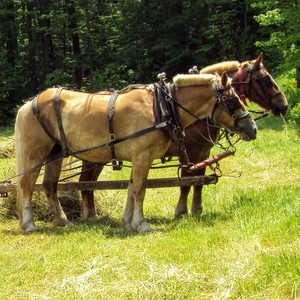
July is here, bringing hot weather and a number of rain-free days in a row. That means it's hay making time! For us. it's as much a normal part of July 4th weekends as picnics and fireworks. We've been fortunate to have a stretch of dry weather, so we have been able to spread the work out over several days. At this point, we've filled one side of the barn up and are working on filling the other mow. Although the weather is 90 + degrees today, we're going to try and push to get the rest of the field in. Even though there is only a slight chance of rain, the longer the hay lies in the field, the more it gets bleached by the sun. So we're in for a long hot day, but hay making is one of the most crucial farm activities for us. The amount and quality of the hay we put in determines how many animals we are able to support over the winter months. Doing it ourselves is not only a significant cost saver over buying hay, we also know what quality we're feeding and that the hay is organically grown. We are also able to complete the entire process with our horses, using no tractors or motorized equipment. We use the horses to cut hay, rake it, and pull the wagon across the fields to pick it up. Instead of running a baler, we put it away loose. Dan uses a pitchfork to load it while I walk back and forth packing it down for a nicely balanced load. Both jobs are physically demanding. Unloading is the easy part, as we have a hay claw on a trolley that lifts large amounts of hay, that carries it along a track and drops it in the mow. If you'd like to see more, we have pictures and descriptions on our website at http://pleasantvalleyfarm.weebly.com/hay-making.html. This picture shows our mares, Dolly & Dixie, with a nearly full wagon load of loose hay.
Although this stretch of dry weather means we need to irrigate the garden and the creek is running low, it did give us the rare opportunity to take a day off yesterday and enjoy a rare summer holiday. Since we were confident that the mowed hay wouldn't be rained on, we had time to relax and have a cookout here. July 4th is all about freedom and independence, and without our farmers, this country wouldn't be self sufficient. So it made me smile as we sat down to our meal, to see how much of it we'd produced ourselves. The steaks were grass fed beef from a cow who was standing in our pasture just a week or two ago. The potato salad made great use of new potatoes dug from the garden just hours before, and was flavored with homemade mustard and dill from the herb garden. I made deviled eggs as well with eggs I'd hand collected from my chickens. A truly enjoyable meal, and I feel so fortunate that eating fresh from the garden isn't an isolated experience. I'm frequently able to make an entire meal using just what we make or grow ourselves.
We hope you & your family had a safe and enjoyable holiday weekend too!