
04 Jan Tue 2011
Planning the 2011 Garden
One of the hardest things for me to get used to on the farm is how far you need to plan ahead to be successful. In college, while studying for my Master's degree, I got to be a horrible procrastinator; I can remember getting up at 5 AM to write a paper due at 9 AM, one that I'd had weeks to work on. Not just once, but often. As long as it got me an A, it didn't really matter. Now, what I do (or don't do) today can have consequences not just tomorrow, but 6 months or an entire year down the road! Although I do try to stay on top of things, one of my resolutions this year is to make sure I keep better records, it's the only way to know what works and what doesn't.
One of my major tasks so far this year has been to plan our seed orders, which will set the stage for what we grow and sell all year. Not just what we sell in May, but right up through November, and it will decide what I'll be eating this time next year, as we're big on using storage vegetables or things I've canned or frozen to feed ourselves through the winter. Truthfully, I probably would have gotten started on this even before Christmas, but my favorite catalog, from Seed Saver's Exchange, didn't get here until late last week. The conventional thinking is that farmers just do what they do, guided by old time wisdom or maybe this year's farmer's almanac. More than once, I've been asked why I'm farming when I have so much schooling, the insinuation being that I'm wasting my intelligence by doing something any hick could do. In reality, it takes a lot of planning, record keeping, and the like to be successful. Be it plants or animals, you have to know what does well on your particular farm to be able to make a living out of it. Growing is more than throwing some seeds in the ground and waiting to harvest. I do have very good records of the seeds we've ordered, variety, amount and all, from our past growing seasons, but the truth is, I make it a huge project not only because it's important, but because it's fun. I ogle seed catalogs the way some girls pour over jewelry ads.
While I do stick to many varieties that we've had success with, and start out our plan with those, each year I add new ones. Some will not work out, but others will make it into our garden for years to come, and the only way to find out is to take a chance on something new. I love the idea of helping to resurrect heirloom varieties instead of planting the newest hybrids, and that's one of the reasons I love Seed Saver's Exchange. Not only can I help to make the farm more self sufficient and sustainable by saving seeds from a plant we want to grow again the following year, but these heirlooms have a history. One I took a chance on a few seasons ago was a lettuce called Grandpa Admire's. It surpassed anything either I or Dan had grown here before. Not only is it lovely to look at, being green tinged with red, but it also has great flavor and goes a long time without getting bitter, a real plus for summer gardening. Also, it's a variety that has been planted and saved and replanted since the Civil War. Not only delicious, but a real piece of American history right on your plate!
Then there are others that are less than successful. For two years, I've longed to taste a melon called Delice de la Table, a very rare French heirloom. The rarity, the beautiful picture of the fruit, and the description made me give it a try after it failed to produce a single melon the first year. It was a tough growing season, though, so I gave it another try. Last season was very favorable, but again I got nothing. Not a single melon from multiple planted seeds. Part of me hates to give up, but it's wasted money and, perhaps even more valuable, wasted garden real estate. But I do think a nice French cantaloupe would be wonderful to offer for sale...luckily for me there are more options! My master list currently has two options- one that says it is the easiest to grow and prolific, but prone to cracking open when ripe; the other is said to be the “most divine and flavorful melon in the world.” I've yet to decide which one (or both?!?) will grace our garden this season. These are the kind of difficult decisions I love to have.
Not every new plant is an heirloom experiment, though. Will anyone in our area buy okra? Hmm, probably not, we're too far north. What about baby corn, like you use in Chinese stir-fries? It's on the list for me to consider, along with a couple exotic sweet corns- one bright red, the other steely blue. I'll also consider things my customers asked for last year that we didn't offer. Orange Hubbard squash? Yellow beets? So many choices. Also, our all-time favorite sweet corn, Seneca Dancer, has been discontinued, so I'll ponder its replacement carefully, since that is such an important crop for a farm stand. In addition to names, descriptions and histories, there are also other considerations- to order seed or wait to buy started plants, days to harvest, tolerance to heat, cold, plant diseases. And that's before I even get into comparing prices. While some places offer things very cheaply, if you're not familiar with that company, you're also taking a chance on the quality of the seed they ship. It's not a bargain if only half the seeds germinate as compared to the slightly more expensive version from a company with quality seed that you usually deal with. So it's a job worth spending a good bit of time over, and in the dead of winter, there is something uplifting about staring at the pictures of ripe red tomatoes, golden ears of corn, and colorful peppers that make spring seem that much closer.
29 Dec Wed 2010
Looking Back, Looking Ahead
It's hard to believe 2010 will be history in a few short days. What a year it has been! It was exciting to be open for a full season, which was a first for me. It was a big leap to go from a full time job away from the farm to being here full time, but I'm a firm believer that everything happens for a reason, and the elimination of my work position was just a way to show me that I was ready for this new challenge. It gave me the time to expand the different products I make here, and it's amazing to look back (or in the pantry!) and see the variety of goodies that came from the garden and the kitchen. Making vinegar was a new adventure, and one that turned out very well. I really got more comfortable in the kitchen with old and new recipes and have really come to enjoy cooking with cast iron, something that was pretty much foreign to me at this time last year. I only hope to get a good industrial blender for mustard making in the new year, as I ruined not one, but two this past year trying to blend up experimental new batches that were a bit on the thick side!
We had a nearly ideal growing season for almost everything this year. While the nights didn't get quite cool enough for the sweet corn and we did get hit by the late blight (thankfully it was at the end of tomato season anyway) the garden was amazing. It's nearly unbelievable how much food came out of such a small space. We had heaps of beets, potatoes, squash, tomatoes, cucumbers, onions, rhubarb...the list could go on! Of course, there is always room for improvement...I'd like to hope I'll do better weeding the garden next year, and find a better way to keep the birds (sparrows and the like, not my birds) from carrying off the blueberry crop. All in all though, the hardest part of the garden this year will be the same as last, and that is narrowing down all the seeds I'd like to buy to a list we can afford, both financially and with garden space!
There were changes in the livestock, too. We got out of the goat breeding business but added heritage turkeys. We doubled our permanent Dexter cow herd to two brood cows. Peachicks (baby peacocks) hatched here for the first time. The sows continue to deliver healthy litters of piglets and the sheep had a nice crop of lambs. I continue to get more comfortable driving the horses and using different machinery. Running the plastic mulch layer was a fun first this year.
The meats went well too. Our little farm produced not only a nice variety, but an amazing quantity as well. We couldn't keep our chickens in stock, which is a great thing! I have really improved my plucking skills, too- practice makes perfect! Pork continues to be our #1 meat, and folks come looking for the Italian sausages now too, which is neat. The beef and lamb also sell well, and I think I've gotten to the point where I really understand each cut of meat, how to prepare it, and what cut to recommend if a customer is looking to make a particular recipe. That was something completely overwhelming to me not that long ago, but since we rely on what we raise for our own groceries, I can say I've learned how to use everything by trial and error in my own kitchen! We also renovated our meat processing kitchen, putting down a new easy-to-clean floor and repainting. We also made a huge improvement when Dan installed an industrial sink & spray faucet and built a new, larger meat cutting area. Those improvements will serve us well for years to come.
So after all this success, how can I possibly hope for more next year? Because I want to continue to grow, both as a person and as a business. I'm looking forward to hatching our own little Bourbon Red turkey poults and transitioning to only heritage turkeys for sale at Thanksgiving. We'll also be butchering a Dexter for beef at some point (Lil's male calf from this year, not one of the girls), and again, we're looking to make a transition towards farm-raised heritage breeds. Lil and Finni are both expected to have a calf in late spring or early summer, which is also really exciting. I've never seen a calf born here, and Dan misses it from the days when this was a dairy farm. And speaking of dairy, we're expecting to transition our household to Dexter milk when this happens, so milkmaid (and possibly amateur cheese artisan!) will be yet another title to add to my job description. We'll try more heirloom vegetables in the garden this year. I hope to finally build a new rabbit hutch. Dan is working on setting up a place to do blacksmithing here. There are always lots of repairs to be done and although we did lots last year, there is still a long list of things we'd like to see completed in the coming year, like repairing the milkhouse, replacing the steel roof on the upper side of the barn and painting everywhere-house, barn, hog house, etc. I'm sure some of it will get done and some will be on the list for 2012, we'll just wait and see which is which!
Finally, I have a new challenge/adventure for the coming year. I would love to incorporate what I do now with the skills I have from college and away-from-farm work. I'd love to be able to supplement the farm income by going out and speaking about why farms are important, why how your food is grown matters, and all the things that I, as an educated adult, really never thought about or knew anything about before I came to the farm. I'd like to be not only a speaker, but an advocate for farming. It's an idea I've tossed around for a while, and I'm really excited to announce that this too is coming to fruition. In March, I'll be putting on an hour-long presentation about Heritage Livestock breeds and why they matter at the Farm to Table conference in Pittsburgh. I'll be sure to post all the details when I get them, and I hope some of you will come out to see me there.
A sincere thanks to everyone who has supported our farm over the past year through your patronage or just by following our adventures here online. We couldn't do what we love without you! We hope to see you again in 2011, and send our wishes for a healthy and happy New Year to your family!
21 Dec Tue 2010
Bouncing Baby Bunnies
Although they don't get much attention in this blog, we also raise rabbits here at the farm. I just like them, and I'll have young rabbits for sale periodically. I can watch them out my kitchen picture window while I'm cooking or doing dishes. The pens all have outdoor access, and some are moveable "tractor" pens which make great mowers as I move them across the back yard. One such tractor is currently right outside my window and houses Honey Bunny, who basically looks like a wild cottontail, and Leo, our tan and white lop-eared breeding male. He's got a short face that looks like he's got some Lion Head rabbit in him, and he's quite adorable. Both bunnies are quite tame and docile. Although that might sound like a weird thing to say about rabbits, I've lost more blood to the bunnies than all the other farm critters combined (including the cats!) They have legs made for digging and sharp claws, and if they kick and scratch you while you're moving them to a different cage, it's often worse than a cat scratch.
Anyways, Honey and Leo have been in the same pen for about two months, so yes, that means there are babies! Usually I do try to take the buck (or male) out before the blessed event, otherwise there's a good chance the mama will be pregnant again before the litter is weaned. It's hard on her to not have a rest between pregnancies, but things have been so busy I just let it slide this time. There are 5 little rabbits who just opened their eyes a few days ago. When I looked out at the pen yesterday, I saw Leo, Honey, and a small, grey-white baby bunny outside. The rabbits get outdoors via a ramp, so I have to put up a small piece of wood to keep the babies from falling out- I call it the "bunny baby gate." By the time they are old enough to climb over it, they seem to be smart enough to get back up into the warm, dry enclosed pen. However, since the baby didn't seem to be distressed, I figured I could finish what I was doing in the kitchen before climbing in the cage to catch it and put up the gate. There isn't much cuter than a farm baby, and tiny bunnies are so fun to watch! It seemed to be snuggling up to mama until she went inside. Now, many people who raise animals of any kind will tell you it's a bad idea to let a breeding male around the babies because no matter what species, the males will harm or kill the little ones. I'm not denying that this can happen (I've had male rabbits fight until one was severely injured) but I also think giving an animal the kind of environment it was designed to live in eases this. Our lambs are born and live on pasture and Rambo the ram looks after his whole flock, babies included. When we bred goats, I never saw the male harm the little kids, although other females would head-butt them away from their own offspring. Leo has been in with babies before and I had no worries about him, but I found it truly fascinating to watch him with this little one. I looked away, and when I next checked, the baby was nowhere to be seen. Leo appeared to be grooming his toes or something. On closer inspection, Leo was actually grooming the baby by licking its little head and letting it cuddle into his fur just like a mother would do. And yes, since the parents look nothing alike, I'm sure it was papa. When I caught the baby and put it back upstairs, it was Leo who seemed to be guarding the rest of the nest.
Raising livestock in a more natural way means that they get to interact with each other in ways more meaningful than just through the bars of one cage to the next. While the disadvantages to this are that yes, sometimes they can and do fight for dominance, and accidents can and will happen, all farm animals are social in nature. I do try not to treat the animals as human, but when you interact with them you can see that, if you get to know them, they all do have personalities and even emotions(some more strongly than others). I think an important part of raising animals naturally is allowing them to have a social life, with members of their own kind and even across species. To me, it's fascinating to watch how these interactions play out, whether it's a bunny family's dynamics, how a mother hen protects her chicks, or how the cat sunning himself reacts to an inquisitive turkey. I often think I'd be $10,000 richer if I could only capture some of these moments for America's Funniest Home Videos. But in addition to providing me with constant entertainment, being observant about these things helps me to be a better farmer. Giving them natural interactions means my animals will be less stressed, and if I use their natural reactions to my advantage when I handle them, it makes life easier for all. That, and lots of snacks!
14 Dec Tue 2010
The End of Meat Season
The last major farm task for the year is over now. This weekend we filled our freezer pork orders, and everything is cut, wrapped and frozen, We're just waiting on the hams & bacons now, as the smoking process takes about a week longer. Between the whole and half hogs ordered this time, we had 4 total hogs to do over the weekend. Each time in the past, Dan's father has come up to lend a hand and offer his expertise when we have more than one to do. However, he lives about 4 hours away and the forecast was for a couple inches of ice topped with a foot or so of snow. In the interest of safety, we told him to come visit another time and tackled the big project ourselves. In the past this would have completely overwhelmed me, but since Dan and I have done so many over the course of the season for the stand (although one at a time!) we pretty much have it down to a two person routine; he cuts and I wrap and label. I can even tell by looking now the different roasts we offer (shoulder, loin end & Boston butt) whereas a few years ago, I couldn't have told you the different names, much less what they looked like or how to cook them!
It is good to be done with the butchering until next May. I don't cry over each pig or chicken, as I know why we raise them and know we give them the best life possible. I do get a little more choked up over my turkeys and cows, as I interact with them for a longer period of time, and to some extent you do get attached. The cows are here for at least a year usually and are the only meat animals I name. But again, I know why they are here. Even though we send the pigs to a USDA-inspected facility for slaughter, we still cut them up and make our secret recipe sausages here at the farm. Pork and poultry are lots of work! It's a big job to coordinate bulk meat orders and have a variety of cuts available each week at the stand, so it's nice to get a break form that for a bit. I also think that taking a break is good mentally...it keeps you from taking an animal's life too lightly. I think the world would be a more humane place, and that consumers would be much less tolerant of factory farming, if everyone who eats meat out there had to raise an animal once in their life and then eat it. Five years ago, I wouldn't even have considered myself capable of such a thing either, but I see now how pretending that meat just magically appears on a Styrofoam tray in the grocery store meat cooler is not good. It's not good for the animals, who suffer in horribly crowded conditions, some never seeing the light of day, being force fed antibiotics and chemicals to get them big and tender quickly without regard to the animals' comfort or health. It's not good for us, because we have no idea where our food comes from or who is producing it, and the end result of that is bad food. We've seen it time and again with the recalls of meat, eggs, and so many other products. Recalls prompted by people getting sick and even dying just because of what they ate. I'm proud to be a part of the movement to change that; I won't sell anything I don't feed my own family, and raising healthy animals is good for them and good for us too.
On a completely different (and lighter!) note: I believe I invented a completely new sentence in the English language yesterday. Finally, I've had time to put up my tree and do some holiday decorating. Despite the fact that it was about 15 (without considering the wind chill) I was out on the porch hanging up my lights and putting some tinsel around the porch columns. Some of the animals were still happily free ranging despite the weather, and about half of my Bourbon Red turkeys came over to see what in the world I was doing. My tinsel is iridescent white with little foil snowmen on it, and as I was finishing winding it around the column, I laughed when I heard myself say:
"Shoo, turkeys! It's tinsel, not turkey food!"
08 Dec Wed 2010
My Personal Cooking Challenge
The first week of December sure has been a snowy one here! It seems it's been coming down steadily for a week now, with a foot or so on the ground here on the farm and road conditions that make me happy I can stay home instead of travelling.
Maybe it's the allure of a warm oven, or maybe it's the Christmas spirit, but I've been baking this week. While I love to be in the kitchen, cooking and canning and making vinegar and mustards and all kinds of other things, the truth is I am a miserable baker. I can screw up brownies from a box mix. I bought a bread machine thinking I could surprise Dan with homemade bread, which he loves, from time to time, but it almost invariably fell and turned into something so rock hard I was afraid even the pigs would have trouble swallowing it! I don't know exactly why I have so much trouble with this form of cooking, since everything else comes fairly naturally. Maybe it's because I love creating my own spin on things and rarely follow a recipe without adjusting it a bit? No, that can't be it...canning is very similar in regard to substitutions and I have no problems there. Maybe it's because of the living yeasts that make things rise? Well, as a farmer, I'm so used to living things, raising animals tending plants, and I've even had success making cheese (using living enzymes) and vinegar (using living mother of vinegar) so I'm sure I can learn to get along with my little yeasty friends.
A mental block? Probably. For years have I told myself and others that I can't bake, I don't like to bake, and I won't bake. Add to that total strangers demanding it of me for the past year and a half, and there is probably something to this idea. For years, our farm was locally famous for Betty's homemade pies, breads, sticky buns, pumpkin rolls...you get the picture. I've been asked, cajoled and have even been given rude demands to take some baking lessons from my mother in law and begin to offer these goodies for public sale again. Now, we get along really well, and I'm sure she'd be happy to share her recipes with me, but the truth is, I just know if I had to do it weekly I would certainly hate it. I like to can and enjoy doing it, so that's what I concentrate on making for sale, along with the veggies, meats, chicks, eggs, field work, weeding, stall cleaning, the list of responsibilities around here never ends and I'm hesitant to add anything major onto it!
However, there is something about a warm kitchen on a cold, snowy winter's day. In the summer, I run my sauce tomatoes though a food mill and freeze them, saving the squished result in the freezer until right about this time of year to spend hours boiling it down to make my own spaghetti & chili sauces. I took care of that last week. I have more than enough jellies and pickles to both give as presents for friends and family and to last us through the winter, so I really don't need to be making any more of it at the moment. I was stuck in the house and low on bread though, and the newest issue of Mother Earth News had a cover story about easy, practically no-knead bread, so I figured I could give it a try. Plus, using only flour, milk, egg, yeast and salt, it has to be so much healthier than the store bought stuff that contains preservatives and HFCS. It was...not a total disaster. Not as fluffy as I'd hoped and a bit on the chewy side, but definitely edible. Dan loved it. While I wouldn't call it a huge success, it had a glimmer of hope to it. For me, part of the enjoyment of the long winters here is to challenge myself to learn something new. Last year, I really became comfortable cooking with cast iron, and even made some meals by simmering them on the woodstove. This year I had planned my goal to be to teach myself how to play guitar, but the winter is certainly long enough to allow for more than one project. So I mixed up another bowl of dough this morning and am letting it rise as I type. I really love learning skills that allow us to be more self-sufficient and many of them have lots of practical uses on the farm or result in a new product to sell. But sometimes it's necessary to do something just because you want to, not because you have to or for any financial reason. So I'm going to continue to see how this goes...they say practice makes perfect!
03 Dec Fri 2010
How to Use a Whole Cow
Since our last cow processed for beef was at the very end of our season, we had a selection of all the cuts in stock when we closed. This means we got some of the "good stuff" for ourselves to eat over the winter. So I treated Dan and myself to some grass fed, farm raised Porterhouse steaks for dinner last night. For a truly gourmet cut of meat, like grass-fed Porterhouses, I wanted to let the flavor of the beef shine through without overpowering it with sauces or condiments. Since it's snowing outside, I wasn't in the mood to grill, so I heated up my favorite cast iron skillet and melted plenty of butter. I caramelized an onion, added another pat of butter and added the steaks. I topped them with a splash of Worcestershire sauce and let them cook, turning once, until they were cooked to about medium. They were tender, flavorful, and truly didn't need anything else, the flavor was that good.
I've learned so much about what different cuts of meat are by being involved directly in the process. A Porterhouse is a T-bone steak with a bit of extra tender meat on the end. Any Porterhouse could also be cut down to a T-Bone, but only a small percentage of T-bones (around 1/5) can be cut to be Porterhouses. And there aren't a whole lot of either in a single cow; we have essentially a 1/4 beef in our freezer, and that meant only 1 package (containing 2 steaks) of Porterhouses and 3 or 4 packages of T-bones. That's a good reason why they are expensive cuts of meat; not only are they tender and delicious, they are relatively rare. In a whole cow, at the size we process, we expect approximately 4 packages of Porterhouses and maybe a dozen of T-bones. In comparison, we'll get lots more of other cuts- around 125 pounds of lean ground beef or 20 or more each of round steaks and chuck roasts. We have a standard way our beef is processed that results in 5 different cuts of steak, 5 kinds of roasts, as well as ground beef, stew meat, and soup bones. This is the most efficient way that best utilizes the whole cow into sellable parts for us, without resulting in ground beef that is less than lean. However, it's not uncommon for us to run out of one cut or another (especially steaks) before we have enough freezer space to process another cow, or before the next cow has reached the size we'd like it to be.
I've learned so much about how to cook the different cuts, because before I had a freezer full of my own beef, I didn't eat a lot of it, and what I did was limited to a few different cuts. I didn't cook roasts much at all, and I suppose that's not uncommon, because they are certainly less popular than steaks or ground meat at the stand. I now know that chuck, R.B., and English roasts are all equally delicious when put in a crock pot all day with some potatoes & onions- a true one-pot meal! The tip roast is my go-to when I want to make a stir fry, cheese steaks, or fajitas, as it slices thinly and cooks up beautifully with great flavor and without being tough. Round steaks are a tougher cut of meat on any cow, but ours are great grilled after marinating or slow cooked in a skillet with some liquid. I don't get to cook the other steaks (rib eye, sirloin, T-bone & Porterhouse) quite as often, as the farmer usually eats the cuts of beef that didn't sell as well (or the turkey with the torn skin, the chicken that didn't pluck right, the "cosmetically challenged" veggies, etc...). Although at first it was a challenge for me to figure out how to cook cuts of beef I'd never even heard of before, there are simple ways to turn any of them into a great meal. So if you're shopping at a farm selling cuts you aren't familiar with, don't hesitate to ask your farmer what they are best used for. Or, tell the farmer what dish you're looking to cook, and he or she can suggest the cut that will cook best using that method. At our farm, roasts are lower priced than the steaks, and with a helpful hint on what to do with a particular cut of meat, you may find that a dinner of humanely raised, grass fed beef (or lamb, or whatever) is more affordable than you thought, and certainly better tasting than feedlot beef!
01 Dec Wed 2010
Winter Farming
Saturday was our final day for the 2010 season. A sincere thanks to all who stopped by this year, you made it a great one for us! Although I'll miss the weekly interaction with my customers as well as the income, it's kind of exciting to look forward to my first weekend off since May as well. Our lovely farm stand is enclosed, but it's not heated, and I was very lucky with the weather this year, only having snow the last day. Today looks like a winter wonderland out there, and with temperatures expected to stay pretty chilly, it's a good thing that all the jars of goodies and winter squash and other storage veggies are safely in my pantry or basement to keep them from freezing. (If we were still open, I would have needed to bring everything to the house anyway, but this way I don't have to lug it all back down there!)
I have heard so many comments lately to the effect that since we're closed for the year we'll finally be able to relax. Although it's surely not as hectic as the middle of summer with the garden, the stand, canning, and making hay all at the same time, a farm is a busy place 100% of the time. Now that the pasture has finally worn out for the year, we need to start feeding hay and bringing the horses and cows into the barn. This means more feeding chores twice daily, not to mention the additional chore of cleaning stalls since the animals are now inside. Inclement weather means every creature will be spending more time inside voluntarily, so the pig pens and poultry houses will also need to be cleaned more frequently. There's also the ever-present challenge of making sure all the critters have access to fresh, clean water, which will soon mean breaking up ice and putting out rubber pans to prevent the plastic bell waterers we normally use from freezing and cracking. And as far as a nice, long winter vacation to someplace warm goes, we just can't do it (at least not together!) unless we have someone who is capable and willing to take care of horses, cows, pigs, sheep, goats, rabbits, chickens, turkeys, ducks, geese and peafowl twice a day for as long as we're gone. I love my animals and our lifestyle, but in some ways it is like a marriage- you have to fully commit to being a diversified family farmer and understand it's a year round obligation, not just a fair weather one.
So besides feeding, watering and stalls, what will I do all winter? Plenty! I have pages I'd like to work on to expand our website, and I'll put out a few email newsletters as well. The seed catalogs have already begun arriving almost daily, and I'll have to plan what we'll grow. Planning a market garden is a big job, we have to figure out what did well last year, what didn't that we won't grow again, which new varieties sound promising, which crops we might be able to transition to heirloom varieties, what we didn't grow last year that customers requested and how much seed of each type (that we didn't save ourselves) will need to be purchased. Although we stick to a few catalogs, I compare prices and varieties and have it all sent out before the groundhog will be looking for his shadow. Our home is a lovely 100+ year old farmhouse, and winter is usually the only season we have time to spend working on it. Winterization is always a big chore, and this year we've planned projects upgrading things like insulation and windows. It's also a good time to paint the interior, sew new curtains, and other small upgrades. I also hope to spend some time in the workshop doing things like finally building a new hutch for my rabbits. Perhaps we'll even get to the new bookshelves we've been planning for some time. A million other projects, too! And like everyone else, the holidays are almost here and we'll want to celebrate by spending time with family. And of course, I'll be blogging all about it throughout the winter!
24 Nov Wed 2010
Turkeys & Other Madness
What a week! Our final week of the season has been our busiest by far. This was my first year to process turkeys for sale, and it's a daunting task. While our original plan in the spring was to raise Broad Breasted White birds and process a few Bourbon Reds as well, an error by the hatchery we were dealing with sent us Broad Breasted Bronze birds instead of the white ones we expected. While nearly identical in that both broad breasted varieties are quick growing, have lots of white meat, and are artificial breeds as they cannot reproduce without artificial insemination, the bronze birds are colored much like a wild turkey rather than having all white feathers. It does make for a more attractive pen of live birds, but it's impossible to clean them up as completely when plucking, as some of the colored pigment remains under the skin. It's much like an ink inside the feathers, which made processing a less than ideal job. I personally went over each bird three separate times, and they still didn't clean up as well as I had hoped. Sunday and Monday were completely consumed with turkeys, and yesterday I had a final cleanup before opening for a special Tuesday afternoon for turkey pickup. I simply let our customers know what they were seeing, and they understood that they were buying a farm-raised, hand-processed bird.
Nearly every customer was thrilled with their bird, and I was grateful that they were happy with the sizes available, as we don't have full control over that. We can feed them quality feed all year, but we don't have the option to choose toms or hens when we buy (or hatch) the babies, which greatly affects the final size of the bird. Too many toms and folks who are having dinner for two or four will be disappointed with a bird that's too big, and too many hens may mean you don't have enough super-sized ones to feed a dozen family members. This kind of lack of choice is the greatest issue with marketing to the general public; most folks are used to getting a bird that's exactly 17 pounds if that's what they want. This is because Butterball or other large industrial producers raise literally millions of birds and freeze them prior to Thanksgiving and other holidays. Out of a few million, there's bound to be hundreds of thousands harvested when they reach just the size you want. A small farm like ours may only be willing to hand pluck two or three dozen birds, and with a number that small, it's possible that not a single one is exactly the weight you originally sought, especially if you're picking up a fresh bird processed just a day or two before. However, a farm bird like the ones we raise will not be “enhanced” with a solution of salt water that can be as high as 20% of the weight you pay for, so going by pounds alone may not be the best way to compare our birds.
Surprisingly, the Bourbon Reds, while still having pigmented feathers, cleaned up much nicer and with less work. Dan and I are discussing the option of offering only the Bourbons in future years. While we'll likely have less birds to process next year if we don't buy poults, I can't say I love doing turkeys enough to be upset about it, and I love the idea of using only heritage birds. Although they were a month or so older than the Bronzes, the Bourbons who did not get to join next year's breeding flock dressed out lighter. However, the heritage turkeys got the same rations as the laying hens, while the meat turkeys got a special turkey grower feed that had a much higher protein content. It will be interesting to me to see how the Bourbons will perform next year on the higher, weight-gaining ration.
Our Bourbon Tom
So all the turkeys have been processed and picked up, but the hectic pace won't slow down yet. Today's agenda includes going to the processor and picking up a pig and a cow. I'll need to sort out the frozen cuts of beef for freezer beef orders that will be picked up Saturday. The pig, as usual, will be cut here, so tonight will include spicing the meat that will become sausage and wrapping roasts, chops and ribs. During a normal week, this would be done on Thursday, but Hirsch's will be closed tomorrow. Friday we'll grind and package sausage as usual, and Saturday we'll finish out the year for our farm stand. When the doors close for the year, all the unsold products will need to be sorted. Canned goods & vinegars will keep, but will need to be moved to the pantry or basement where they will be kept from freezing or direct sunlight. Storage vegetables that we'll use to feed ourselves over the winter will get the same treatment. Extra vegetables will be used to supplement the pig's rations. We'll try to condense all the unsold meats into one freezer so we'll be able to unplug the one in the stand ASAP, and that will be our meals for the months to come. Nothing goes to waste!
Oh yes, in the midst of this madness there's a holiday thrown in too! Since we've got so much going on, we won't be traveling for the big meal. I'm cooking dinner for Dan and I plus Dan's brother Matt. While I'm a master of roasting a whole chicken, this will be the first time in my life that I've single-handedly tried to manage a turkey and all the trimmings. It's also a known fact that I'm no baker, but I hope to have a delicious surprise or two for them. I'm excited, and my guys are the least picky eaters ever, so I'm very optimistic that our dinner will be a success. With sustainably raised ingredients and ones I love sharing the table, how could it not be?
From our farm to your family, we wish you safe travels and good times with family, friends, and (sustainable!) food. HAPPY THANKSGIVING!
12 Nov Fri 2010
Grinding Cornmeal
One of this week's projects for me has been making cornmeal. It's not the bright yellow you may have come to expect because instead of using yellow corn, I use an heirloom variety called Earth Tones Dent that we grow here at the farm. "Dent" means that it's not a sweet corn to be eaten fresh, but rather an Indian corn type which is not harvested until the kernels have dried out, resulting in a dent at the top of each one when the moisture is gone. It's an heirloom, open pollinated variety which means that it is not a GMO like the corn used commercially for meal, it's not a hybrid, and the seeds can be saved from year to year. The ears come in a variety of colors from deep red to a mix of blue and purple.
Once the dried ears have been picked from the stalks, the husks are removed. We store the husked ears in onion sacks hung from the ceiling to make sure there is enough airflow so it will keep well until we use it. To make cornmeal, we start by removing the kernels from the cob. It's a time consuming job if done by hand, but we were fortunate to find a corn sheller at auction last fall. It looks like a big red box with a large metal wheel on the outside. A handle is turned until the wheel is revolving quickly, at which point ears are dropped in one at a time through a slot in the top. Inside, there are large plates with teeth that revolve which separate the cob from the kernels. The kernels drop out into a bucket or pan placed under the machine while the cobs are spit out the side.
After that, I grind using a cast iron grain mill in the kitchen. While this can also be turned by hand, Dan has put a small electric motor on it which powers the grinder using a belt from the motor to the large wheel. It can be adjusted from a coarse to a fine grind. The kernels go into a hopper on top, and come out the bottom. This has not only the cornmeal, but also the hard outer part of each kernel, so the next step is to sift out the usable meal using a simple hand cranked flour sifter. Finally, I weigh and package it. We're happy to have it back in stock just in time for Thanksgiving, and are proud to advertise that our cornmeal is grown here, ground here, and hand sifted!
07 Nov Sun 2010
101 Things to Do With a Tractor
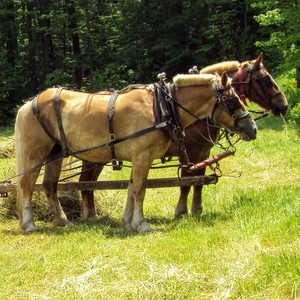
One of the things we're known for, and a point of pride for us, is that we do all our field work and hay making with a team of draft horses. For us, this is truly what "sustainable" is all about; the horses help us to make the hay in the summer that will sustain them all winter, and we use the manure to naturally enrich the soil of our farm the way nature intended. They are born here and trained here- our mare Dolly is a 3rd generation Pleasant Valley Farm Belgian! It's definitely a commitment not taken lightly: the horses actually require more care in the winter, when a tractor can be parked. Using horsedrawn equipment can be a challenge to find or to maintain, as some pieces we use are nearly 100 years old and parts aren't readily available. For us though, it is a labor of love and I wouldn't trade Dixie & Dolly for a John Deere, no matter what its retail value might be.
However, we choose to work horses, and unlike the Amish, aren't bound by any restrictions against changing that choice if we feel like it on any given day. So this weekend was a bit of a noisy one, as Dan and his brother Matt rented a tractor from the neighboring Builder's Supply store. I asked Dan and he said the real name of the machine would be a compact escavator, or a compact backhoe would also be acceptable. I'm not really up on the names of construction equipment, so Dan knew if he didn't tell me otherwise I'd probably end up calling it the "orange diggy thing" or something like it!
I'm amazed at the number of people who comment that the work must really be winding down, because on a farm work never really slows, it just changes form. Right now we're putting our energy to building repair, maintenance, and winterization. A few different projects got lumped together for tractor time this weekend. The scooper on the front of the tractor saved my back and arms from wheeling loads of gravel from the pile by the road to the house. We're putting a gravel floor in the basement, and I'll be excited to have that space available to use someday soon. Then the next project was digging a ditch and installing a French drain behind the barn, then filling the ditch with gravel. One problem that occurs whenever we get heavy rain or a significant snowmelt is that water will come into the barn, leaking between the barnstones that form the foundation and into the horses' stalls. That project went very well, the most difficult part was keeping the cows from sneaking past into the haymow for an all-you-can-eat lunch! The rest of the gravel was spread over the parking lot, so neither we nor our customers will be stepping out of our vehicles into mud puddles anymore! It was great; 3 projects down and 21 tons of gravel moved with minimal hand work.
The milk house between the barn and the road recently received a new steel roof, (the goats had put holes in the shingles) and next up is to repair the part of the block wall that has fallen in, so the orange diggy...I mean compact backhoe... was taken around the barn to dig out behind the wall. The angles of the building itself, the corncrib and barn, and the slope of the hill made it a bit tough, but it will be less hand digging now for that project. I suggested using it to move some of the mud & muck that has accumulated near the gate by the barn and that went well. The gate is near what we call the "lower part" of the barn, which is primarily used as a run-in shed where pastured animals can get out of the elements. The problem is where animals congregate, manure happens. Since that area is dirt, you tend not to notice how much has ended up there, decomposing and becoming part of the soil, until it reaches a point where water no longer flows past but rater is retained in all that organic material, creating a terrible mess to trudge through while doing chores. Not something that was crucial on the to-do list of the farm, but while we had the tool to make it a quick project, it just made sense to make life a little easier. Also, a little drainage ditch was put in to ease the giant mud puddle that forms on the lane through the barnyard down by the road. To me, it seems like when you get access to some new piece of machinery, especially when you pay for it, you can think of 101 projects you'd like to get done before that time is up!
It was a very productive weekend for us, and I'm really thankful Matt came and helped us out so much while I was waiting on the stand. It's wonderful to have all these projects well underway or completely finished. (Believe me, on a farm with numerous 100+ year old buildings, there are always more things you'd like to do than you ever have time or money for!) However, we will be completely content to return the tractor and go back to the real horse-powered life.
02 Nov Tue 2010
Retiring Canned Products
I truly enjoy canning. I love the process of creating something wonderful from scratch, something that will last for months or longer until I open it up to savor a flavor of something that was plentiful seasons ago. I love playing around with recipes and trying out new ones. For years, my mother in law made the stand famous with her pies and baked goods. While I don't share her talent for baking, nothing is a bigger compliment to me than when someone says they stopped by just for my dill pickles or some carrot cake jam or any one of the products I work so hard to create.
Taking stock of what has been produced over the course of this year, I've made 9 kinds of jelly, 3 mustards, 2 salsas, various vegetable pickles using cucumbers, beets, beans and peppers, 6 vinegars, some assorted stuff like Bruschetta, Thai dipping sauce, prepared horseradish, or peach barbecue sauce, plus an assortment of dried herbs. Now that the farm stand season is winding down to the final month, it's been on my mind to take stock and see if I want to continue all of them into next year.
The answer is...no.
Most of my canned products are the result of trying to preserve something I have a bounty of during the growing season. If I have to buy all the ingredients, it may not make sense for me to expect to make a profit, especially when I factor in my time and now that I have built up a selection of recipes tailored just to what we grow. (That's why, to the disappointment of some, I don't offer blackberry or elderberry jams...we don't grow those here!) So that is a consideration. The next is how time-consuming the process is, as the more involved it is the less time I can spend on the numerous other things I may need to be doing in the course of a day. Some of the really messy or hard ones never even make it to the stand, as Dan and I will eat them when I know it's not a project I would look forward to doing again. I had a recipe that made both blueberry butter and a blueberry ice cream sauce. Both turned out to be delicious, but took forever, only produced a very few jars of each, and by the time I was done, everything in the kitchen was stained some shade of bluish-purple, especially me. Not a winning recipe in my book.
But the final and most important test is whether they sell. If my customers just aren't interested in them, it makes absolutely no sense to spend lots of time and materials making more of whatever it is. I know many folks don't want to spend their hard-earned money on something they've never heard of and might not like, so I have offered free samples of something or another all season long. While I have a pretty good sense of what's being purchased since I work the counter every week, I also kept track of how much I made of each over the year. If I only made a batch or two and still have most of it left, it's a good candidate for retirement.
So, I know you're curious, and yes, decisions have been made. Fans of Carrot Cake Jam or Black Forest Preserves (chocolate & cherry flavored), don't worry. It looks like these will be around a long, long time. However, if you're a fan of the Gingered Pear Preserves or the Oriental Rhubarb Jam, you may want to stop by before the close of the season since you won't be seeing them in the spring. The pears don't really use much of anything produced here, even if they are tasty and not especially hard. I can use up my rhubarb in the Orange-Rhubarb jam, which is much more popular. This is the first time I've discontinued any of the products I make, and it is a little hard. But I want to have room to find new recipes that I love and hope you will too! So come by and stock up on your favorites now so you won't have to miss them over the winter, and be sure to check back next year to see what new things have been dreamed up in the meantime!
30 Oct Sat 2010
A Great Pumpkin
Although Halloween is mostly a children's holiday, here at the farm it feels like a celebration of the end of the growing season. The pumpkins have been gathered up and put in the stand where they are protected from the freezing temperatures we have had lately. One was particularly interesting- looking, big and warty and orange. However, its base had a blossom end like a buttercup squash. I've always loved Halloween and usually carve a pumpkin, and since it's my garden I get to choose the coolest looking one now! This must have been an accidental hybrid, as when I opened it up there were hardly any seeds, not enough to bother separating from the goo, so Dan didn't get any roasted seeds from this one. I had fun carving it up with a special farm design!
Happy and safe Halloween to all!
21 Oct Thu 2010
Goodbye, Garden 2010
Yesterday was another glorious fall day and a great day to be outside. I'm so blessed to be home on the farm full time where I can take advantage of such days and not be confined to an office for 8 hours!
The day started out cold, with a low temperature of 28 overnight resulting in a freeze here, That means even row cover wouldn't save the frost-sensitive plants, so my basil and peppers are truly gone until next year, except for ones I've dried, canned or frozen. We've also finished digging onions and potatoes. While I hope to have beets again and the Swiss chard is still growing strong, the last major vegetable to harvest is our winter squash. If you've been to the stand recently, you've seen baskets overflowing with them, but the vines are dead and it was time to bring in the rest for storage as they were as ripe as they will get out there. Although the Kabocha and buttercups didn't do quite as well as they had in the past, we had a bumper crop of butternuts and great success with a new variety called sweet dumpling. It's like an acorn with a lighter, milder flavor and a beautiful white & green mottled exterior. There were still so many out there, I got the garden tractor and a trailer to cart them back to the stand. Although I can drive this little tractor, it's a joke between Dan and I that I can't touch a lawn tractor without breaking it; I get it stuck in a ditch, a bolt for the steering comes loose and I shut it off and abandon it mid-field, a belt breaks, or I jackknife the trailer hopelessly trying to turn. He's always on the lookout for where I've left the tractor around the farm after some such disaster for him to repair when he gets home. Amazingly, it was a tractor problem-free day. The squash looked so pretty, I just had to take a picture of it partway through collecting: you can see various gourds, acorns, buttercups, butternuts, sweet dumplings, spaghetti, and hubbard squash!
Hundreds of pounds of squash later, I was done. After we cut some more sunflower heads and some more corn shocks, all that will remain to do will be to pull up the plastic and fabric mulches that helped to keep the weeds at bay over the growing season.
Every year, there are successes and failures, that's why it's so important to us to have a diverse planting of vegetables. This year, the successes far outweighed the crops that under-performed. We keep careful track of which varieties work well for us, so each year we can learn more and take that knowledge into the next growing season. Although it's always a bit bittersweet to see the seasons change and the plants die or go dormant in preparation for winter snow, I know when the snow really starts to pile up I'll be able to warm myself by the cozy woodstove in the living room, perusing the seed catalogs, eyeing up new varieties and old favorites, and planning for the 2011 garden.
15 Oct Fri 2010
Why So Much?
It's another beautiful fall day here. As always, it's been yet another busy week on the farm. I've got some fresh horseradish roots, dug from the herb garden today, that I'll be processing as soon as I'm done blogging. Then tonight Dan and I will finish the sausage making process we started yesterday so we will have fresh hot and mild Italian sausage for sale on Saturday. The roasts and pork chops were wrapped up last night. It's been a busy week for meat, as we also sent 3 lambs for processing. Our processor, Hirsch's Meats, cuts and wraps them for us, so it's a bit of a break in work compared to the other meats after the animals are loaded onto the trailer. We're fully stocked on more lamb chops, ground lamb, and stew meat, plus we'll be offering small shoulder roasts as well this time.
The main job today, however, will be processing chicken. We do this entirely by hand here at the farm. We joke that my title in this department is "Head Chicken Plucker & Quality Control." Dan does the knife work and I pull the feathers by hand after the birds are scalded in 160 degree water. It's a labor intensive job. Some day, we've talked about investing in a plucking machine that would speed up the process and allow us to sell more birds over the course of the year. But today, our Friday night will be spend covered in wet, smelly feathers. (Can you tell it's not my favorite job on the farm?)
We charge $2.25/lb for our birds. Even at that price, they are definitely not our most profitable meat product. We use the Cornish-Rock crosses, and can't breed them ourselves, so we purchase the chicks. Unlike our beef and lamb, you need to supplement the pasture diet with quite a bit of high protein feed, which we purchase. It may be surprising, but we could cut that feed bill significantly by feeding antibiotics to our birds for their entire lives. We pay MORE for feed without added medicine. It comes as a surprise to some of our farm stand's visitors that we charge the price we do per pound for our chicken. Eye-rolling or an exasperated “Why so much?” aren't unheard of. When a grocery store can run a special for $.79 a pound, it might seem to some like price gouging. However, we make less money on chicken than any of our other meat products and most of the price is a reflection of what you aren't getting.
You aren't getting corporate America. Four big companies are responsible for 95% of the chicken produced in America today. Four. While they subcontract the daily dirty work to smaller farms, watch the movie Food Inc. and you'll get an idea of what that is like...many of those family farms are going into debt to keep up with company regulations while the corporate CEO's make money hand over fist. The companies like to call it “vertical integration” and proclaim it as a model of efficiency. Other points of view compare it to indentured servitude. And that also doesn't take into consideration how your tax dollars subsidize cheap corn and oil, creating an artificially low price for a finished product like chicken.
You aren't getting growth enhancing chemicals and harmful additives. Organic chicken feed isn't cheap. Apparently arsenic is. While arsenic is known as a deadly poison, our government allows big chicken plants to feed it to their birds. At low levels, it gives the meat a nicer, healthier appearance. (Ironic, huh?) While lots of packages of commercial chicken claim to be hormone-free, look at the fine print and you'll see the only reason why is because the FDA prohibits it.
You also aren't getting antibiotics from our birds. This is necessary at Concentrated Animal Feeding Operations since in close confinement conditions, a sick bird can spread its disease to literally hundreds of other birds before anyone can see symptoms. It spreads so fast because of the overcrowded conditions the birds live in- the axiom of CAFO's is that “room to turn around is room enough” for the animals. We prefer to give our birds room to run, scratch, peck and spread their wings. We also prefer to give our birds fresh air and sunlight. A commercially-raised bird literally never sees the light of the sun its entire life. Not once. This is also true for most so called “free range” birds- the doors to the outside runs are generally kept locked until the last 2 weeks or so of the birds' lives. By that time, they are slow and have difficulty moving around, not to mention no incentive to move very far from the feeders. Many of those runs are also small balconies, with no access to the soil, and only enough room for about 1/10th of the birds to be on them. Big "organic" corporations have even been known to skirt the mandatory outside access part of federal law by finding a sympathetic vet to issue a written statement that outdoor access would be harmful to the health of the flock. This allows them to keep the birds enclosed without losing USDA organic certification, and they can charge you accordingly. Raising small flocks and moving them on the soil daily also eliminates the horrendous manure problem factory farms produce. The runoff of this industrial bird sewage is known to kill every living thing in streams downhill from CAFOs. We move our chickens around the garden areas, where the garden benefits from the bugs the chickens eat and the manageable quantities of manure which serve to enrich the soil, not destroy it.
Tyson or Cargill don't care if they make $.05 profit on each bird they sell, they sell literally billions every year, so they can afford to sell cheap. If I'm only making a few cents more than the cost of feed, I wouldn't be selling chicken. I happen to believe my time is worth something too. Every day, we need to feed the birds, make sure they have fresh clean water and move the pen to fresh grass, making sure they have a healthy, sanitary environment. While not terribly time-consuming in terms of farm work, it still must be done every day, morning and evening without fail. That means every morning, regardless of where else you have to be or what else you have to do. What would you pay to be able to hit the snooze on the alarm just once all summer long? (or shut it off completely for just one day, Sundays included?) Another aspect is processing. We do it here, by hand. An afternoon and evening covered in wet chicken feathers and worse really isn't my idea of a fun Friday night. You're paying me for that time, too.
So, the next time you see a price at your local farm stand that seems completely out of line with what a conventional store charges, don't be afraid to ask why. Your local farmer wants you to understand the true cost of your food. We take questions like these as a learning opportunity, and a chance to talk about what we do. (Which we love and believe in or we wouldn't be doing it!)
10 Oct Sun 2010
Fall Decoration Time
Beautiful fall weather here after much rain. We're happy to have 9 more piglets here at the farm, as Fern finally had her fall litter yesterday. The mud has kept me from the garden lately, but now it's been so much fun to see all the gourds that have matured. We didn't plant them from seed, but bought some assorted gourd starters from a local greenhouse, so I loved seeing what came of the beautiful yellow and white blooms that appeared on the vines earlier this growing season. Warty little gourds, smooth colorful ones the shape of pumpkins, and big birdhouse gourds in various colors. We grew pumpkins too. Our winter squash did very well this year, and there are bushels of acorn, spaghetti, sweet dumpling, and butternut squash at the stand, along with some Hubbard and Giant Pink Bananas as well. Although there is lees produce filling up the table since we've been hit by our first frost, the floor and benches are overflowing with our fall harvest!
Although I've been fighting a bit of a fall cold, it was so nice to be outside Friday gathering corn stalks to gather into decorative shocks. Although the strawberry popcorn I planted didn't pan out as I hoped, I'll try again next year and this year be thankful for the deep red stalks I harvested. Although we do so much by hand and by horse, there is something gratifying about putting together these decorative bundles. I harvest them simply; with a machete in hand, I chop the base while I hold the stalk, trying to keep the tassel upright. I carry them down to the shed and tie what seems to be the right number together with bailer twine. Halloween is a favorite holiday of mine for very personal reasons, so I love decorating for fall. I love being able to offer these fun treats for my customers as well.
Another fall staple here at he farm is lamb. We've sold out of most of the cuts from earlier this year, so it's time to send a few more for processing. It was a great day to saddle up Sara and bring the flock down to the barn. She seemed to remember how this went last time, and surprisingly so did the sheep. It was a short ride because it went so flawlessly.