
07 Oct Wed 2009
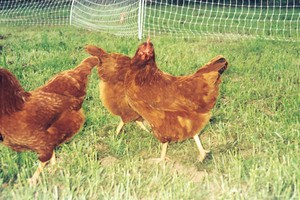
Broody Picks a New Home
Our second flock of layers has a broody chicken. She's actually gone broody two times this year. Although breaking them of broodiness is not that hard it is still a change to all concerned. You need to isolate them and make sure they have plenty of food and water. The most important thing after that is to make sure they don't have an egg to sit on. A broody hen will not lay eggs while brooding so you don't have to worry about her. Isolating her makes sure other hens don't take advantage of her broodiness by dropping eggs in her nest.
We took Broody out of the nesting box in flock two and placed her in the hospital pen setup in a stall in the barn. The isolation process can take anywhere from five to ten days. When a broody hen starts laying eggs you'll know that you have broken them of the broodiness and it is time to introduce them back to the flock.
In the past we've let the hens acclimate themselves. We'd open the barn door and let her come out when she choose. Sometimes it would take a couple days but eventually they come out preferring the outdoors to the pen. The last two times we've done this the hen actually went back to her flock on her own. This time however, Broody would come out of the barn but at night she would return to the hospital pen. We thought, ok, she's confused and doesn't know to go back to her flock. We seem to always rationalize their behavior but we never ask them to confirm our suspicion.
We then decided that she was going to have to be re-introduced to her old flock. From the start we encountered stiff opposition from her mates. When we put Broody in the pen they just started squaring off and no amount of yelling or screaming seemed to break it up. I found that I needed to get physically in between them in order to settle them down. Our first day of re-introducing Broody to flock two (her original flock) went something like the chicken version of a gang fight. Only Broody was a one hen gang. I was in the pen for about an hour staying between Broody and the combatants. I was getting tired of standing there and frustrated by all the fights so I gave up and took Broody out of the pen and let her roam the grounds.
At dusk she went back to the barn and settled into the hospital pen. This went on for another two days. I decided to try again but this time put her in with flock one. It is the smallest and oldest of all the flocks so I figured there were less hens and being more mature would not cause trouble. I took Broody in my arms and went into the pen. I walked her around so the other hens could see her. The whole time I'm saying shish to calm them. I set her down and before I could get out of the pen the pecking order was being strictly enforced.
This time I decided to place the trouble makers out side of the pen and let them roam. Much to my surprise after two hens were ejected the flock was at peace. The two banished layers stayed outside the fence and foraged far and wide. For the rest of the day there was harmony among the flocks.
As dusk took hold the hens started heading to bed. I knew I was going to have to go looking for the trouble makers so I went out to search before day light vanished. I went to the barn first to see if Broody was on her perch. No Broody. Okay, she's probably out back. I left the door open and went to close up the closest flock. We usually count the hens before locking up for the night and the second flock was all accounted for. I try to get them to count off but they just refuse.
Flock three was all accounted for and I headed to the last house. At this time I'm starting to worry, Broody is no where in sight and I can't hear a sound from the banished.
I look in the last house and shine my light on the roosting polls. The two banished hens came back from exploring and were quietly perched ready for sleep. On the other end in the corner to my surprise perched Broody. Everyone was settled in and ready for the night so I closed the door.
That was three days ago. At night she sleeps with flock one. During the day she flies the coop, roams and lays her egg in the barn. At night she goes back into the coop to sleep. We're trying to figure out how to break the egg laying habit but we figure one change at a time.
Buy Local - From a farmer not a chain hard selling the fact!
04 Oct Sun 2009
Maybe We should rethink the whole goat thing
I heard a farmer once say that cutting grass is one of the most useless chores on a farm. At the time I didn't really understand what he meant and he didn't explain and I didn't question. I made a living cutting grass and that is what helped pay my way through college.
It was seasonal work but it was lucrative and the hours were flexible. I would target my advertising to more affluent neighborhoods and those enclaves that had professionals. My rational was that they wouldn't be home enough to cut the grass and I could charge a premium for my time and effort. I have always been a type A who strives to do the best job I can. As the saying goes, "If a job is worth doing it's worth doing well."
I hold myself to a higher standard and that has proven to be a problem when dealing with our employees. I try to make sure they know what a great job they are doing and how much we appreciate their help. First time mistakes are tollerated but also used as learning experiences. The work is grueling and in the worst of the heat. We make sure that they get plenty of water and rest breaks. We often feed them at lunch if they haven't brought anything and sometimes we'll cook a light meal.
For me once I get started in the morning I don't stop, I'll work through until 4:00 or 4:30. I stay hydrated all day but I don't break for a meal. I hate stopping mid-day to eat, it makes me sluggish, weighs me down but most importantly I never seem to have the appetite. To me its like working out in a gym and stopping for food and then continue the work out. It's just not done.
The jobs on a farm are broken into tasks and those tasks that generate revenue are most important. Those tasks that don't generate revenue must be done but are done begrudgingly. Like mowing the lawn or trimming the edges or draging the stone driveway. These are the tasks that are the biggest waste of time and are fruitless in their endeavor.
What once paid my way through school has now become a bane to my summer routine. I know what that farmer meant when he said mowing lawns is a useless chore. You spend time on something you can't sell. Once you cut grass the darn thing just grows back until you cut it again. I'd love to have an astro-turf lawn but I think it would run counter to our entire ecological mission, but then again maybe we need to re-think the whole goat thing.
BUY LOCAL - from a farmer not from a chain advertising "Local"
23 Sep Wed 2009
Happy chickens
I read that more and more of us are starting backyard chicken pens. If you've ever had a fresh egg you can understand why. We read a lot about raising chickens, specifically layers, before we actually took the leap. As I've lamented before mortality bothers us and was one of the main reasons it took us so long to incorporate hens into our farm model.
But I have to tell you it has been an experience that I wouldn't change. We've had some sad times but the hens have brought us more joy than sorrow. We've picked up veterinary tips and tricks and have become quite adept at handling situations as they arise. One on the most important things to know when raising hens in your backyard is what to look for in terms of health and how to detect unhealthy situations as quickly as you can before the problem spreads to the entire flock..
We had never thought of chickens as being happy but I guess like most things you are either stressed or not stressed. If not stressed then I guess you could consider the bird to be what we would call happy. You can tell signs of stress and negative stress affects taste if a bird has been stressed for extended periods. Anything subjected to long periods of stress is going to have problems. That's why cows, pigs, chickens or any animal raised on these confinment farms are pumped up with anti-biotics, hormones and other synthetic substances. They were not meant to live that way. Evolution has prepared them to be grazers, hence the term ruminant. Not in confinment yards where they stand and sleep in their own excrement laden pens with no hope of getting on grass.
First and foremost you must know what signs to look for in chickens and you must be able to compare it to what a healthy chicken looks like. The first signs of any problem with a layer is that they will not be themselves. We have learned that if we see any anomally whatsoever we need to act upon it. Meaning if there is the slightest change in the bird, isolate her from the rest of the flock and give it a health check. You should always have a hospital pen available. This is usually an enclosed area that has food, water, a nest and a roost. I've seen a little 2 chicken box setup for this purpose. The last thing you need to worry about if you have a sick chicken is where are you going to put it when isolated from the flock. Even if you do not have a special place at least know what you will do if isolation is needed.
We've lost a chicken or two because when we saw a problem it didn't look like a problem to us. Like counting 11 chickens when there should be 12. Then the next day counting ten hens when there should be 12. Then coming outside on day three in the morning and seeing the neighbors dog in the pen. Or you see a hen in the nesting box that doesn't sound right. They normally are vocal when laying but this is an agitated kind of squawking. I guess the rule of thumb should be if in your mind you question ANYTHING then do something about it. Isolate the bird and examine it. This action also protects the rest of the flock.
A healthy chicken will be active, pecking and scratching and chasing anything that flies within its eyesight. However, they are not constantly active and you will sometimes find them taking a dirt bath. They will scratch up the soil making a nice indentation in the earth which has all of this fluffy dirt they just created. They'll sit in it and roll and flap there wings and just have a grand old time. When they get up watch out, much like a wet dog they will shake and a mini dust shower come's extruding from their body.
Healthy birds have clear eyes, beak and nostrils. There should be no discharges dried or otherwise. Their combs and wattles should be red. There should be no limp or what's known as bumblefoot in their gate. Their vent should be pink and the feathers around the vent clean. If the feathers around the vent are dirty then she could have diarreha. Food intake varies by stage of development, weather and species. I've found the following site to be very helpful; http://www.ces.ncsu.edu/depts/poulsci/tech_manuals/small_flock_resources.html
During the winter chickens eat more because eating helps them to stay warm. It seems water intake is constant but in warmer times it does go up. It is important to note that they should always have plenty of water and food. The last thing you want to do is promote competition in the flock.
There should be plenty of roosting, nesting and roaming space. If any of these things are lacking you will promote competiion within the flock and only the strongest will survive. If there is plenty of room( a good rule of thumb is at least four square feet per bird inside (at night) and eight outside), water and food, your entire flock will be happy and even the runts will get enough to eat and drink. Productivity, in turn, will be higher if the bird is happy. You'll get more eggs and tastier meat.
If you are raising meat birds there is a strong belief that a bird rasied in a stressful environement will not taste as good as a bird in a stress-free environment. If you don't believe me do a taste test yourself. buy a store bought chicken and a free range chicken. Prepare them identically and give your family and friends a blind test taste. You will pay more for a free range chicken but know that it cost us more to raise them. But a free range chicken will be free of hormones, steriods, anti-biotics and other synthetic substances that do come with chickens from the industrial food complex.
See what your family and friends say. Let them vote and then send us the results. We'll compile and post what we get.
Buy Local - from a farmer not a chain hard selling the fact.
16 Sep Wed 2009
The House
The farm house we live in was built in 1837 by David and Richard Specht. David was the original owner. He bought the land from Charles Caroll a signer of the Declartion of Independance. They built the house with clay bricks they made by hand from materials dug on the property.
The floor joists are solid trees with the bark still attached. On the second floor one room has the ceiling exposed to the roof. When you look up you see they used wooden dowls to secure the wood in place for the attic floor joists. The wood itself has hand honed marks on it where you can see they smoothed it out.
Each room has its own fireplace which are very shallow. We were told that's how coal fireplaces were designed. The rooms themselves have ten foot ceilings. The walls are covered in horse hair plaster, no lattice work just plaster slapped up against the brick interieror of the house. The house exterior itself is made three bricks deep and has widows sills that are almost a foot and a half deep.
My wife started researching the history behind the house and found that among other things that the brothers Specht had a run in with Union soldiers. It seems when the Union was getting ready to attack the Confederate Army at Point of Rocks, Maryland they tour down fences in case they needed to retreat. Well the Specht brothers didn't like having their fences down and their cows running free so they built them up.
As it turned out the Union did have to beat a retreat from Point of Rocks and when they came upon the Specht property they did not like that the fences were restored. In his book The History of Carrollton Manor, 1928, William Jarboe Grove surmizes that had the Union had any ammunition left the brothers would not have lived to tell about it.
Another little bit of written history was the demise of David Specht himself. It was written that he went out during a bad storm to check on the house when a brick fell and hit him in the head. Since Mr. Specht there have only been six owners of the farm house.
So when it came time to renovate the house we were advised that the cheapest and quickest way to accomplish what we wanted to do was to tear the house down and build it from scratch. Knowing what we knew about the house we just could not bring ourselves to make that decision. It did cost more and it did take longer to fix. But, you can't replace history, you can't replace the kind of hand craftsmanship that was put into this house and you'll never replace the hopes and dreams that first built this house.
We are mere stewards, keeping the place up so that hopefully generations from now, someone else will read the history and decide that the house is to precious to tear down and build from scratch and will want to preserve it for as yet unknown generations.
Buy local - from a farmer not from a chain advertising "Local"
13 Sep Sun 2009
The whole goat thing
We were talking about getting goats, milk goats specifically. At least my wife was. I can only see the negative with goats so it was pretty much a one sided conversation. I'm sure she's right; she was right about the farm, the chickens, the fruits, the eggs, the marriage....
I don't want to offend anyone, I know goat people and I respect people that have goats. But I've heard goat people talk about goats and it usually ends with a story about one of the goats getting out and eating everything in sight. Or goats getting out, roaming and eating the neighbor's expensive plants out of their yard. Or goats getting out and you can't find them and when you do, you can't get them in the truck. Or goats getting out and eating the neighbor's Harley Davidson. Let's just say my issue is goats getting out.
I know a lot of people with goats, they are great people but they tell me stories and inevetably one will be about their goat getting out. I've been to seminars and presentations where other farmers are talking about how great goats are, but someone will have a story about the time their goat got out So I asked the question, how do you keep goats in? Strong fences I’m told. Strong fences!
Problem is I've asked the person that has told me the story of their goat getting out. So, the answer is a strong fence, that’s the recommendation I’ve gotten from the extension office, from farmers and from goat herding friends. Does anyone see a problem here? The same people that have told me about goats getting out are the ones recommending strong fences. Hummmm. Was the escape before or after they installed strong fences?
I have found that there is a special electric fence for goats, sheep and chickens. I read the website It is designed specifically for goats and sheep. The advertisement reads "Keeps your goats and sheep in and predators out." Yeah, but I don't believe it.
Once you buy the fence and then get the goat you’re done. The gig is up, there is no turning back. The goat will get out, they always do. I'll end up having to give my neighbor free vegetables for a season. Or worse while trying to corral the goat it kicks me in an area not meant to be kicked. To me, goats are Mother Nature’s way of teaching us that ruminants are suppose to roam.
Then I start to think of the benefits: they can clear brush and eat grass. I learned of a type of pygmy goat that I found to be quite comical. There is a goat called a Fainting Goat, and as its name implies when this thing gets scared it faints. I saw a video of it, and all most spit my milk out from laughing. So I waited for the right time and told my wife if she gets a milk goat then I wanted to get a fainting goat. "What's a fainting goat?" she asks. "A pygmy goat," I respond.
I get a quizzical look but I avoid her eyes and quickly change the subject. I ask what kind of food would we need to feed the goat. She starts to rattle off the list of things she has learned that a goat will eat and by the end of the list I'm thinking she missed our next door neighbor's roses and the Harley. I know she is holding back.
I can tell she is pleased that I've started to ask questions about the goats. "Ya know," I say "we'll have to think about this whole goat thing".
BUY LOCAL- from a farmer, not a chain advertising "LOCAL"
09 Sep Wed 2009
Beware of "Free Range"
Okay, maybe this is another rant against the industrial food complex, but I was brought up to stand up for what is right and not to sit back when someone was in trouble. My parents raised all of their kids to treat everyone equally regardless of skin color or religion. Besides, I like to think of it as educational more than just a rant.
We all know that our food supply has many flaws, often we get to read about the major events when they happen. What we don't get to read about unless you dig deep is the smaller stuff. Like how the IFC is able to sell chickens labeled as "free-range" even though the chicken has never been outside on grass, ever! I got to give them credit, it takes a certain kind of sleaze to take a regulation that is meant to be beneficial to the consumer and use it against them.
On their website the USDA defines free range or free roaming thusly: Producers must demonstrate to the Agency that the poultry has been allowed access to the outside.
Now to you and I that means the chicken should be outside on grass. The USDA has found that there are broiler houses that hold tens of thousands of chickens that are being labeled and sold as free range even though they have never been outside. Why? Because the houses have a door at one end and they can open them to the outside. It doesn't matter that the door opens up to a cement pad or to dirt or the best case, grass. Never mind the area outside wasn't large enough to hold all 10,000 birds; the producers will tell you they meet the USDA definition.
I've only been raising layers for the last three years. I am not a knowledge expert by any means. What I do know is that we get chicks at a day old, raise them indoors until they can handle the weather outside, usually 8-10 weeks. We move them to a moveable house that has no bottom and is surrounded by an electrified fence. The fence is to keep predators out not the chickens in. They can fly the coop, if you will, pretty easy. As they get older they hardly ever do. They get in a routine and it doesn't seem to change.
Most broilers are processed between 12 and 15 weeks of age. The sooner a broiler is processed the more tender the meat. 10,000 birds raised in a closed environment will remain in a closed environment when a single door is open. It's not like the door is a garage door either, the USDA found that some of these houses had one door leading to, you guessed it, a cement pad.
The USDA is changing the rule because the IFC took advantage of the current regulation by calling housed chickens free range. What we've read and commented on from the USDA helps to clearly define FREE RANGE. Until the new regulations are put into affect the monoliths that feed the IFC will continue to label and sell housed chickens as free range.
You're asking "now what? How do I know which company really has free range chickens or chickens just labeled as free range? It is easier than you think. Just buy local. Find a farmer that raises free range chickens in your area. Go to the farm, talk to them and see for yourself what their free range practices are. LocalHarvest has a great search tool to find them.
Your buying habits will need to change somewhat in that you won't be able to just go there and buy a chicken, you might, and it depends on the farm. In some cases you'll need to order the bird before hand and you might need to buy in quantity in order to have chicken whenever you want. The trade off is you get fresh, tasty, real free range chickens and eggs. If you don't believe me, buy a store bought chicken and a local free range chicken. Cook them the same and give your family and friends a blind taste test. Not only is it a fun activity you'll get to see for yourself through others taste buds.
BUY LOCAL - from a farmer, not from a chain hard selling the fact.
06 Sep Sun 2009
Green Manure and other nitrogen fixers
We use field rotation and cover crops as a way of resting and building our soils' nutrients and tilth. It is also a way to cut down on our weeds. Some plants like "Morning Glory" are invasive species and seeds can be viable for up to fifty years. It has become one of my goals to eradicate them. The Federal Government categorizes Morning Glory as a noxious weed. It has a beautiful flower and we suspect was used around outhouses in the days before modern plumbing because it is so prevalent here. In order to get that flower, the vines of the morning glory wrap around anything that is vertical. The vine climbs and squeezes its host; usually corn, tomatoes, peppers; you get the picture. As the host plant grows so too does the vine until the vine chokes out its host.
Sort of a parasitic relationship when you look at the whole process. Then to have the seeds viable for so long it has become the scourge of our farm. I can be doing something totally unrelated to weeding and see one and it will draw my attention. I'm sure there is something clinical about this behavior but I figure due diligence is a must with this weed.
We use a farm practice that is frowned upon but we do it because it works and we can eliminate run off. The growing ecological trend is to disturb the soil the least amount possible. In order to plant, farmers use what is called a drill press planter. It is referred to as No-Till planting. With No-till practices managing weeds takes on two varied methods. If you are conventional then weeds are sprayed. On the organic side cover crops are used for their ability to be rolled over and flattened and stay flat enough for the planted seed to germinate. This works well along with cover cropping in general.
What we do is till, but we till on flat land so run off doesn't exist. If done incorrectly, tilling soil leads to erosion, run-off, and depletion of nutrients and loss of topsoil. It is one of the factors that created the Great Dust Bowl in the 1930's. The areas that we own that are sloped are put in pasture and cover cropping. Cover cropping is a way to keep weeds down while adding natural nitrogen back to the soil. We have a multi-tiered approach to weed control and yes heat is one aspect (see Are We Done Planting...)
Depending on the use of the land, we will do the following; starting in early spring as soon as the ground temperature reaches forty degrees we will do a deep till then let the land sit. We'll wait for the weeds to come up and fill the tilled area. I'll then do a shallow till between two-three inches deep. It is important to note that you do not want to wait for the weeds to get seed heads. The reason you want the weeds to grow is to expend the seeds in the ground. Letting the weeds mature to seed heads defeats the purpose.
After the shallow till we will plant with grasses and nitrogen-fixing legumes. If the chickens are going on the land we will plant rye and hairy vetch (a legume). Once the seeds have germinated and grass is established we move the chickens on to feast. They eat the bugs, the grasses and leave behind fertilizer. They get moved periodically so that manure is evenly distributed in the field but more importantly for the chickens' health.
The next season’s production gardens are treated differently. First they've been rested for a year with just green manure on them. In the spring of the second year they are tilled and planted as described above. For the spring, summer, fall and winter the chickens stay on them. The difference is after the first six months of the second year the chickens are moved to another production garden and we till the area and plant grasses. The rotation on the next year's production garden is such that we have seeded fields, fields ready to mature and mature fields. That way the chickens always have fresh grass to be moved onto when the current plot has been used up. The chickens are moved every three days onto a new patch of grass and this dance takes place all year long. In the spring of the production year the area is deep tilled and left for weed seeds to grow. It is tilled one last time and planted with production vegetables and cover crops.
This practice is great for the birds, the land and the vegetables that inevitably benefit. The birds are out in the open and get fresh air and grass and clean space. This practice eliminates respiratory ailments, the need for anti-biotic because they are not standing ankle deep in their own waste and cuts down on the spread of a disease. Think about it, the first thing we want to do when cooped up for long periods of time is to get outside and take a deep breath. We all crave it at some point in time. That is one of the underlining factors for us as an ecologically sensitive operation that uses sustainable practices.
Buy Local - from a farmer not from a chain that advertises "Local"
02 Sep Wed 2009
To wash or not to wash?
When a chicken lays an egg the shell is covered with a protein outer covering known as the "bloom". The bloom quickly dries and seals the egg from pathogens from the outside world. This is a good thing especially if the egg is going to be incubated or remain fresh. Because the egg is sealed nothing penetrates the shell and gets into the inner part. However, before you sell them you must wash the bloom off.
The logical question that comes to mind is why do we have to wash the egg's protection off creating a permeable shell? If the bloom keeps pathogens out of the albumen (white) and yolk why would we remove that protected coating? Not only does it keep things out it also does not allow the inside to dry out, keeping the egg fresher longer. A commercial egg left in the refrigerator will slowly dry from the inside. It will also absorb the odors that are in the ice box too.
An egg that has not been washed can remain unrefrigerated for up to three months. Wash the bloom off and the egg cannot last a day with temperatures above 45 degrees before it starts to develop salmonella and other bacteria harmful to the digestive tract.
There has been a fight to get egg producers to date stamp individual eggs, this is required in the UK but not herein the US. I saw a news show awhile back that did an expose on egg producers recycling old unsold eggs back into the food chain. If you've ever bought a carton of eggs and get them home and crack one open and the white is very cloudy you've probably gotten one.
When you buy a fresh egg the albumen should be clear with the exception of the chalaza. The chalaza is the strand that anchors the egg to the shell. This strand will be solid white. The yolk should be standing tall and proud. The yolk color from a free range or organic egg will be dark orange, hence the high beta carotene content. Its commercial counter part will look yellow to pale yellow if it has been recycled. Because the shell is permeable the egg white can be smaller do to shrinkage and the egg can take on the properties of what it has absorbed.
If eggs were individually date stamped then they couldn't get recycled the way they are doing now, creating a safer egg supply. Let’s get this straight; people get sick because of bad food in the industrial food supply. Other people point this out, document the abuses and lobby their leaders for change. What happens is people with more money hire insiders or just give money directly to campaigns and our leaders end up doing nothing. Sure there are counter arguments that they will point to and the will of the people is of utmost consideration, they'll say. Yet this is the same group that says we must wash eggs before we sell them.
Why? Because we as consumers can't be trusted to safely handle the eggs and we'll contaminate ourselves. In the interest of objectivity an egg does come from the chicken's vent. The vent is used to expel everything from the chicken. So the outer shell of the egg is contaminated when it comes out. This is important to note, the outer shell is contaminated not the inner shell or the albumen or the yolk.
Sometimes our eggs do have particulate matter on them but because of the bloom it does not come in contact with the inside of the egg. Can an unwashed egg make some one sick if not handled correctly? YES, it can. Will it make us sick if it is handled properly, NO. Is it hard to safely handle an unwashed egg, no. Wash the egg and your hands before use and your fine. Chicken itself can cause more cross contamination and illness than a dirty egg but I digress.
I'm sure I'll wrap my head around this someday but until then I'll keep raising chickens for their eggs. For the record we are a registered egg producer and all the eggs we sell are washed per regulations. The eggs we keep for ourselves are not.
Eat safe fresh vegetables purchased from a local farmer, not a chain hard selling that fact.
30 Aug Sun 2009
Bitter Sweet
We like more than 90 percent of small farmers across the nation have full time jobs. We've been working every weekend since March 21st, non-stop. We've had some good times, great successes and huge failures. We are physically and mentally tired and looking forward to the colder days and slower pace.
Yet there is melancholy to the coming days. Putting the green grass covers on the gardens, getting the chickens on next years production beds and covering the strawberries. We are exhausted yet we do these choirs with a heavy heart. We need and want the break but there is something sad to the fact that we won't be outside for long periods of time tending to growing vegetables, fruits, herbs and watching the chickens frolic.
We'll get into canning mode so we have vegetables over the winter. The irrigation will be pulled and plants mowed from this years production fields I'll do a shallow till and cover the fields with winter rye and hairy vetch. Once that is done the place has been put to bed for the winter.
We then turn our attention to making Italian and French breads, the Italian cooking classes and keeping the chickens comfortable if the weather gets to extreme. I do lament the passing of summer, as hard as the work is, the sun hot and atmosphere moist, I like eating fresh vegetables out of the garden. I eat more vegetables now knowing there the freshest, safest money can buy and they are from our hands and our efforts. I'll miss the weekly interactions with our customers and talking about how to prepare a vegetable or certain dish. Our customers have been supportive, rejuvenating, focused, motivating and most importantly there.
Keep eating fresh and local, David did beat Goliath and we will again this time. Eat local, find a farmer that is growing healthy food. Tell your friends, your family and your colleagues about him or her. The more we speak out the safer our food supply should become.
Don't be complacent, there are some people like my wife and I who do extraordinary things in order to bring safe fresh foods to our community and there are people in your community doing the same thing for you. We all know of parents that have a child or children that have food allergies? Let me ask, how many friends did you have growing up with food allergies? I didn't have any; except for me I hated Brussels sprouts. Proportionally more humans are suffering from food born illnesses now then ever before, despite taking into account the increase in surface population. Haven't enough people given their lives just because they wanted a simple meal with maybe spinach or a hamburger with lettuce, or peanut butter treat?
Please don't underestimate the fight that we are in. Food is our energy, our fuel and a life sustaining force. Don't let the big Agra-businesses jam GMO foods down our throats, they've been killing us for profit and will continue to do so unless we the consumer stand up and say "I'm mad as hell and I’m not going to take it any more" (from the movie "Network"). Demand more with your dollars, choose with your wallet. Money and the lack there of will make them notice. Choose to live healthy. Choose to stop playing Russian roulette with your food choices. Pass the word on it is too important to leave to the media and our officials. Start with your family and work out from there.
Buy Local - from a farmer not a chain advertising "Local"
26 Aug Wed 2009
Why doesn't everyone else know?
We have been at this farmer's market for about six weeks. There is a mix of vegetable growers and other stands that make up the total market. Foot traffic is good, not great but good. There is a grower a couple of stalls down that is young and sells mainly corn, tomatoes and melons. I don't pay much attention to the other vendors because I read my insect book or am taking care of customers.
The day was beautiful, sunshine, light breeze, low humidity and we were seeing more and more repeat customers. One told us that the jam she purchased last week was the best she had ever tasted. At the same time another repeat customer was buying two more jars of jam based on his last purchase. We said thank you and I slowly patted my wife on her back. It was her idea. labor and her mom's recipe. It was turning out to be a good day.
We were selling organic eggs, our carrots had started to come in, the string beans bounced back and our raspberry plants started producing. So our offerings were diversified and plentiful. At one point in time I spotted a customer coming back to us with a box of our eggs. My stomach dropped because the look on her face was not pleasant. I was dealing with a customer so I got my wife’s attention and motioned for her to check out and see what the customer wanted. She had gone home, went to put the eggs away and realized she had only received nine. Of all the mistakes we make and have made, this one was the most embarrassing. Once I realized what had happened I excused myself from the other customer and immediately started asking her what she liked that we had. At the same time my wife was getting her more eggs. I asked about a couple vegetables and got to the potatoes. She said she didn't have potatoes so I gave her a pound of the German Butter Ball and apologized profusely. She left, hopefully satisfied and maybe to return.
Then at closing the young farmer from a couple stalls down came up to look at what we had. He asked about the German Queen tomatoes, we were selling. These things are huge weighing between 1.25-1.75 lbs each. They are by far the biggest we've grown. The skin is thin, seed pod small and flesh is sweet. As I'm telling him this I'm looking into his eyes and seeing sadness. We all look tired and worn down, that is part of the job. It is physically and mentally challenging. Your mind is always ready to give up before your body is but you know this and go on to the next chore.
I use the term heart-wrenching a lot when describing things on the farm because those words invoke a visceral reaction. We all know what heart break is in all its forms. But to use those words makes one understand the physical and emotional toll taking place within the person. What I was seeing and hearing from this young man was heart-wrenching.
He is at his cross roads. He works full time on a dairy farm; he grows five acres of vegetables in his spare time. He is having trouble making ends meet. He doesn't know if he'll be able to pay off all his bills by the end of the growing season. As he was standing there telling me his young wife came up and put her arm around him. I asked, "How’d it go today?" He started to grouse but his wife pulled his arm and he shifted some and kicked the dirt and said "not that bad". A customer came up to their stand and his wife went to take care of them.
I had stopped tearing down and was just talking to him. I could tell he was in despair and was looking for some sort of guidance or a kind word or words of encouragement. He told me that other people he talked to told him to stay in it that things would change. I didn't tell him they were right or wrong. I just said that this is an incredibly hard thing to do and not many people really understand the sacrifice and toll it takes on us. That he wasn't alone in his doubt and his struggles. The last time I stopped breaking down and talked to someone my wife got livid, at least at that time we had help. This time it was just her and I was torn. Should I cut him off and help her or should I do what many have done for me in the past and that was to lend a sympathetic ear and maybe some advice and encouragement.
She could hear the conversation and knew the plight of the young vegetable farmer. I empathized with him and told him about the MD Small Farm Co-op. I told him by joining he would meet people like us who pull our resources and are able to buy in bulk thus cutting down on overall costs. I gave him my name and number and told him if he had any questions to call. This all seemed woefully inadequate but it was the best I could do. For my wife's part she continued breaking down and when he left I helped finish up. She didn't say a word. We packed up and headed home. What should have been a pleasant trip after a good day selling was just silent. It seemed both of us were thinking about the young man and his wife.
It was a good day for us but when you see the pain, self-doubt and struggle that someone like you is going through you can't help but question why is this so hard and why doesn't everyone else know?
PLEASE-buy local, find a farmer around you, go visit them, try what they have for sale. If you don't like what you got tell them that and tell them why. Vegetable farmers live on feedback. If there is something you'd like them to grow, tell them. It can only help with their future plans. The more sustainable farmers we keep in business the healthier the environment and all of us will be in the long run.
24 Aug Mon 2009
What Nature Brings
We have a hen that has taken to, let me see, how to say this so I keep a "G" rating. We have a hen that has taken to being the rooster. I kid you not. She has taken on the roll of the fertilizer or pretend fertilizer. I've said before we've only been raisng hens for three years going on four. So I might think I've seen it all, but apperantly that's not true. My wife read a book that said hens can change gender but we never took it seriously.
We thought it was one of those things, except we have this chicken that doesn't really fight the other hens as much as she gets on their backs. A rooster when he is in procreation mode will grab a hen by the back of her neck holding her down so he can do what a rooster does. My wife said she thought she saw this behavior in one of our hens, but me being me, I wouldn't believe it until I saw the event for myself.
We were all eating lunch one day sitting outside in the shade and enjoying a slight breeze. I was facing the pen of the second generation hens. Their numbers have dwindled due to a neighbor's errent dog, but the ones that survived have rebounded and they are pretty good layers. It was a Saturday and we had picked corn for taste testing. We feed our help most times and its always a good time when breaking bread with them. No matter what I cook they always seem to like it. Of course when you work on an organic vegetable farm you tend to work up a big appetite. Male or female they can all put food away. So I cooked the corn for everyone and we were sitting there enjoying the sweet taste and the respite.
If the hens start fighting or going crazy I usually yell at them which startles them and is enought to return the flock to some sort of harmony. I heard a commotion and looked up to see a hen on top of another hen biting and holding her down while seemingly girating like the rooster does. I looked at my wife; she gave me a look and just shrugged. I yelled, then got up to get closer and yelled again. That broke the hovering hen's concentration and her captive scurried away. So, once again I think I've seen it all.
We kid ourselves by thinking we've got a handle on things. Then we discover that the learning curve just seems to keep bending upward. But, these are things that nature brings.
Buy Local - from a farmer, not from a chain that advertises "Local"
19 Aug Wed 2009
Good times are not always around the corner
It’s the third week of August and flock three of our Rhode Island Reds have just started to lay eggs. They are so small you can hold half a dozen in your hand. This is a big day for us, a day we've been looking forward to ever since March 19th, 2009. They have made it this far healthy, happy and vigorous. The one rooster we got (by accident) has grown to be quite the leader. His problem is he is too big and the hens are smaller, thinner and faster.
Here they are at a day old.

You spend a lot of time with them making sure they are ok, that they don't get Coccidiosis, that their pen is clean and water free of foreign objects. If you look closely at this picture you will notice that the feed trough does not have bird droppings in it. That was an anomaly; as soon as they got enough strength the crap hit the fan.
They are energetic, inquisitive and love tomatoes. We have them outside and they can't resist flying the coop and raiding the garden. We know this not because we caught them but we started noticing peck marks on the reddest tomatoes. We have these huge German Queen heirlooms. They weigh in about 1.5 to 1.75 pounds each. These are bigger than the Mortgage Buster we had a couple of years ago and they are tasty. So the new chickens have found out too.
We finally figured it out when we saw an egg sitting in one of the rows between tomatoes plants. We packed up the electric fence and moved the house out behind the barn so they wouldn't be tempted, for all the hard work seeing a picture of them at a day old and seeing them now full grown you can't help but feel a sort of elation at the accomplishment. .
I am by nature a pessimist with a type A personality, I'm ok with that. But it is times like these that make me a laid back optimist. To have nurtured them to this point is time to celebrate the good fortune. But being a farm you don't want to crow too much because good times are not always around the corner.
Buy Local - from a farmer not from a chain that advertises "Local"
16 Aug Sun 2009
Farm Market Tales
For the first three years of selling we were at a farmers market that was trying to rebound. It was located in a stayed community of old houses and income levels. We didn't learn this until later but it didn't matter. I liked being part of nostalgia by trying to bring back the old farmers market.
We were learning how to grow organic on a large scale and also learning about farmers markets. Each market has its own personality, procedures and clientel. Our enthusiasm and drive were not lacking, but week after week foot traffic was minimal and we often wondered if we were in the right place. It certainly was not making copious amounts of money. Slowly we started to build up a clientel and we were bringing in fruits and vegetables that were coming into season.
For six years my wife and I were the only ones doing the work. As with most small farmers we too had full-time jobs. We both gave up our weekends and evenings. In the off season we would plow through insect, plant identification, pasture management and animal husbandry books. We attended lectures and classes on small farming and other specialties. We belong to the Maryland Small Farm Co-op, the Pastured Poultry Association, CASA-Future Harvest and the Maryland Organic Food and Farmers Association.
Each of these groups have specific functions but all are setup to gather, trade and disseminate information with most of the emphasis on providing education to there members. These groups are great for getting started and networking. It doesn't matter who you are or what you know, or if you've been farming for years there is value to joining and participating in the events.
It is in these groups were you find kindred spirits, market stories, working knowledge and moral support. The first three years selling was hard for us, we were putting in maximum effort but were getting little if any return on our investment and time.
We kept hearing one phrase over and over again at the market. There was a point where we could identify the person that was going to say it. We heard the phrase in English, Spanish and German. We couldn't tell what they were saying but the body language of some of the Asian customers spoke loud enough.
It was always the same thing, different languages but the same facial expressions, "Is this all there is?". We tried not to take it personally but weekend after weekend it did wear on us. I would often engage the people and ask sincerely what they would like to see. Mostly the answer was more vendors. We would pass this information on to the market manager.
What struck me as odd was we had plenty of a variety of fruits and vegetables, we were transitional organic and our prices were a dollar. We joked that we were the other dollar store. Cucumbers 4 for a dollar, tomatoes dollar a pound, onions same thing, berries they sold at a premium. Everything else went for a buck. Because there wasn't a big vendor presence most people just turned and left. There were days when we ended up giving more food to our local soup kitchen then what we sold. Giving to the soup kitchen had its own intrinsic reward and helped us gain perspective with the days events.
It was hard but we made the best of it and made some really good friends that we still have to this day. The market provided us with a way to sell our vegetables and have fun. Besides, without the market how would we learn?
Buy Local - from a farmer not a chain advertising "Local"
12 Aug Wed 2009
Broody is broody again
We are learning, we have learned and we will continue to learn. Our knowledge comes from reading, talking to others, working and observing. Like on Saturday we observed that Broody was back sitting in her nesting box. Then we observed on Sunday, Monday and Tuesday the same thing.
This is a natural occurance for chickens sometimes they go broody. We've only been raising hens for three years so we don't have a lot of experience. However, we have faced broodiness before so we sorta know what we are doing. In all the books that we've read I don't remember if they talked about a broody hen going broody twice in the same year.
I did observe something I hadn't noticed before. When a chicken is broody the last thing you want to do is let her sit on an egg. Everything that we've read says to take eggs from her. You don't want to encourage the behavior so taking the eggs gives her nothing to hatch.
Chickens will lay one egg every 25 hours, give or take, on Sunday we took the egg from under her. Monday when we checked she was in the same nesting box but there were two eggs. I took them, my glimer of hope was the two eggs in the box. She had laid one (broody chickens do not) and she was out of the box long enough for another chicken to lay her egg.
Getting a broody chicken out of our nesting box is pretty hard due to the design of the nest and access to it. So, we put off getting her out until we were sure she really was broody. Tuesday when we checked she had three eggs under her and we took them. She was still in the same box though. Wednesday morning I looked in the box for eggs and saw two under Broody and one in the middle box. Broody was still nesting in the third box farthest from the opening. I thought once again she had laid, gotten out of the box and another hen laid her own egg. I went about the day's chores and kept the chicken pen within site. The day progressed with no sight of Broody. By late afternoon I had decided to check the nesting boxes again.
I looked in and Broody was still in the third nest facing the back. Yet, she had another two eggs under her and it dawned on me. She wasn't laying and she wasn't getting out of the nest. The other chickens must know she is broody. They are nesting in her box and laying their eggs for her to hatch. Four eggs on Wednesday and three the day before that. She hadn't left the nest at all and she wasn't laying. There is no way a chicken can move an egg in our nesting boxes. The floor is on a decline from front to back, with a back wall high enough to let the egg roll underneath and in a holding area. These were all under her front wings.
We decided that it was time to get her out of the nesting box and into the barn. This is not a stress free process for the bird or us. I eventualy got her out and headed for the barn. While we were walking I took the liberty to feel her abdomen and lower fluff by the vent. No hard object or abnormal feeling of the large intenstines. She was just broody again. Broody is in he barn digging holes for nests and sitting on non-existant eggs. She's got plenty of fresh water and mash to eat. So far she's still in the barn, day seven and counting. We'll let you know how it goes.
Buy Local - From a farmer not a chain that advertises "local"
09 Aug Sun 2009
That's the Paradox
We are a humane farm; our animals almost run the place. However, sometimes there is mortality. With each loss we've had on the farm it has been hard on me and I take them all personally even though I know I shouldn't. You don't take responsibility for the health and welfare of an animal and not take it personally when it dies. At least I don't. We learn and make sure if it’s controllable it doesn't happen again, we try our best to be good stewards and shepherds. This is one thing that coming from the city actually works against me. If I grew up on a farm my bet is I'd have a better handle on the whole mortality thing. I have to get over this though; if we are going to succeed I am going to have to get over this hurdle. Think and say what you will about my manliness and machismo, it’s just how I'm wired. If you are going to raise an animal organically you are going to spend a lot of time looking out for its well being. This equates to spending a lot of time with the animal, observing them and watching for signs of illness, distress, infestation, injury and overall environmental health.
As we thought over twenty years ago death on a farm is inevitable and it is a hard burden for us to bare. I guess that’s why it took us so long before we added chickens to the mix. I'm ok with vegetables passing away; it seems natural to me. This is the first time that I found growing up in the city was an impediment to what we do here. I'm not naive I saw horrible violent things by accident living in the city. I worked in a hospital for over ten years; I saw the grief people went through. I saw more than one person die in front of my eyes. Within the last two years both of my parents have passed. I've had more loved ones than I care to count leave this earth. I am just not good with death, as natural as it is and as much as it is part of the whole life cycle I am not good with mortality.
I have no problem going to the local butcher and getting my meat and pork. I see the cows, pigs and chickens in the field. I know where my meat comes from, how it is raised and processed. I've had numerous blind taste tests with family, friends, clients and students. More than 90 percent pick the local product, whether it is eggs, bacon, steak, hamburger, cucumbers, tomatoes or whatever. I know that we are getting the safest, tastiest, freshest products anywhere.
Does this mean I will be vegetarian or vegan? No, this is the paradox that is my life. I love to cook and grow vegetables. Now, we have our potential role in providing fresh poultry to our community as part of the sustainability model. It is one of the more profitable functions on a farm.
Free range, organic poultry is in great demand and it is a low cost, low maintenance activity. You get day old chicks, raise them for sixteen weeks and process them. Raise them humanely, free of stress and in an open environment and you’ve given them the best life that can be hoped for. Add to that we would use Rhode Island Reds because they are a recovering species and we are furthering sustainable agriculture.
Seven years we've been talking about this, 2555 days. Seven years we've been deciding not to raise poultry for meat. We are not making enough money to be profitable. Five out of the seven years we have shown a loss and this is with out expensing our time as labor. Meat chickens add a degree of stability and profitability that we have not achieved yet from vegetables, berries, jams, bread and cooking classes. It is that simple, yet for us there has been nothing simple about the decision. As natural as death is on a farm it is still creates a paradox for me.
Buy Local - from a farmer not a chain that advertises "Local"
06 Aug Thu 2009
Where else would you rather be
When we first started to talk to our family and friends about buying a farm the reactions were mixed but predominately quizzical. Why? As if something was wrong with us. How come? As if there was some force pushing us into something we weren't ready for. Are you sure? As if we hadn't spent enough time debating and talking about the move. Then there was the big one. What are you going to do with a farm? As if the question didn't already have the answer in it, FARM.
We are city folks, my family is third generation urbanites. Our friends were of the same ilk. So it wasn't too surprising that we were met with their concerns, doubts and skepticisms. I guess all of them thought that gardening was fine but large scale gardening was border line psychotic. I know they liked our tomatoes, peppers and herbs but we wanted to try other things, lots of other things.
Besides, I never told anyone what my childhood dreams were. To do that would jeopardize the possibility of achieving them. So no one knew that I wanted land, horses, a big garden and a pool and they probably thought that it was something that we just started talking about. But when word got around that we had placed a contract on a farm everyone weighed in with thoughtful words of caution, limited encouragement and counseling referrals.
When you come from the city, gardening on a large scale is for people established in the farming community. In the city you're supposed to grow a couple vegetables as a hobby, you certainly don't make a living at it and you'll live in relative obscurity if you try. They all made perfect sense- farms have been on the decline ever since we've been alive. Farm-Aide started when we were teens, and the scenes depicted of families losing everything, having to stand by at auctions and watch their possessions sold off was heart-breaking. It was real and it was tragic. People don't choose to be farmers; they are born into it, at least that was the prevailing feeling we got. You don't invest money and time in a declining industry. Yet we were on the precipice of doing just that.
So while all the concern was being directed at us we were slowly moving towards purchasing the farm house and the property. The house was built in 1837 on land once owned by a historic figure. As part of the purchase we had the house inspected by a family friend.
Before he was done he took both of us aside and flat out said you don't want this house. It would cost us more to fix it up than the structure was worth. We'd be better off tearing it down and building from scratch. When he was done he had over eighteen pages of notes and things wrong with the house, barn and milking shed.
We had twenty four hours to decide to back out or continue forward. My wife and I are very deliberate logical people, fiscally and environmentally conservative and socially liberal. We are not the fix-it-up types. There were so many factors telling us not to buy and move on that it seemed like a no brainer to anyone looking at all the facts.
There was just something about the place, I think had we'd known we would pull 68 black snakes out of the house maybe we would have went in the opposite direction. As it turned out we didn't and there has been something akin to a spiritual journey taking place ever since. We are religious people, we believe in a higher calling and that we are on this earth to help make a difference no matter how insignificant it may be.
The first six months in the house were arduous and filled with snake encounters. My wife called it luxury camping. We added living in the house as part of our prayer routine. During that time we had what I call our fetal position moments: we cried, we had great doubts and we had buyers' remorse. But we kept praying not really asking for anything but the strength to continue. One day a cat showed up at our door, I scared it away but we'd see it again and again. We found that it was living in our barn which was fine with me but my wife wanted to bring it inside. I resisted and gave a cogent argument as to why not. "It's feral," I said, it turned out not to be and was already spayed. After a two foot snow fall the barn cat was introduced to her new home. She was aptly named BC and she was the first cat to adopt us.
The snow thawed and with spring came snakes. Except these snakes were showing up dead. We were finding them all over the place. It didn't take long for us to realize that BC was the one killing the snakes. She was the answer to our prayers. BC could care less for mice. I saw her once watch a mouse eating out of her food bowl. She was sitting by the woodstove and just watched as the mouse ate away. She didn't flinch, but if it was a snake that was a different story. We could tell when she had spotted one as she never moved but waited for her chance at the slithery creature.
That was the start of the turn-around for us. We are now part of something bigger than what we had expected. There was a time when it was just meat making people sick and being recalled. Recently, more stories of vegetables like spinach, lettuce, tomatoes, peppers and even peanut butter have been contaminated. We are part of a greater community of people that are providing safe, fresh and tasty food to our neighbors and friends. As bad as the past has been moving here,doing what we have been doing seems right.
Before every game legendary coach Marv Levy, of the Buffalo Bills, said to his team "At this moment in time, where else would you rather be, than right here, right now?" I would not want it any other way.
02 Aug Sun 2009
No shucking
Did you know that you are not suppose to shuck corn at a farmers market? It's one of those unwritten rules. As soon as an ear is even partially opened, it begins to go to starch. As a child I remember the Arraber coming around and he would pick the corn for you. Depending upon where you were on his route you either got thirteen good ears of corn or a mix.
That's another thing - whatever happened to a baker's dozen? People seem actually surprised when we give them another ear of corn or put 13 into the bag. That use to be standard operating procedure. When the industrial food complex came into the picture you bought the corn pre-packaged or by the ear. Please don't get me wrong. We are a capitalistic society which is built around the principle of making money. I think it's a wonderful idea but my frustration comes in when I see people cutting corners, ignoring safety, using techniques and tactics that are harmful under the guise of the bottom line. Besides I'm also jealous that I don't make tons of money or even pounds for that matter.
I know that when twelve people buy a dozen we lose a dozen. But we also sell by the ear and I learned long ago the smaller the quantity for sale the greater revenue. Meaning, if 72 people each baught two ears of corn revenue would be greater because the per ear cost is higher. So we look at it as a wash. The goodwill it generates for our customers and then back to us surpases the pain of losing a dozen. In the past six years we've lost more than 90 percent of each year's corn crop due to multiple factors. So we're kind of use to losing corn.
Seven years ago we were selling at a farmers market, and we had corn that was raised organically but was not from organic seed. It wasn't being sold as organic but it was local and it was picked hours before. I was working with a customer when I saw an elderly lady go over to the corn and start to shuck the ears. I looked right and saw my wife looking at her. I kept talking to and taking care of my customer, but I noticed my wife's body language and non-verbal cues change. She was getting agitated.
A minute goes by, I'm trying to finish with my customer but he has questions about cooking. Every so often I take a right peripheral view to see how my wife is doing. At that time, I don't know why, I can't put my finger on it but my wife's reactions are catching my attention. I follow her gaze and see the woman is still shucking her way through the corn.
My customer asked about making a zuchinni recipe, we have adapted from "Chef's Illustrated," and I'm telling him about it and describing the nuances. I feel my wife walking behind me towards the woman shucking corn.
My wife is one of the most intelligent, kindest, caring, level-headed people I've ever met. She is the conotation of grace under fire and who you'd want to be with when trouble strikes. But don't shuck the corn at a famer's market in front of her.
Buy Local- from a farmer not from a chain that advertises "local"
p.s. no one was hurt in the actual events or the retelling of events.
29 Jul Wed 2009
Corn Battles pt 3
Part 3 of 3
We learned with corn the best sustainable practice is called field rotation. We let our soils rest for two years after it has been used to grow vegetables. With cover cropping, planting green manures (grasses and legumes) and letting the chickens graze on them minerals, nutrients and tilth are replenished naturally. We don't fertilize mostly because of these practices. The corn, because it is such a heavy feeder, does get organic fertilizer once or twice during the growing season. Other than that we rely on Mother Nature and the chickens for soil fertility.
We sell more organic fertilizer than we use but it was not always that way. It has only been since getting the chickens and adding them to the rotational practice that we found soil fertility to be adequate for corn. This past winter we had the chickens in the garden for over five months. Once the new rye and hairy vetch came up the chickens were moved in. We moved them once every two days up and down the length of the garden. People tell us that our eggs have the best taste, once a customer compared ours to fresh eggs she had while in Italy. Getting compliments like that is a humbling experience for a city boy. I always thank our customers for their feedback and point out the chickens did most of the work. I can't help but think the grasses and legumes are what make the eggs taste like they do. One day I'll write about garlic eggs.
This year's production garden was tilled and ready for spring planting in March. This was all good but I was waiting to plant the corn. We had the garden mapped out and had our seed ready. This year I kept the seed in the house instead of the barn. Did you know that mice can tell good corn from not so good corn even when it is dry? I didn't, so when I went to get my saved seeds from the barn two years ago I found that the yellow corn was mostly left alone. Not true for the white sugar pearl. They cleaned the cobs perfectly. The mice climbed up a metal shelving unit to the top and over the basket that held the corn. I had to give it to them, determined little (insert cussword of your choice here).
2009 was going to be a different year. We had seed, a strong chicken wire fence and great soil. We planted the first batch in April and followed those two weeks later with another planting. The first started to coming up in nice rows. The second planting didn't budge, and it didn't budge and didn't budge; after 3 weeks I tilled and replanted.
We weeded, watered, mounded and I watched over like it was gold. I am proud to say that when the Maryland Small Farm Co-op had its field day at Foxhaven Farm on July 12th we took corn to sell. Not just any corn but certified organic, white, sugar pearl sweet corn. I had trouble getting in the truck my head was so big. The question everyone asked was "Is that yours?" followed up by "How did you do it?" Man that was a great feeling. We took twenty dozen ears of corn that day and sold every last one. I still have a Cheshire grin going. We had a customer come up to my wife the following week at the Urbana Farmers Market and told her the corn she bought was the best she had ever tasted.
But being that it is farming, a couple of days later we found that the raccoons had defeated our perimeter defenses. They cleaned out what was left of the first planting and are now waiting for the second planting to come in. I got the tractor out and started dumping dirt around the bottom of the fences, and where the fence was old we added new chicken wire and placed posts around to keep the fence up. So the corn battle still rages, but for one fleeting second my head was too big to fit inside the truck.
Buy Local - from a farmer not a chain store advertising "local."
26 Jul Sun 2009
Corn Battles pt 2
Part 2 of 3
At our old house I tracked sunlight to find out what little plot of land got the most sunshine and I would plant corn in that area. I was stopped from planting in the front of the house one year, something about being tacky or something but I would have. The first year on the farm we grew about twelve rows by fifty feet. It was not organic seed but it was raised organic. By all accounts it was a winner and we were off and running.
As we started to prepare for certification we learned that you could only use certified organic seed. So the next year we went totally organic and that’s when things started to fall apart. Year after year we failed to get corn like we had that first year. It was not the seeds' fault as much as it was the inexperience of the gardener. When we finally started to get things right we found we also started feeding the wildlife.
One of our sustainable practices is to save seeds from year to year and I wanted to do this with the corn. In the old days this was standard practice, farmers would keep seed from one year to the next in order to plant. That’s when we learned the difference between hybrids and open pollinated. A hybrid is a mix of characteristics between two different types of plants in the same species.
A hybrid corn seed example could be a mix of a corn plant that has large kernels and a corn plant that is very sweet. The child seed of those two would have both characteristics a large kernel that is very sweet. You plant the hybrid seed and get corn that has very large sweet kernels on the cob. If you were to save the seeds from the hybrid and planted them the next year there isno telling what dominant characteristic will show up. What is known is that you will not get both traits; you will get one or the other.
So you could have a plant that has large kernels or is very sweet but not both. Open pollinated plants on the other hand are consistent from year to year. If you have a plant that is open pollinated then you can harvest the seeds and use them the next year. Not only will you get consistent results but you will be able to save on seed costs. Don't confuse hybrids with genetically modified organisms (GMO). GMO's are genetically modified on a DNA level, not just mixing traits of the same species. For greater understanding of GMO and the potential dangers in our food supply go to WWW.HULU.COM and search for "Future of Food,”
We've tried all kinds of planting techniques, transplanting, planting early and covering them with row covers and planting corn with the lowest number of days to germination. It is all in an attempt to be the first one on the block with sweet corn. My true motivation is to get sweet corn for myself and my family. We do not eat corn from any other source. We eat what we grow, freezing much to get through the winter. Besides there is no meal better than fried tomatoes and corn on the cob; add steamed Chesapeake Bay blue crabs and you have raised the meal to mythic standards.
The earlier you get corn the higher the price justification at the market (the law of supply and demand) which is the other incentive to growing early. However, these practices are not without peril. Corn needs soil and ambient temperatures to be no lower than fifty degrees Fahrenheit. You get a frost and your whole first planting can be wiped out. It’s a gamble that if you know about going into it you are prepared when a late frost hits. Being prepared doesn't mean you are out of the woods, it just means you have a chance at saving the first planting.
This year was no exception when it came to planting early with one notable change. The corn was planted in our very first garden plot. The plot of land was completely encased with chicken wire. I had buried it one foot deep with five feet sticking out of the ground. I also used metal posts to keep the wire up. Without knowing I added a degree of protection from the groundhogs and raccoons. If they tried to climb the fence it would collapse backwards from their weight, stopping them from getting in. If the raccoons ever get their act together one will climb and bring the fence down letting his buddies get in. We'll have to keep an eye on that. In the mean time the corn battles rage on.
Buy Local - from a farmer not from a national advertising "local"