
The LocalHarvest Blog
29 Jun Mon 2015
Meet Beekeeper Kari Nobel
Welcome back to the LocalHarvest newsletter.
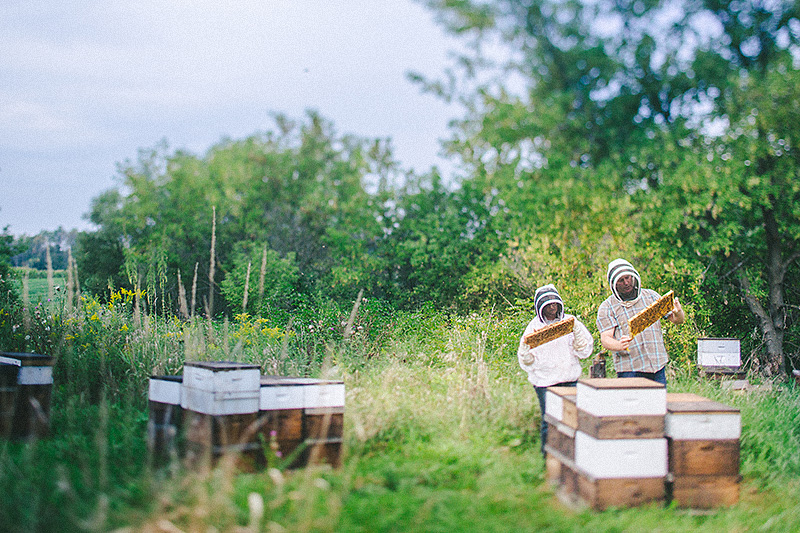
Beekeeper Kari Nobel loves it when customers approach her at the farmers market to talk about seeing honeybees in their gardens. "It's awesome to hear people being excited about bees!" More and more people are getting interested in bees and even cheer them on when they see them hard at work. Perhaps this is one small upside to bees' well-publicized challenges: bees are certainly no longer taken for granted.
Kari Nobel had not given bees much thought one way or another before she began dating a beekeeper over a decade ago. Now she is fully immersed in their world as she helps her husband Jonathon care for their 700 hives, sells honey at the farmers market and runs their retail operation, which includes a store on LocalHarvest. In the summer, the Nobels and their bees live in Michigan; in the winter they take the hives on semi-trucks down to the citrus groves in Florida. I asked Kari how the work had changed since she first got involved. She said commercial beekeeping now involves much more time-sensitive and high-stakes management of the mites that plague bees and can cause hives to weaken and die. "Nowadays we're constantly on the watch for mites. A bad situation can arise so much faster than it used to." The reason for the change, she believes, is that the bees' overall level of health used to be higher, so they could resist the mites more readily and infestations evolved more slowly. A variety of factors including different use of pesticides now seem to make the hives more susceptible to grave damage from mites. Meanwhile, the mites are getting stronger as they become tolerant of the treatments used to knock them back.
With so many complex and ongoing challenges, it would be understandable for beekeepers to be gloomy. The Nobels, though, seem to draw a lot of strength for the work from their passion for the bees. Kari likens the work to animal husbandry. "Just like a farmer would not want to see a cow get sick, beekeepers care about their bees. We're stewards of our bees, and it's our livelihood. We've chosen this. It's definitely a labor of love."
Knowing that many people are concerned about honeybees' well-being, I asked Kari how consumers could be involved. She said, "The best way to support beekeepers is to make sure you know where your honey is coming from. Honey bought in the grocery store is often imported from Brazil and Mexico. Looking for honey sourced in the U.S. creates a steady demand for domestic honey." Creating a more solid market seems like an excellent way to support beekeepers as they work to make a living under an increasingly challenging set of circumstances. If good, local honey is hard to find in your area, try LocalHarvest!
It will take a lot of work from beekeepers, researchers, and regulators -- and support from the rest of us -- to create a food system where bees can be returned to their former strength and fulfill their role in fully pollinating our food supply. In this, we can take a lesson from the bees themselves. I once learned that a honey bee will make just 1/8 teaspoon of honey in her entire lifetime, and for that small volume will forage for ten hours a day. Yet over the course of the season, a healthy hive will produce well over a hundred pounds of honey. That is a lot of 1/8 teaspoons coming together, and speaks to the power of a common purpose.
To hard work and pulling together, like and for the bees.
Until next time, take good care and eat well.
Erin
Erin Barnett
Director
LocalHarvest
28 May Thu 2015
How will you eat this summer?
Welcome back to the LocalHarvest newsletter.
In many parts of the country the end of May marks the beginning of the local food season, and with it come many delights. Bringing home greens harvested just hours ago is exciting after months of shipped-in produce. After being snowbound all winter, it is just as exciting to see neighbors browsing at the farmers market, and the friendly, familiar faces of your local farmers. Late spring is a time of anticipation and reconnection for local food lovers.
The excitement of Spring inspires many of us to want to upgrade our eating habits in some way. This requires some consideration and thought, since changing our eating patterns takes intention and planning. Changes we might consider include shopping a farmers market or farm stand, setting aside more time to cook, redistributing our budget to create a little more money for food, and/or incorporating more fresh produce into our meals. Creating an intention for the new growing season essentially means spending time asking ourselves how we want to eat this summer.
Once we have committed to an idea, the next step in making it happen is putting structures in place so that the change is doable. The plan depends on the goal, but in all cases it is useful to make the plan as specific as possible. "Shop at the farmers market more" is not nearly as effective as "Stop at the farmers market every Tuesday on the way home from work."
Many of us have a general goal of eating more local food. Unless this goal becomes specific, though, it can feel either overwhelming or unmanageable. Fortunately, there are a variety of organizations that offer opportunities to help people jumpstart changes to their food buying habits. My local food co-op offers a 10 day "local food challenge" twice a year, and there area many of these nationwide. For many people, short term commitments like these are a good way to get started eating local or to take their commitment a little deeper in some specific way. Most local food challenges focus on the amount of local food consumed, but Michael Olson of Food Chain Radio offers a different angle. He calls it the "2 x 2 Pledge." The commitment is pretty simple: spend $2/day on local food, and convince two other people to do the same. One thing I like about Olson's idea is that it is so easy to measure and feels so doable. I can do $14/week without either breaking the bank or feeling overwhelmed. The other thing I am drawn to here is the potential cumulative impact. If a few people took the pledge and got two other people to sign up until eventually everyone in my town (population 20,000) signed up, together we would add about $1.5 million to the local food economy per year. Olson says that local food dollars recirculate seven times before leaving the community, meaning that our $1.5 million would have a $100 million impact on our local economy. Over time, that kind of money - and the energy it would generate - would utterly transform our local food system. It could happen here, and it could happen in every town and city across the country.
All of our efforts to upgrade our eating habits have the potential to make a big impact in our lives and in our communities. As the new growing season gets underway, we at LocalHarvest encourage you to spend some time thinking about how you want to eat this year. What's your intention and how are you going to make it happen? Please share your ideas! We love to hear from you.
Until next time, take good care and eat well.
Erin
Erin Barnett
Director
LocalHarvest
30 Apr Thu 2015
Living the Drought
Welcome back to the LocalHarvest newsletter.
The drought in California has been in the news more lately as the state groans through its fourth dry year. The situation is indisputably urgent, and personally relevant for just about everyone who eats. Last week I realized I was having a hard time imagining the situation because it is inconceivably big, so I decided to start small. I called Linda Butler, a farmer from Lindencroft Farm in Ben Lomond, CA. Within minutes, the drought became much more real.
As a small-scale farmer with no access to municipal water and no water rights, Linda and her husband Steven are living the drought day in and day out. They own 90 acres of sandy soil on a hillside in the Santa Cruz Mountains. Ten years ago when they bought the property, they terraced two acres to carve out a small farm. In the beginning, rain was plentiful. "Back when our valley got 60-80" of rain a year, everything thrived," Linda remembers. "We would lay a heavy layer of compost over everything, and count on the rain to do the rest." The Butlers rely on their well and two reservoirs for all their water needs. Before the drought, the winter rains filled their reservoirs, replenished the well, and watered their winter crops, allowing them to save the well and reservoir water for summer and fall.
Last year they got less than 10" of rain, Linda says, and had to irrigate through the winter. The well level is now precariously low and not refilling. The farm is different. The Butlers no longer grow water-intensive crops like melons, and have stopped watering their roses and other ornamental plants. Fruit trees get watered first. Vegetable crops now get a time-consuming six inch layer of straw mulch to help conserve moisture. Linda says they are "growing less but working more." Even the types of insects that come to the gardens have changed.
Last year the Butlers took money out of savings to buy water from a neighboring water district. This year there is no water to buy. It was too expensive anyway. "Last year we said to each other, 'this could be our last year.' We are saying that this year too."
Every choice comes down to water. Until recently, the Butlers sold their produce to local restaurants and to local families through their CSA. This year they closed down a quarter of their farm because they couldn't water it all. That meant they had to drop their restaurant accounts. They miss the income. "We try really hard to keep our employees employed, but boy is it tough. If our car breaks down, I don't know what we are going to do."
Despite the daily strain and worry, Linda remains hopeful. "We will get a decent winter one of these years. Then we could build another reservoir and we'd be okay. That's my dream." Until then, Linda says that they will continue making do. "We find that we are willing to give up more and more and more. We don't go on vacations or to conferences anymore, but it doesn't really matter. Our farm is where we want to be. In spite of everything, I think it's the most beautiful thing we have ever done with ourselves."
Since talking with Linda, I have been thinking about the drought every day – about the many present and future hardships of growing food; about how easy it is to take abundance for granted. Mostly I have been considering the resilience of the human heart, which has the capacity to love a life this difficult, and does.
Until next time, take good care and eat well.
Erin
Erin Barnett
Director
LocalHarvest
30 Mar Mon 2015
The only work there is

Welcome back to the LocalHarvest newsletter.
Last summer one of my country neighbors told me a story about another neighbor's barn cat who decided to have her kittens in my neighbor's shed. A couple of months later, one of the kittens fell from the loft and lost use of its back legs. When the mama was ready to move the litter back to her home farm, the lame kitten was too big to be carried and had to be left behind. Every day after, the mama trekked a half mile across the fields to tend the lone kitten. This had been going on for some months at the time I heard about it. When I told my daughter the tale, she said, "Awww! The mama loves that kitten a lot!" I don't know if cats can love, but this story makes me think about how we creatures of the Earth occasionally make a choice driven by something more reliable than love and deeper than reason. If everything within us tells us it is the only thing to do, we do it, despite the strain and risks involved.
For some people, farming is like that. Whether or not it pencils out, it is the only thing they can imagine themselves doing. It is the only work there is. Last week I had the pleasure of talking to with one such farmer, Carden Willis, of A Place on Earth CSA Farm in Turners Station, KY, about 40 miles outside of Louisville. Carden and his wife Courtney run a 50-share CSA. When they arrived on their farm eight years ago, the soil was worn out from hard use in tobacco production and the only structure on the place was a dilapidated barn. The early years were devoted to rehabilitating the land and putting basic farm infrastructure in place. Then their two boys came along, now four and two, and since then much time and attention has gone toward the children. Between the farm, the boys, and Courtney's full time teaching job, they have their hands full. "My goal for the last four years has been to survive, and so far so good with that," says Carden. But farming while parenting full-time brings considerable challenges, and Carden allows that he has done "an awful lot of farming by headlamp" the last few years.
Yet they persist.
Before the idea of becoming a farmer came to him, Carden says he just hadn't seen a way to feel good about working any of the occupations he could imagine. Farming suited him completely. "With farming I was able to find something that addressed the central, whole parts of myself. I can be challenged mentally, physically and psychologically. Whereas it was a great stretch to see myself working in a job. So as long as I can farm, this is all I can see myself doing."
It would be easy to overstate the impact of this certainty and believe that it would make farming easy. Yet singularity of purpose does not dig the potatoes, or lengthen the day, or pay the bills. The work itself remains full of struggle and compromise. Knowing this is the only work for him doesn't necessarily infuse Carden with perfect confidence either. He spoke to the difficulty of expanding the size of the CSA while the boys are small and their needs must sometimes trump the vegetables'.
Carden's certainty about his work doesn't assure him that he can do it, only that he will. That knowing seems to offer a kind of protection against the doubt that might otherwise gnaw at the edges of a proposition as complex and enduring as small-scale farming in the modern world.
As farmers everywhere head into the greenhouse and the fields this Spring, it is my hope that all will be blessed with the gift of deep certainty about their work. And may the rest of us support our local farmers all season long with gratitude for the purpose and perseverance they bring to the work of growing good food.
Until next time, take good care and eat well.
Erin
Erin Barnett
Director
LocalHarvest
02 Mar Mon 2015
John Ubaldo, on 'doing it right
Welcome back to the LocalHarvest newsletter.
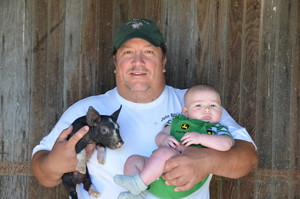
In our last newsletter, LocalHarvest president Guillermo Payet reflected on the last 15 years in the local food movement. Several people commented on his article, including one John Ubaldo of John Boys Farm who felt that small scale farmers should talk up their strengths. "We have a lot more power than we are given credit for," he wrote. I was intrigued by this idea, so I looked him up and was entirely taken by his description of his farm, and by his photo. Anyone who looks equally comfortable carrying a piglet and a baby is somebody I want to talk to.
My hunch proved right. I like talking to all farmers, but the fiery ones might be my favorite and John is all fire. Exhibit A: "One of my jobs at the farmers market is to beat people over the head about how much work actually goes into farming. Most people have no idea! I've been doing this for a long time and I'm still staggered by how much work goes into doing it right. People have to get that. You have to be willing to beat people up."
"Doing it right" is one of John's catch phrases, and you get the idea that there isn't much wiggle room between right and emphatically not right. He never sprays anything on his crops, even organically approved products, and he gets even more "angry and militant" (his words) about GMOs. In short, he's a purist about producing the highest quality food, and a purist who takes his role as a health educator seriously. "Small farmers are in a is a powerful position because of our ability to impact people's health. How many other jobs offer the ability to change people's lives so positively, on such a basic, human level? Not many. That's not something we farmers can squander. If we do, we're idiots!" There's that fire again.
John wants customers not only to pay whatever he asks for his products, but to thank him afterward. And it seems they do. "I am not the only meat guy at our farmers market, but mine is the only stand with a line. If you're doing it right, your products are going to set themselves apart. Telling the story about what your farm does gets people excited about your food, and then people from all walks of life choose to eat properly and are willing to pay for it."
When talking with his customers about their food choices, John will sometimes go dollar for dollar with them comparing the cost of taking the family to McDonald's versus what they could get for the same money at his stand. "I'll tell them that the main difference, besides their health, between fast food and my food is convenience. I'm not afraid to call people out on being lazy. At the beginning, it was tough sell, but now, every week they're there, and they eat what we bring down." His style wouldn't work for everyone, but it seems to work very well for him, perhaps because he does it with so much heart. "The way I see it, I have hundreds and hundreds of family members. We do a lot of education and we find out what our customers are cooking at home. Then they are either talking to me at the stand every week, or avoiding me because they are doing something stupid and don't want me to bop them."
I loved this John Ubaldo character, and if I ever find myself in his neck of rural New York you can bet I'm going to look him up. Meanwhile, I am taking his words to heart. Farmers who produce good, clean food should be extraordinarily proud of it. And maybe the rest of us could raise the bar a little higher in our food choices and move a little closer to our own version of "doing it right."
As Guillermo mentioned last month, 2015 is LocalHarvest's fifteenth anniversary. We are going to devote most of our newsletter space to our members' voices this year. We created LocalHarvest to serve farmers, and this year we want you to hear directly from some of them, like John Ubaldo. If you have topics you'd like our farmers to weigh in on this year, please submit your ideas via our comments page.
Until next time, take good care and eat well.
Erin
Erin Barnett
Director
LocalHarvest
01 Feb Sun 2015
15 Years of Good Food
Welcome back to the LocalHarvest newsletter.
Fifteen years ago this March, we launched LocalHarvest.org, and this month I offered to be the guest newsletter writer so I could share some thoughts on the "good food movement."
Back in 2000, the organic food movement was well established, but many people, including me, thought that it was starting to lose touch with what we saw as its true 'essence.' We wanted a food system that went beyond the "no synthetic chemicals" imperative of organic to create a food economy that existed on a more 'human' scale. We hoped this movement would create structures that renewed local economies and environmental health, strengthened our communities, and led to the mindful enjoyment of sharing fresh and delicious foods with our loved ones.
At that time we hoped that by redirecting the conversation to include local food, we could take back the 'good food' flag from the money interests then starting to take over the organic market space. We wanted to return it to its legitimate grassroots owners: the small farmers, CSA subscribers, farmers markets, and myriad small businesses working hard to create food systems based on quality, authenticity, fairness, and environmental responsibility. We joked that the day might come when 'buy local' would be trendy and if that happened, real CSAs would have to defend their businesses against franchised CSAs or other inauthentic attempts to capitalize on the demand created by good, honest food.
That day did come. We now have dozens of venture capital-funded enterprises trying to capitalize on local food, farm to table, and other permutations of the good food movement. But who is benefiting? Unfortunately, in many cases, it is not the farmers. The reality is that handcrafted, sustainably grown food is expensive to produce and in most cases cannot compete against conventional agriculture on price. The margins on good food are so slim that companies cannot both pay farmers well and create the kinds of returns on investment that traditional investors expect. Fortunately, there are now other "patient capital" options, like Slow Money, that will fund food businesses without unreasonable expectations of large liquidity events. We believe that these sources of funding are essential to the health of the good food space.
At LocalHarvest, we believe that for local, sustainably grown foods to become more than a niche market many things still need to change. Energy prices need to reflect their true costs - including their environmental costs. The very fabric of our culture needs to change so that more people have the time and resources to choose their food with considerations of community and quality in mind, rather than exclusively by convenience and price.
Cultural changes come slowly. We are aware that this is a generational change that we've embarked on. The groundwork has been laid, however, and we feel hopeful about the continued changes that the next 15 years will bring.
Guillermo Payet
President
LocalHarvest
17 Dec Wed 2014
Simple is Good
Welcome back to the LocalHarvest newsletter.
A few days ago I went down to the pantry to get a jar of jam for a sandwich. While there I took note of the supply and found it surprisingly low -- only two jars remaining. Immediately my mind went to the bags of strawberries I had put in the freezer last June. "I could make a batch of jam one night next week;" I thought, "then we would have plenty." I added it to my mental list, which was already cramped with holiday tasks. Then I stopped. The mistake I so often make in December is adding one more thing when the days are already full. Having plenty of homemade jam on hand is a good thing, but slowing down is better. Jam can wait until January.
The holiday season is an ironic time of year. We get extra busy in the darkest weeks of winter, when our bodies naturally want to go to bed early. And this busyness sometimes keeps us from looking around and counting our blessings. Every year I try to remember to keep December simple. Every year I get stressed out and have to re-learn the lesson.
This week I found myself repeating "simple is good" like a mantra. We are having eggs for supper tonight...simple. Bean soup tomorrow night...simple. We will bake Christmas cookies on Saturday...but only two kinds. A couple of years ago my extended family started drawing names for a book exchange and it transformed the shopping experience into something manageable and enjoyable. Every small simplification offers a gift: the opportunity to be a little more relaxed and grounded. Taken together these have the potential to create a holiday season in which I am both nicer to be around and happier.
Sometimes we think that we need to buy, cook, schedule, bake, do a lot of extra things to feel the holiday spirit and make our family and friends feel loved. But I think what we all really crave at the holidays is feeling connected. Connection doesn't take a lot of hoopla, and in fact, that gets in the way. Connection takes intention and the willingness to put aside whatever keeps us from opening our hearts to those around us.
So in this season of holy days, my wish for myself and you is that we may all put our holiday energy into genuine connections with the people we love. As the folksinger Kate Wolf said so well, "Give yourself to love, if love is what you're after..."
With our wishes for connection and peace for all, now and in the new year,
Erin
Erin Barnett
Director
LocalHarvest
19 Nov Wed 2014
CSA Survey Findings
Welcome back to the LocalHarvest newsletter.
Last July we asked our CSAs to tell us their thoughts about the current status and future of community supported agriculture (CSA). Over 1,000 CSAs participated in our survey, which yielded some thought provoking results. Here is some of what we learned from the survey and some number crunching from our own database.
The vast majority of CSAs are relatively small. Over 85% of our CSAs have fewer than 150 members. Though many CSA farmers find ways to thrive at this size, others operating at a small scale find it quite trying. When farm income does not cover expenses, farmers must work off-farm jobs and/or do without hired employees. For some, these things become unsustainable over time.
The traditional CSA model is changing in many ways. We think of traditional CSAs as those with one farmer, one size weekly box, and one payment made by members before the delivery season begins. Fewer and fewer CSAs utilize this model. More farmers are expanding their offerings. Our survey found that over two-thirds of respondents now sell add-on products like eggs or meat in addition to their vegetable shares. Meanwhile, 71% of CSAs surveyed said that offering multiple payment options has been a key part of their growth strategy. The traditional model is evolving.
CSAs' top concern: low profit margins. We gave survey respondents a list of 11 challenges faced by CSAs and asked them to indicate which three were of chief concern. The most frequently named obstacle, across every size category and number of years farming, was "low profit margin." One farmer wrote, "Every dollar [farmers] make off the farm is a direct subsidy of the cost of food. "What other segment of our society is asked to produce and provide their goods as well as subsidize the cost?"
Other issues of immediate concern to CSAs included climate changes affecting food production, the number of CSAs in their area, balancing demands of farm/off-farm employment, and finding/retaining qualified employees.
Looking to the future, CSAs worry about money and regulations. Given the same list of obstacles and asked to choose the single biggest challenge facing CSAs in ten years, the top two concerns were low profit margins and increased federal food safety regulations. These were followed closely by climate change and retirement/succession issues. Interestingly, small CSAs ranked "climate changes affecting food production" third among potential future challenges, but large CSAs placed it ninth of 11; large CSAs were most concerned about future pressure from food aggregators and home delivery services.
Some CSA farmers are moving on, but many believe CSA is the way to go. Just over half of the CSAs we surveyed are anticipating a growth in their membership over the next three years. Newer farmers anticipate more growth than experienced farmers, despite the fact that more experienced farmers enjoy significantly higher member retention rates from year to year.
Some farmers reported that they are closing their CSAs, typically because they find the model labor intensive and unprofitable. Others love everything about the traditional CSA model. One of these farmers wrote, "I think CSAs are THE FUTURE of small farm marketing." The biggest group of farmers told us that while they think CSA is a good idea, it needs significant modifications to work well for their farms. Ideas farmers are testing include offering CSA-like "grab and go" boxes at the farmers market, smaller share sizes, customization options, and a CSA cooperative.
Farmers are inventors and problem solvers by nature. We have no doubt that over time they will create new forms for CSA that suit both themselves and the members of their communities.
We want to thank all the CSA farmers who participated in our survey. We learned much from your comments and will write about how your thoughts have informed our sense of the future of CSAs in our January newsletter.
Until next time, take good care and eat well,
Erin
Erin Barnett
Director
LocalHarvest
P.S. Don't miss the great offer below from our new partner, NakedWines.com!
29 Oct Wed 2014
Farm Pride
Welcome back to the LocalHarvest newsletter.
Last week we heard news worth sharing about several LocalHarvest farmers. First, two of our farmers' heritage turkeys received high praise in the current issue of Cook's Illustrated. Those of you familiar with Cook's Illustrated and America's Test Kitchen will know what a big deal this is: these cooks pride themselves on their perfectionism in the kitchen. When they say a turkey is special, it is. Here's what they wrote about Elmwood Stock Farm's heritage turkey: "This turkey [has] white meat "so rich in flavor that it tastes like dark meat." The dark meat was even more tender and flavorful, prompting one taster to ask, "Is this dark turkey or pulled pork?" Taste testers for Heritage Turkey Farm's bird designated it as the "best buy", and gave it this praise for its flavor: "Fantastic," "perfectly juicy," and "full of turkey taste." The "lovely" dark meat was praised for being "packed with meaty flavor," "supple," and "richly flavored"."
We were so pleased to see this piece describing the differences of high quality poultry. (Spoiler alert: the Butterball turkey didn't get high marks in Cook's taste test.) Hopefully the article will prompt many people to seek out a good bird this Thanksgiving. Meanwhile, we are delighted that these two farmers are getting the recognition they deserve for their exceptional turkeys!
Six years ago, one of these farmers, Bob Both of Heritage Turkey Farm, was just beginning to sell his turkeys with LocalHarvest. He and I spoke on the phone many times that season. Bob was comfortable with raising the birds, but the idea of shipping them had him a little nervous, with good reason. Shipping a frozen bird across the country and having it arrive in perfect shape just in time to thaw before the big day is a big deal, and any missteps tend to have disastrous results. We all wanted everything to go well. Bob was careful to ask a lot of questions, and fortunately we had experienced poultry farmers willing to teach him a few tricks. He developed his own system, tested it, and quickly became one of our most reliable farmers for shipped birds. Now he's getting national attention for his turkeys.
Bob's success serves as a good reminder of all that goes into mastering a new skill or craft. There's the need to tolerate one's initial incompetence, commit to the learning curve, seek outside help, experiment and make mid-course corrections, all while maintaining a strong commitment to quality. When the skill being mastered is farming, one has to take significant financial risks as well.
The other farmers I wanted to tell you about this month are all seeking to expand their operations. Like Bob Both back in 2009, they have developed their initial skill set and are looking to move into new products, new markets, or into a new scale of production. All of these activities strengthen local food economies, which is work worth supporting. And we can offer our support, in tangible and significant ways.
Last May, I wrote about Kiva Zip, a new zero-interest micro-lending program for U.S. farmers. Getting involved in the capital needs of small farms is one way we who don't farm can support those who do. Since that article appeared, about 20 LocalHarvest farmers have initiated fundraising campaigns through Kiva Zip. A number of them are already fully funded and the farmers are using the loans to buy equipment, expand their herds, or strengthen their infrastructure. Several more are currently in the fundraising phase. I am hoping that many of you will read these farmers' profiles and consider making a small loan to their fundraising campaigns. (Individual loan amounts start at $25.) Becoming a micro-lender on Kiva Zip is easy and, for me, a satisfying new way to support small farms. By helping share the financial burden of growth, we can help a new group of farmers solidify their businesses and feed their communities.
Here are the LocalHarvest members currently raising funds through Kiva Zip.
- Bryan and Cindy Pruett from Appleby Community Farm & CSA - (zip.kiva.org/loans/7379)
- Gale Livingstone from Rainbow Hill Farm, LLC - (zip.kiva.org/loans/6363)
- David Fisher from Fisher Family Farm and Ranch - (zip.kiva.org/loans/7469)
- Ron Trunk from Iron Mountain Nursery and Farm - (zip.kiva.org/loans/7514)
Thank you for lending your support to these farmers and those in your own communities. Together, we can help family farmers thrive, and they, in turn, will feed us well -- at Thanksgiving and around the year.
Until next time, take good care and eat well,
Erin
Erin Barnett
Director
LocalHarvest
22 Sep Mon 2014
Beyond Local

Welcome back to the LocalHarvest newsletter.
A couple of months back a journalist asked me why I feel so passionate about local food. She caught me at an odd moment and my mind went utterly blank. All I could think was, "Yikes. Do I feel passionately about this?" I don't remember what answer I gave her, but the question and my blankness stuck with me for days.
Weeks, actually. For a while I felt restless and guilty. "What am I doing promoting local food if I can't find my passion for it?" Eventually my husband helped me out of the hole I was digging; he pointed out that I have been supporting family farmers and eating locally so long that what once inspired a lot of emotion is now regular life.
This isn't just happening to me, of course. The culture is changing. Everywhere we look people are embracing the notion of 'local'. What was a new idea back in 2000 when we launched LocalHarvest is slowly becoming the standard. That is just what we wanted! Fortunately, a life that includes beautiful local foods yields a lot of delight and gratitude (e.g. our neighbor's early apples are fantastic this year!) even as passion for the idea of local food may fade with familiarity.
To me, all this means it is time to go deeper. Buying directly from farms is good. It gives farmers a higher return, making small scale farming more economically viable. Buying local is good too. Communities benefit when their members keep their money recirculating within the group. But we can do much more to protect the integrity and viability of small scale farming. First, we need to make sure that "real" food stays real. The more successful 'local' is within mainstream society, the more likely it is to be coopted by big business. "Farmer McDonald's CSA Egg McMuffins" - it sounds farfetched but it could happen, and in smaller ways already is. Second, our communities will be strengthened as more of us get involved in the complex issues facing agriculture. There are many issues to choose from, such as local zoning issues, federal farm regulations and the ongoing GMO fight, to name a few. For all the incredible momentum buying local has gained, making substantive, long lasting political and economic changes in the food system will require tenacious collective attention.
We can do it. My hunch is that our love for real food will be what prods us to make the effort and strengthens us along the way. Then we may both rediscover our passion for local food and put it to good use.
Until next time, take good care and eat well,
Erin
Erin Barnett
Director
LocalHarvest
27 Aug Wed 2014
Love Note to Farmers
Welcome back to the LocalHarvest newsletter.
Someone once told me never to ask a farmer about their career choice in August. By this point in the summer, most produce farmers are tired, if not downright weary. Too much worry about weather and bugs and money for one summer. Too many 14 hour days in the heat. Too much uncertainty and guesswork. By the time they have to lift a few tons of melons out of a field in August, some farmers say, "Never again!"
At least quietly, to themselves. Luckily for us, most get rested enough over the winter to go back out and do it again.
Fall is the traditional time to give thanks for the year's harvest, but it seems to me that we should also do so in the heat of summer. What better time than August to express appreciation to the people who produce summer's bounty? Starting now.
To all the family farmers and all the farmworkers:
We are so lucky to get to eat the food you grow! Thank you for all the work that goes into it - the long days and endless tasks, the freezing hands and aching back. We appreciate your willingness to take risks and tolerate financial uncertainty. For your labor, skill and perseverance, we are grateful.
Most of all, thank you for the beautiful food. Eating it makes us feel healthy. We who have access to such magnificent produce are truly fortunate. We give thanks for the food, and for all the hands and hearts who nurture it from seed to table.
-- With love from local farm fans everywhere
Hopefully our deep appreciation will give the farmers who receive it a measure of the sustenance their food brings to us. And later, with any luck, they can sit down and crack open one of those beautiful watermelons and enjoy it for themselves.
Until next time, take good care and eat well,
Erin
Erin Barnett
Director
LocalHarvest
24 Jul Thu 2014
Kids, Meet Strawberries

Welcome back to the LocalHarvest newsletter.
A while back one of my sisters and I were sitting around talking about the farmers market she had been frequenting, when one of her sons came in and got mildly interested in the conversation. We began talking about where and when different things grow, and I was surprised to realize how unfamiliar he was with the origins of his favorite foods. Potatoes grow underground? Cucumbers on vines? Almonds on trees? I will never forget the flash of insight that lit up his face when he said, "So that's why there are always pictures of cows on milk cartons!"
We know that kids are not born knowing where food comes from, yet we may assume they pick up that information along the way. In most cultures, in most periods of human history, children did just that. Nowadays, though, how could they? The typical activities of modern childhood do not afford kids many opportunities to use their natural curiosity and observation skills to learn about food production or the wider natural world. Given the chance, children still like to do so.
Summer and fall are great times to take kids to visit farms or plant a garden so they can see food production in action. What's not to love about picking berries, digging for potatoes, squatting on the ground to watch worms wiggle through the soil, or leaning against a fencepost watching goats be goats? Most children I know have fun doing these things, IF (and it is a big ‘if') their grown-ups do not spoil the experience. From a kid's perspective, it isn't very fun to be outside if your parents make a fuss when you get muddy, or whip out the hand sanitizer every time you touch something cool. And who can really look at anything if the grownups are always in a hurry?
Don't get me wrong: some days I am that parent. ("The ripe strawberries are RED!" or "Keep moving, we have to go!") In other situations I can be the kind of parent who wants to make everything into a "teachable moment." But I am trying to relax and remember that if I want my child to be curious about food and enjoy exploring the natural world, I need to give her chances to do these things and then get out of the way. I am not suggesting that we take our kids to farms and leave them to their own devices. Not at all. Yikes. I am suggesting, though, that once our kids are settled at the farm or in the garden, we step back a little and let them have their own experience. Maybe we talk with them about it on the ride home, or maybe we let it be. They'll figure out which strawberries taste the sweetest, and next year they'll remember that it was the red ones. They might even remember that strawberries grow on the short plants with the dark green, deeply veined, serrated leaves that grow in groups of three.
Until next time, take good care and eat well,
Erin
Erin Barnett
Director
LocalHarvest
19 Jun Thu 2014
Menus for Good

Welcome back to the LocalHarvest newsletter.
At the beginning of each month I sit down with a calendar and write out dinner menus for the whole month. I have been doing this since 2009. I have said that this chore changed my life. It's true. The worst part of any weekday used to be coming home from work and having no idea what to make for dinner. It turns out that 5:30 p.m. is not my most creative hour. I know I am not alone. Having a plan completely eliminates this form of stress, which alone is reason enough to take up the practice. But there's more. Menu planning allows for a balanced, thoughtful plan across each week, which for us means a variety of vegetables and proteins, not too much pasta, bigger meals every couple of days to allow for leftovers for our lunches. It also reduces trips to the grocery store and it allows me to plan easy meals for the nights I know will be busy.
Lately I have become aware of another advantage of meal planning, and that is the opportunity to reduce food waste. When I buy a head of lettuce, for example, I put salad on the menu a couple times that week. If I roast a chicken, I make a plan for using the leftovers in a pasta. About the only food that gets thrown out at our house is the occasional half-bunch of parsley that I didn't find a use for before it got old. Thinking ahead about how to use the food we buy has significantly reduced the amount of food we waste.
If menu planning caught on it could have a huge impact on the food system. According to the Natural Resources Defense Council (NRDC), members of the average U.S. household waste about one-quarter of the food and beverages they purchase. That is an incredible statistic! Buy four grocery bags full of food and one of them is destined for the trash. If you include the food wasted in the fields, in restaurants, etc., the amount of wasted food rises to 40 percent of all that is produced. What a sad and sorry use of fresh water, pesticides, fossil fuels, nutrients, labor and money.
The bad news/good news here is that the problem has gotten much worse than it used to be. The NRDC reports that food waste was fully 50 percent lower in the 1970s. As their report states, and this is the good news, “This means there was once a time when we wasted far less, and we can get back there again.” Indeed we can.
Menu planning is just one way to do so. Taking steps to store food properly at home to reduce spoilage is another. Composting is a third; though it does not reduce food waste directly, it does keep uneaten food out of the landfills. Food rotting in the oxygen-deprived environment of a landfill creates methane gas, a major contributor to climate change. On the other hand, food decomposing in a compost pile turns into a rich resource for the garden, landscaping, or houseplants. Sustainable America has a great info-graphic on how urban dwellers can compost, among others.
Reducing food waste makes good sense, and is something that all of us can help with, whether we do so through composting, improved storage, or menu planning. Menu-planning is a great place to start, since it helps cooks reduce stress at the end of the day. If you need a little inspiration to get your menu planning off to a good start, check out our cookbook giveaway below.
If you plan your menus a week or month at a time, or have other tips for reducing food waste, we would love to hear from you.
Until next time, take good care and eat well,
Erin
Erin Barnett
Director
LocalHarvest
28 May Wed 2014
Crowd-sourced Funding for Farmers

Welcome back to the LocalHarvest newsletter.
Earlier this month I poked through the recently released 2012 agricultural census data. The more I dug, the more concerned I became about the story the numbers tell. I came away feeling that we who support local farmers need to get more directly involved in the success of family farms.
According to the census data, nearly 100,000 farms were lost and over 7.5 million acres of land were taken out of farming since the last agricultural census was taken in 2007. The American Farmland Trust, says that translates into 1200 acres of U.S. farmland being developed every day. The census also found that one-third of American farmers are age 65 or over, and another 29% are between age 55-64. Our aging farm population puts more of our nation's farmland at risk. Oftentimes, farmers who want to retire must sell their land to developers because their retirement "savings" is in their farms and the highest bidder wants to plant houses or a strip mall.
We need sufficient farmland to feed the nation; we will also need hundreds of thousands of new farmers to take the wheel from those who retire. These new farmers will need to be able to afford farmland and equipment. When farmers and developers compete for the same land, farmland becomes prohibitively expensive, or leaves farmers with too little money to properly equip the new enterprise, thus driving down its likelihood of success. Small and mid-sized farms are disproportionately hit by these economics. Nearly 70% of the farms that went out of business between 2007-2012, were under 180 acres. For those of us who believe that thriving rural economies mutually benefit the communities they surround, these numbers are not good news.
Agricultural census data is used by policymakers to fund farm programs, some of which we at LocalHarvest support. But after spending time with the data, I found myself feeling impatient. Thoughtful federal farm programs can do a lot of good to support new farmers, but wheels turn slowly in Washington D.C. and these numbers tell me that we are not moving quickly enough to create a nation of vibrant direct-market farms committed to feeding their local communities.
The reasons behind these numbers are many and complex. But there are things that we as supporters of local food systems can do to help farmers make their operations viable and help them grow. Last month I was introduced to Kiva Zip, and I would like to let you know about their work. Like its parent organization, Kiva, Kiva Zip exists to facilitate small scale, "crowd funded," zero interest loans to emerging entrepreneurs. Whereas Kiva works on a variety of kinds of projects all over the world, Kiva Zip focuses on the U.S. and has a strong emphasis on food and agricultural businesses.
Unlike traditional lenders, which determine eligibility based on credit scores and the like, Kiva Zip uses a more relational model, which they call "character-based lending." It relies on a farmer's ability to build trust, confidence, and relationships. Farmers can post their project online and have people from all over the world chip in as little as $5 to fund the project. Over the last year, 80 farmers have raised up to $10,000 each to buy a needed piece of equipment, expand into a new market, and the like, usually raising the money within a few weeks. One hundred percent of farmers have successfully raised the funds they sought, and thus far the pay-back rate from the farmers has also been 100%.
Kiva Zip allows all of us to help farmers quickly raise needed capital with favorable terms. We hope you will consider participating. If crowd sourced funding of farm projects takes off over the next few years, we can hope that the 2017 census will show momentum building toward a time when hundreds of thousands of small farms are prospering all across the nation.
Until next time, take good care and eat well,
Erin
Erin Barnett
Director
LocalHarvest
23 Apr Wed 2014
Organic and Your Health

Welcome back to the LocalHarvest newsletter.
We all know there are compelling environmental reasons to choose organic food. Many of us buy organic out of a belief that it must be healthier, too. In terms of avoiding the potential toxicity of pesticide residues, it is. But the case for organic food actually being more nutritious has been harder to make. Over the last few years, though, there has been a growing body of research demonstrating not only that organic food is better for us, but how.
This month I had a chance to speak with Jessica Shade, Ph.D., Director of Science Programs at The Organic Center. She pointed out that scientists haven't yet demonstrated that all organically grown food is more nutritious than conventional. Studies have focused on individual crops, and even then there are so many variables that it is difficult to isolate the impact of organic management practices. Still, research on a variety of fruit and vegetable crops has shown that organic methods yield produce with higher levels of certain nutrients and other good things. Research has established, for example, that organically grown spinach, peppers, oranges, pears, peaches, strawberries and tomatoes all have higher levels of Vitamin C than their conventionally grown counterparts. Other studies show significantly higher levels of antioxidants and other phytochemicals important for disease prevention.
So the research is beginning to back up what intuitively seems like it must be right: nix the noxious toxins, treat the soil well, and the resulting food will be more nutritious. But exactly why is this? According to Dr. Shade, there are two prevailing guesses. The first is that plants respond well to the somewhat increased stress level found in organic systems. "What?" you say, "My organic tomatoes lived a life of stress?" It's true: plants are less protected from weeds and pests in organic systems, and that puts a little more strain on them. Taken too far, the plants will not produce. There seems to be some optimal level of stress, though, where the plants' response may be to produce more antioxidants. That turns out to be a boon for human health.
The second hypothesis on how organically grown produce comes to be more nutritious has to do with plants' self-defense system. As insects start to gnaw on plants, the plants fight back by producing compounds to make plant unsavory to insects and, like the antioxidants produced under stress, many of those compounds are good for us. Remarkable, huh?
The above applies to produce, but the dairy story is equally interesting and possibly more impactful. The main known nutritional benefit of organic dairy as is the high level of omega-3 fatty acids it provides. As many are aware, diets low in omega-3 but high in omega-6 fatty acids are linked to increased rates of many diseases, and increasing one's level of omega-3s is a good thing for your health. In a study released last December, organic milk was shown to have a significantly lower ratio of omega-6 to omega-3 fatty acids than found in conventional milk, making it a very healthy choice. The reason is believed to be because in organic systems the cows are required to be on pasture longer, and the fresh grass they consume there leads to milk rich in omega-3s and low in omega-6s. According to Dr. Shade, the pasture rule in the organic law was put there for the cows' well-being, but it turns out that more time on pasture means healthier milk, so everyone wins. The study's authors encourage people to leverage their findings to maximum benefit by minimizing the intake of foods high in omega-6s while also shifting some of their fat intake to full-fat, organic dairy products.
For me, all this research points to an elegant intelligence inherent in organic food production systems. What's good for the plants and animals is also good for humans and the environment. To learn more about organic research, visit The Organic Center's website.
On a different note, if you are a farmer or other food producer, please see the announcement below about an important survey pertaining to the Food Safety Modernization Act.
Until next time, take good care and eat well,
Erin
Erin Barnett
Director
LocalHarvest